




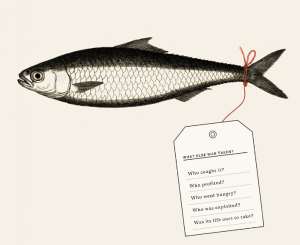
There is something reassuring about a tin of tuna that can tell us where it came from. Some carry sustainability labels, while others have codes that allow us to trace the fish online, sometimes to the very vessel that caught it. It is a remarkable amount of information for something we might open without a second thought at lunchtime, and comforting to believe that someone has taken the trouble to ask the difficult questions on our behalf.
But knowing so much about the fish can tell us surprisingly little about the people who caught it. Were they paid? Were they safe? Could they leave the vessel if they wanted to? Sustainability and traceability can tell us whether a fishery is managed responsibly; they cannot, by themselves, tell us whether it is morally just.
We want to believe that our ordinary pleasures need not come at somebody else’s expense.
In 2022, Greenpeace East Asia investigators entered tracking codes from 73 tins of tuna and retrieved information about 452 fishing trips involving 290 vessels. Yet interviews with nine fishers from six vessels linked to the supply network included reports of excessive overtime, retained identity documents and withheld wages. The interviews were too few to establish conditions across an entire fleet, but they exposed a troubling imbalance: we had become remarkably good at following fish across the ocean while knowing comparatively little about the people who caught them.
The information was valuable. It simply could not tell us everything we wanted to believe it did.
Traceability is one measure of responsible fishing; biological sustainability is another. Scientists assess populations, governments set catch limits and companies work to demonstrate that seafood comes from legal, well-managed fisheries. These are important achievements, particularly as warming seas and mounting fishing pressure make ecological recovery increasingly difficult.
Yet a healthy fish population cannot tell us whether workers were free, whether coastal families could afford the catch or what an individual animal experienced during capture. A fishery can be sustainable and still be exploitative, exclusionary or cruel. Environmental performance matters, but it does not settle every question of justice.
This is the question that led us to developThe Moral Catch, a Faiths for Oceans inquiry informed by scientific evidence and reflections from Islamic, Jewish, Christian, Hindu and Buddhist contributors. As governments gather in Yerevan later this month for the United Nations biodiversity conference, COP17, we are launching the inquiry with a question that environmental targets alone cannot settle.
Is there such a thing as a moral catch?
One of our contributors, Ulfat Hussein Masibo, remembers fishermen arriving at her family’s doorstep in Lamu, Kenya, carrying their morning catch. Her mother would offer freshly baked millet bread in return. Fish was so plentiful that buying it hardly entered her mind, and the exchange belonged to the ordinary rhythms of neighbourliness and community.
Today, she writes, many families struggle to afford what was once an everyday food. For her, the moral question is not only whether fish remain abundant, but why communities living beside the sea can no longer afford the fish caught from their own waters. The loss extends beyond nourishment into the relationships that connected people to the sea and to one another. In her Islamic tradition, the ocean is part of an amanah, a trust entrusted to human care.
This idea echoes throughout the reflections gathered in The Moral Catch. Although they draw on different religious traditions, the contributors converge on a remarkably similar insight: the ocean is more than a source of food, income or commodities. It is a trust, a gift, a community of life and a source of responsibility. Together, their reflections invite us to move beyond the familiar question of how much we can sustainably take from the ocean and ask a more demanding one: what do we owe to the ocean, to the people who depend upon it and to the generations that will inherit it?
Rabbi Ed Rosenthal, another contributor, turns to a remarkable detail in Genesis: the creatures of the sea receive a blessing before humanity is given dominion. Before a fish becomes something we can own or consume, it already has a place within creation. He also draws on the Jewish obligation to remember slavery, a memory made painfully relevant by the recruitment debt, withheld wages and isolation that can trap workers aboard fishing vessels.
The worth of a living being does not begin when somebody discovers a use for it.
Sujatha Kotamraju approaches the ocean through the Hindu understanding of Samudra, the womb of life, and the teachings of dharma and ahimsa, which invite reflection on duty and non-harm. Her contribution asks what happens when we become so accustomed to taking from the sea that we forget our own dependence upon the life it sustains.
Taken together, these traditions challenge a narrow understanding of fisheries based solely on extraction and efficiency. They encourage us to see fishing not only as the harvesting of a resource, but as a relationship carrying responsibilities towards people, communities and the living world.
For one of us, Gopal, that question has a personal answer. He is Hindu and does not eat fish, regarding abstention as a meaningful moral choice. This is neither a rule shared by all Hindus nor a judgment on communities whose nourishment depends on fishing. Yet it raises a possibility our discussions of sustainable seafood seldom entertain: even when taking a life is permitted and ecologically sustainable, we may still have reasons to leave it alone.
This is where the word moral begins to demand something more of us. A healthy stock cannot compensate for forced labour, and a profitable fishery cannot justify extinction. Nor can ecological recovery excuse the dispossession of people whose livelihoods depend on the same waters.
These concerns led us to propose six conditions in The Moral Catch: Protect, Nourish, Reconcile, Restore, Source and Abstain. Together, they offer a broader test than sustainability alone. Does a fishery protect marine life? Does it nourish communities? Does it recognise historical harms, restore what has been damaged, ensure ethical sourcing and exercise restraint when necessary? Success in one area cannot excuse failure in another.
Among these six conditions, Abstain, may be the most unsettling. When an activity causes harm, our first instinct is often to find a better way to continue it. Sometimes that is necessary. But there are moments when responsibility requires us to stop.
Shoukei Matsumoto, a Buddhist monk who grew up in a Japanese fishing village, describes restraint as a form of subtraction: loosening our grasp rather than endlessly finding new reasons to hold on. Sometimes that means allowing fish populations time to recover or refusing seafood linked to exploitation. For people with abundant alternatives, it may mean choosing not to consume fish at all.
Yet restraint cannot become another burden imposed on those with the fewest choices. Families that depend on fishing need viable livelihoods when harmful practices end, and those with the greatest power over the industry should carry more of the cost of change. As Matsumoto writes, “Restraint without repair would be abandonment; what the grasp has taken must also be returned.”
Governments, vessel owners, buyers and financiers all influence the conditions under which fish are caught and sold. Their decisions can prevent harm and make repair possible. Faith institutions also have obligations through their purchasing, investments and conservation partnerships.
There is one more consideration: the ocean we leave behind will sustain lives long after today’s catch has been consumed. Children growing up along its shores will inherit the fish that remain, the habitats we have protected or damaged, and the choices we make about what constitutes responsible fishing.
Which brings us back to the tin of tuna and its reassuring code. We should value the knowledge that helps us protect marine life, while recognising the questions that remain even after every vessel has been identified and every fish accounted for.
Science can help establish how much fishing an ecosystem can sustain. Law can determine what is permitted. Neither can answer every question about what we owe to the people and living beings affected by our choices.
Sustainability asks whether a fish population can endure. A moral catch asks something more demanding: who benefits, who bears the cost, and what we owe to the people, creatures and communities connected by the ocean.
Perhaps the true test of a moral catch is whether we are willing to ask a question sustainability alone cannot answer: even when we can keep taking, should we?
By Tariq Al-Olaimy and Gopal Patel, Faiths for Oceans

 Ghana deports South Korean man wanted over $3.6bn cocaine haul
 Minority threatens vote of censure on Ablakwa if fails to resign over South Afri...
 UEW students express shock as SRC spending reveals over GH¢574,000 blown on camp...
 Judicial independence does not shield judges from scrutiny, accountability — Jus...
 Adu-Boahene trial: Justice Achibonga must be free from political pressure — Rev....
 'Free speech is not a licence for defamation' – Supreme Court Judge warns
 Court adjourns Wontumi’s Exim Bank case to November 2 and 3 for prosecution’s di...
 'For an institution keen on responsible sourcing; there's no way our CEO will en...
 Ghanaian twin brothers plead guilty in US romance fraud case involving $9m losse...


