




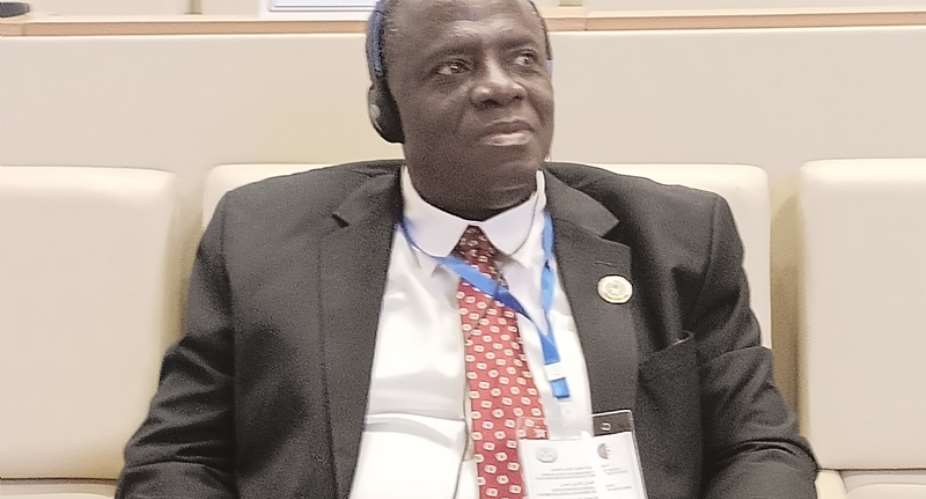
A Justice of the Supreme Court of Ghana, Sir Justice Dennis Dominic Adjei, has cautioned that freedom of speech, while constitutionally protected, carries lawful consequences when abused, but stressed that accountability for speech must itself be accountable to the law.
Sir Justice Adjei stressed the consequences of abuse of speech, dismantling the misconception that the repeal of criminal libel created absolute freedom to publish anything.
He explained that civil defamation can result in damages and, where legally justified, injunctive relief, stressing that a claimant must establish the applicable elements, and the court must consider relevant defences including truth, protected comment and privilege as the circumstances permit.
The Supreme Court Judge noted that correction, a rejoinder and an apology may remedy harm without suppressing lawful debate.
Sir Justice Adjei, who is a Judge of the African Court on Human and Peoples’ Rights, made these disclosures during the Inaugural Annual St. John the Baptist Memorial Lecture in Accra, which was organised by the Joint Board of the Supreme Subordinate Commandery and Ladies’ Auxiliary of the Knights of St. John International, Ghana.
High-level personalities, including the Vice President, the Speaker of Parliament, superior court justices, religious leaders, traditional leaders, and the diplomatic corps, attended the event, which was themed “Speaking Truth to Power: Upholding Justice, Morality, and National Accountability."
He explained that "Liability cannot be inferred merely from an official's assertion that a publication is insulting."
Sir Justice Adjei emphasized that in 2001 Ghana repealed criminal libel and specified seditious provisions through Act 602 of 2001. That repeal, he clarified, did not abolish civil defamation or every offence involving words. Threats, extortion or conduct amounting to legally defined incitement may attract criminal liability where an applicable offence is established.
Citing Section 208 of the Criminal Offences Act, 1960 (Act 29), which addresses publication or reproduction of false statements likely to cause public fear and alarm or disturb the public peace, the African Court Judge explained that the law includes knowledge or reason-to-believe requirements and a verification provision and classifies the offence as a misdemeanour.
"Its existence is not a licence to arrest a critic merely for embarrassing an officeholder. An allegation of falsity, by itself, is not a substitute for establishing the applicable statutory ingredients. Conviction can carry the fine or imprisonment prescribed for the particular offence, subject to constitutional protection and proportionality," he stated.
On contempt and journalism protection, he said it can address conduct that unlawfully obstructs or interferes with the administration of justice but must not serve as a general shield against informed criticism of judgements.
He said Articles 126(2) and 19(12) expressly recognise the superior courts' contempt powers, including the constitutional exception to the ordinary written-offence requirement, but fair process remains indispensable.
He referenced the landmark African Court judgement in “Lohé Issa Konaté v Burkina Faso, delivered on 5 December 2014,” which held the custodial penalty for defamation disproportionate and explained that fines and civil or administrative sanctions must also satisfy necessity and proportionality.
Sir Justice Adjei stressed that "a remedy for reputational harm must not become a means of destroying independent journalism."
The Supreme Court Judge concluded that other consequences may include professional discipline, complaints proceedings within the National Media Commission's mandate, and platform measures under lawful service conditions, but with clear limits.
"The NMC is not a criminal court, and an employer's displeasure does not authorise punishment for protected disclosure. Accountability for speech must itself be accountable to law," he stated.
The lecture, instituted in honour of St. John the Baptist – the biblical figure executed for confronting power – is positioned by the Knights of St. John International as an annual platform for interrogating the moral and legal foundations of Ghana's democracy.








 'Free speech is not a licence for defamation' – Supreme Court Judge warns
 Court adjourns Wontumi’s Exim Bank case to November 2 and 3 for prosecution’s di...
 Mahama receives honorary doctorate from Russian university nearly 40 years after...
 Oppong Nkrumah demands clarity on Women’s Development Bank, One Million Coders p...
 Obuasi SHTS sex scandal: Three students withdraw from State interventions
 'Ghana has same medium sweet crude with Ivory Coast and Nigeria; If TOR refines ...
 'For an institution keen on responsible sourcing; there's no way our CEO will en...
 Ghanaian twin brothers plead guilty in US romance fraud case involving $9m losse...
 Obuasi SHTS sexual abuse allegations: Emily Nyarko urges sustained pressure for ...
 Ghana, Canada sign agreement to deepen bilateral cooperation – Ablakwa


