




The Question
The question is not "Should Cabinda secede?" That is the West's binary - yes or no, secession or unity. The Pan-Afrikanist question is harder: How does a state that lives on oil earn the right to rule the people who live on top of that oil?
Cabinda is where Angola must answer it.
The Map That Bleeds
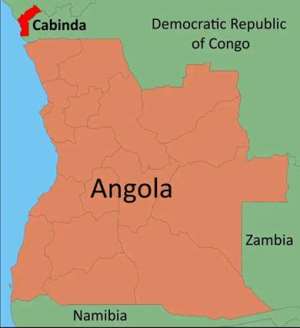
Look at the map of Angola and you will see a wound. A piece of Angola lives far away from Angola.
Cabinda - 7,200 square kilometers wedged between Congo-Brazzaville to the north and Congo-Kinshasa to the south, face to the Atlantic - is cut from the rest of Angola by a narrow strip of land and the mouth of the Congo River.
How does a country lose its own arm? Not by geography. By Berlin.
In 1885, Portugal signed the Treaty of Simulambuco with the princes of Cabinda - Prince Mani-Kongo and others. That treaty did not say Cabinda is Angola. It said Cabinda is a separate protectorate under the Portuguese crown. Portuguese Congo. With its own legal personality. Protection, not integration. Article 1 and 2 of that text, archived in Lisbon, are clear.
In that same year, in that same cold room in Berlin, King Leopold II demanded a corridor to the sea for his personal property, the Congo Free State. The powers gave it to him. They drew a corridor straight to the Atlantic, cutting Cabinda from Angola. That corridor is today the DRC.
From 1933 to 1956, Lisbon kept the fiction of distinction in its constitution. Then in 1956, for administrative convenience, Portugal transferred Cabinda to the Governor-General in Luanda. Convenience became conquest. A protectorate on paper became a district in practice.
In 1975, Portugal collapsed and committed its final betrayal. At Alvor, it handed Cabinda to Luanda as part of Angola. The Alvor Agreement was signed by Portugal and three Angolan movements - MPLA, FNLA, UNITA. Cabindan political movements were not at the table. They rejected Alvor. Lisbon did not listen.
Treaties in Europe. Corridors on maps. Memos in Luanda. That is how a people became a province.
Four Pillars That Keep Cabinda Chained
One: The Doctrine That Froze The Cut.
The OAU in 1964 adopted _uti possidetis juris_ - keep colonial borders to avoid endless wars. A wise principle to stop secessionism. But here, it froze an injustice. It turned Berlin's cut into AU law. We condemn Berlin, yet we sanctify its map in Addis Ababa. That is our contradiction.
Two: Oil - The Treasury.
Cabinda produces roughly three-fifths - about 60% - of Angola's crude and at peak funded 80% of the state budget. Cabinda is not a province. Cabinda _is_ the budget. It is the currency. It is the army's salary. For the MPLA in Luanda, losing Cabinda is not losing land. It is losing the state itself. That is why for Luanda, Cabinda is non-negotiable. This is not just American pressure. This is Luanda's survival logic.
And Luanda has its own argument we must hear: over 50 years, more than 500,000 Angolans from other provinces have moved to Cabinda to work, intermarry, and build lives. Cabinda Town today is not only Bawoyo and Bavili. It is also Ovimbundu, Kimbundu, Bakongo from all over Angola. The MPLA also buried over a thousand soldiers defending it during the long war. For a family in Huambo, Cabinda is not oil - it is their cousin who never returned from service.
Three: The Gun.
Since 1975, Cabinda has lived under tight military control and low-intensity war.
Four: The Failure We Must Name.
The Front for the Liberation of the Enclave of Cabinda, FLEC, claims to fight for independence. But FLEC is not one front. It is FLEC-FAC, FLEC-Nzita, FLEC-PM, FLEC-Lopes - factions that have spent more time fighting each other in Pointe-Noire and Brussels than fighting for Cabinda in Malembo. A liberation movement that cannot liberate itself cannot liberate a people. If we hide this, we become propagandists. A Pan-Afrikanist must tell the truth even about his brothers.
This is why Cabinda bleeds but does not break away. Luanda is too strong to lose it, FLEC is too divided to win it, and ordinary people are caught in between.
The Fisherman Who Sees The Flame
Statistics hide people. So go to Malembo.
There you will meet fishermen - call one of them Nlandu Antonio, 58, a composite from multiple testimonies gathered from Malembo landing site reports and church records in 2023-2024. Every night at 6pm, he sees it. The gas flare of Block 0 burning offshore like a second sun.
In Ibinda, his language, the sea is m'bu. The flame is nlaku. But this nlaku is not his.
That light is Chevron. That light is TotalEnergies. That light is Angola's budget. That light is energy security in Houston. But it is not his light.
His village has no clinic. His catch has shrunk from reported oil spills. His son learns in Portuguese only, not in Ibinda, so the boy learns he is a stranger in his father's house. The sea gives oil to America, but gives no fish to Cabinda.
"M'bu gives nlaku to the world, but darkness to its children".
That is internal colonialism. That is the resource curse made flesh.
Cabinda is not a percentage. It is Nhaku watching his wealth burn on the horizon.
Simulambuco vs The Textbook
Open an Angolan history textbook in Luanda. It will teach Berlin. It will teach Alvor. It will rarely teach Simulambuco.
Article 1 of Simulambuco says Cabinda placed itself under protection, distinct from Angola. The original is in Lisbon archives. Yet Heritage-Based Education in Luanda, in Harare, in Addis, rarely teaches it.
If we do not teach Simulambuco, we teach Angolan nationalism as if it were natural and eternal. We teach the last Rhodesian farm all over again.
The textbook is the last Rhodesian farm because it tells the child Cabinda was always Angola. Simulambuco tells him it never was.
To annex a people, first annex their history. To free a people, return their history.
The Tongue They Tried to Bury
The deepest annexation is linguistic. Cabinda speaks Ibinda, a tongue of Kikongo, close to its cousins across the border in Congo, not the Luanda Portuguese of the musseques.
After 1975, Luanda sent teachers from the south. Curriculum: Portuguese only. No Ibinda in schools. No Ibinda on state radio for decades. A Cabindan child learns that his mother tongue is noise.
This is the same miseducation we fight everywhere. Colonialism survives when it kills the language that carries sovereignty. When Nlandu's son cannot learn in Ibinda, he learns that sovereignty lives elsewhere.
The Lobito Question - My Reading
Now look at the new map - the emerging American map.
Washington is funding the Lobito Corridor to move Zambian and Congolese copper and cobalt from Kolwezi to Lobito, past Cabinda, for the green transition. At the same time, Cabindan oil moves from Malongo to Houston.
My reading: Angola is being positioned as a corridor manager for two gates cut in Berlin. One gate in the east, Lobito, for critical minerals. One gate in the north, Cabinda, for oil. This is why, in my assessment, Washington will not back FLEC - it needs a strong, stable Luanda to keep both gates open and predictable in competition with Beijing. Luanda understands this leverage.
This is analysis, not proof. But maps have interests.
February 2025: Internationalization Attempt
In early February 2025 (reported widely 2-3 Feb 2026 by AFP from Brussels), FLEC leaders in exile - Jacinto Télica and Jean-Claude Nzita - proclaimed unilateral independence, a provisional parliament, constitution, interim executive. Video showed Telica in a clearing with FLEC flag. They appealed to external powers - oil and minerals for backing.
This is not naivety. It is the classic liberation strategy: externalize the conflict. Turn Cabinda from a domestic security problem into an international self-determination case.
But it will fail as secession. Angola is rising, not retreating like Indonesia in Timor-Leste. FLEC has no UN sponsorship. And sabotage will only bring more garrisons.
The Pan-Afrikanist Solution - Zanzibar, Not Yugoslavia
Cabinda exposes our contradiction. We shout sovereignty against the West, yet we practice internal colonialism when oil is at stake.
The solution is not more garrisons. Garrison is not legitimacy.
The solution is Nkrumah's answer: confederal autonomy.
Like Zanzibar in Tanzania. Zanzibar has its own parliament, its own president, its own language policy, its own share of revenue, yet remains Tanzania. Tanzania earned unity.
Angola can earn Cabinda, and there are small steps already: Angola's 750,000 bpd Cabinda refinery at Malongo, inaugurated in initial phase in 2025, is a start - it begins to process oil in Cabinda, not just extract it. That is value addition at home. It must be expanded, not tokenized.
A fuller earning would be:
1. Its own parliament in Cabinda Town with legislative powers.
2. Ibinda as an official language alongside Portuguese in schools and radio.
3. 40% of oil revenue retained and audited by Cabindans for Cabinda development - transparent, published.
4. Malongo refinery completed to full capacity and Cabindan employment prioritized.
Dialogue, wealth-sharing, linguistic justice - not pipelines and patrols alone. Security without political legitimacy is not sovereignty; it is occupation.
The textbook says Cabinda is a province. Simulambuco says Cabinda is a protectorate. The oil rig says Cabinda is a vault.
But go to Malembo at 6pm and ask Nlandu what Cabinda is.
He will not point to a map. He will point to the _tadidi_ burning on the _m'bu_.
He will say: "That flame is my sea. But the light has never reached my house."
Until that light reaches his house, Africa's frozen conflict will keep bleeding.
_F. Madondo (African Teacher) [email protected]


 'Free speech is not a licence for defamation' – Supreme Court Judge warns
 Court adjourns Wontumi’s Exim Bank case to November 2 and 3 for prosecution’s di...
 Mahama receives honorary doctorate from Russian university nearly 40 years after...
 Oppong Nkrumah demands clarity on Women’s Development Bank, One Million Coders p...
 Obuasi SHTS sex scandal: Three students withdraw from State interventions
 'Ghana has same medium sweet crude with Ivory Coast and Nigeria; If TOR refines ...
 'For an institution keen on responsible sourcing; there's no way our CEO will en...
 Ghanaian twin brothers plead guilty in US romance fraud case involving $9m losse...
 Obuasi SHTS sexual abuse allegations: Emily Nyarko urges sustained pressure for ...
 Ghana, Canada sign agreement to deepen bilateral cooperation – Ablakwa


