




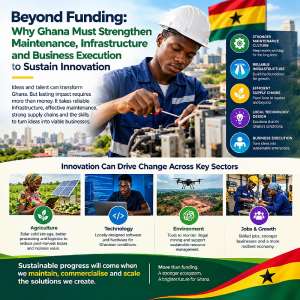
Ghana’s quest to transform its wealth of ideas, technical expertise and entrepreneurial talent into sustainable businesses requires more than access to finance. While funding remains essential for innovation and economic growth, the long-term success of enterprises and development projects also depends on reliable infrastructure, effective maintenance systems, strong agricultural supply chains and the ability to convert technical solutions into commercially viable products.
Across the country, engineers, software developers, technicians and entrepreneurs continue to develop promising solutions to local challenges. Yet, many innovations that perform well during initial testing struggle to achieve commercial success or remain operational over time. This disconnect highlights a fundamental weakness in Ghana’s innovation ecosystem: the tendency to prioritise the launch of projects over the systems required to sustain them.
One of the most significant challenges is the inadequate maintenance culture affecting both public infrastructure and private investments. Roads, machinery, processing equipment and other assets can deteriorate prematurely when routine servicing, repairs and replacement of components are neglected. The resulting breakdowns increase operating costs, disrupt productivity and undermine the value of the original investment.
Addressing this problem requires maintenance to become an integral part of project planning, budgeting and institutional accountability. Development projects and businesses should make adequate provision for spare parts, regular servicing, technical inspections and equipment replacement throughout the asset’s useful life. Strengthening vocational and technical education is equally important to ensure that local technicians possess the practical skills needed to maintain and repair equipment rather than relying excessively on expensive external expertise.
Beyond maintenance, many Ghanaian innovators face difficulties translating technical competence into sustainable commercial operations. Developing a product is only one stage of building a successful enterprise. Entrepreneurs must also understand customer needs, pricing, marketing, distribution, regulatory requirements and after-sales service. Without these capabilities, technically sound innovations may fail to attract customers or generate sufficient revenue to support continued operations.
Improving collaboration between engineers, business professionals, investors, universities and industry associations could help address this gap. Incubators, technical training institutions and entrepreneurship programmes should place greater emphasis on market research, business management, product development and commercial partnerships. Such an approach would enable innovators to design solutions around genuine market needs while developing realistic strategies for growth.
Access to customers and institutional procurement opportunities also remains important. Small and medium-sized enterprises may develop effective technologies but struggle to secure contracts, demonstrate their products to decision-makers or meet the requirements of large organisations. Transparent procurement systems, pilot programmes and stronger links between local innovators and public institutions could create opportunities for promising Ghanaian solutions to be tested, improved and adopted at scale.
These challenges have practical implications across several sectors. In agriculture, solar-powered cold storage, improved processing equipment and efficient logistics systems could help reduce post-harvest losses and increase the value of locally produced commodities. However, such technologies will only deliver lasting benefits if they are affordable, appropriately designed, properly maintained and supported by reliable supply chains.
Similarly, locally developed software and hardware must respond to Ghanaian operating conditions, including infrastructure limitations, user needs and the cost of repairs. In environmental management, technologies designed to monitor illegal mining, commonly known as galamsey, could strengthen surveillance and enforcement, provided they are supported by dependable equipment, trained personnel, institutional coordination and effective responses to the information collected.
Environmental sustainability must also be considered when developing and deploying new technologies. Solutions should account for energy efficiency, responsible waste management, equipment durability and the availability of replacement components. Designing products for local conditions and long-term use can reduce operating costs while improving resilience and reducing dependence on imported technical support.
Ultimately, Ghana needs an innovation strategy that treats finance, maintenance, infrastructure, technical skills and commercial execution as interconnected priorities. Public institutions, private investors, educational establishments and development partners must work together to create an environment in which promising ideas can progress from prototypes to dependable products and profitable enterprises.
The measure of innovation should not simply be the number of projects launched, funds disbursed or technologies demonstrated. It should also include how reliably those solutions operate, how many customers they serve, the jobs they create and the economic and social value they deliver over time.
For Ghana to build a competitive and resilient economy, investment must extend beyond financing the creation of new ideas. It must also support the systems, skills and disciplines required to keep those ideas working. Sustainable progress will depend not only on the ability to innovate, but also on the capacity to maintain, commercialise and scale solutions that address the country’s most pressing challenges.


 Israel votes in first election since October 7 attack as Netanyahu faces crucial...
 US-EU trade truce at risk over $3.4 billion Airbus loan, Trump official warns
 Flavio Bolsonaro vows to lead opposition after Brazil court imposes travel ban
 Mecca pact nations hold talks with Iran to prevent renewed Middle East war
 New DStv sports package will save subscribers over Ghc500 monthly – Sam George
 Your past prescriptions never helped developing countries - TOR MD tells IMF
 Crude Distillation Unit turnaround was funded from TOR's internally generated fu...
 Trump offers $1 million for tipoffs leading to vote fraud conviction as midterms...
 UN cites 'ethnic cleansing' concerns around Israel's Palestinian displacement op...
 'Irresponsible media coverage is hurting Obuasi SHTS abuse probe' – Gender Minis...


