




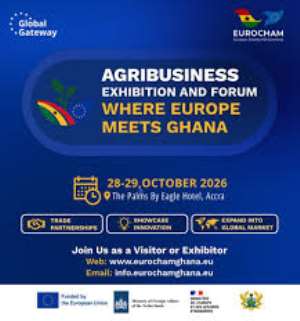
Ghana's drive to transform its agricultural sector through value addition, technology, investment and stronger international partnerships will take centre stage at the EU-Ghana Agribusiness Exhibition and Forum 2026, scheduled for October 28 and 29 at The Palms by Eagle Hotel in Accra.
Organised under the European Union's Global Gateway initiative, the two-day event is expected to bring together Ghanaian and European businesses, investors, farmers, processors, exporters, policymakers and development partners to explore practical opportunities for cooperation across the agricultural value chain.
Under the theme, "Where Europe Meets Ghana," the forum seeks to strengthen commercial relationships between European and Ghanaian agribusinesses while promoting investment, technology transfer, sustainable production and improved access to local and international markets.
The event is being organised by the European Chamber of Commerce in Ghana (EuroCham Ghana), in partnership with the Ghana Investment Promotion Centre (GIPC), the Ministry of Foreign Affairs of the Netherlands and the Ghana Netherlands Business and Culture Council (GNBCC), with AAK serving as a strategic sponsor.
The initiative comes at a time when Ghana is seeking to maximise the economic benefits of its agricultural resources by expanding domestic processing, strengthening local enterprises and reducing dependence on imported finished food products. Although the country produces significant quantities of cocoa, cashew, oil palm, fruits, vegetables and other agricultural commodities, considerable opportunities remain to increase local value addition, improve productivity and develop competitive export-oriented businesses.
Stronger partnerships between Ghanaian enterprises and European investors could help address some of these challenges through access to modern processing equipment, technical expertise, financing, quality assurance systems and international distribution networks. Such cooperation could also support the development of more resilient agricultural supply chains, create employment and improve the competitiveness of Ghanaian products in international markets.
The forum is designed to move beyond policy discussions towards practical business outcomes. Its programme is expected to feature exhibitions, business-to-business matchmaking, investor engagements and knowledge-sharing sessions aimed at connecting companies with potential partners, investors and customers.
Key areas of interest include agro-processing, horticulture, poultry production, livestock development, agricultural technology, access to machinery and finance, and the establishment of sustainable value chains linking farmers to processors, retailers and export markets.
Participants are also expected to examine European market requirements, certification procedures, food safety regulations and export-readiness strategies that could help Ghanaian small and medium-sized enterprises improve product quality and access new markets.
Among the featured speakers is Alberta Nana Akyaa Akosa, Executive Director of Agrihouse Foundation, whose work has focused on strengthening agricultural entrepreneurship, promoting women's participation in agribusiness and creating opportunities for young people across Ghana's agricultural sector.
Through Agrihouse Foundation, Akosa has championed several agricultural platforms, including the Pre-Harvest Agribusiness Exhibition and Conference, the Women in Food and Agricultural Leadership Forum (WOFAGRIC), the Gold in the Soil Awards, Ghana Poultry Day and the Agri-Woman Marketplace. These initiatives seek to connect agricultural stakeholders, promote innovation, recognise industry achievements and improve the economic prospects of farmers and agribusiness operators.
Her work has reached farmers and other agricultural stakeholders across Ghana's 16 regions, with the foundation reporting a broad national impact. Her international recognition includes the 2024 Agrifood Future Prize in Italy and an ambassadorial role with Brazil's Mulheres do Agro Rally. She also serves on the board of the Ghana Incentive-Based Risk-Sharing System for Agricultural Lending (GIRSAL).
At the Accra forum, Akosa is expected to contribute to discussions on building successful partnerships between European and Ghanaian agribusinesses, drawing on her experience in agricultural development, enterprise support and inclusive value-chain development.
A central consideration in such partnerships is how to ensure that international investment delivers tangible benefits to local producers and businesses. While access to European capital, technology and markets can create significant opportunities, sustainable cooperation also requires local participation, skills development, commercially viable business models and a commitment to building Ghanaian ownership and productive capacity.
Women, young people and persons with disabilities are among the groups whose participation in agricultural value chains could be strengthened through targeted investment, entrepreneurship support and improved access to finance, technology and markets.
The forum therefore presents an opportunity to explore how international partnerships can help transform agriculture from a predominantly raw-material-producing sector into a stronger engine of industrialisation, employment creation, export growth and rural economic development.
For Ghanaian farmers, processors, exporters, agricultural input suppliers, equipment manufacturers, financial institutions and technology providers, the event could provide opportunities to establish commercial relationships and identify solutions to persistent challenges affecting productivity and business expansion.
European companies, meanwhile, could use the platform to identify investment opportunities, establish local partnerships and contribute expertise in processing, logistics, quality management, sustainable production and market development.
The success of the initiative will ultimately depend on the ability of participating businesses and institutions to translate discussions into concrete investments, lasting commercial relationships and measurable improvements in agricultural productivity and profitability.
As Ghana continues to pursue industrialisation and economic diversification, strengthening the connections between agricultural production, manufacturing and international trade remains essential. Strategic cooperation between Ghanaian enterprises and European partners could help accelerate this process, provided the resulting opportunities are accessible to local businesses and deliver lasting economic value.
The EU-Ghana Agribusiness Exhibition and Forum 2026 will take place on October 28 and 29, beginning at 9:00 a.m. each day, at The Palms by Eagle Hotel in Accra.
As Ghana seeks to build a more competitive and sustainable agricultural economy, the forum offers a platform for stakeholders to explore how international cooperation can support local enterprise, expand value addition and create new opportunities across the agribusiness sector.


 Israel votes in first election since October 7 attack as Netanyahu faces crucial...
 US-EU trade truce at risk over $3.4 billion Airbus loan, Trump official warns
 Flavio Bolsonaro vows to lead opposition after Brazil court imposes travel ban
 Mecca pact nations hold talks with Iran to prevent renewed Middle East war
 New DStv sports package will save subscribers over Ghc500 monthly – Sam George
 Your past prescriptions never helped developing countries - TOR MD tells IMF
 Crude Distillation Unit turnaround was funded from TOR's internally generated fu...
 Trump offers $1 million for tipoffs leading to vote fraud conviction as midterms...
 UN cites 'ethnic cleansing' concerns around Israel's Palestinian displacement op...
 'Irresponsible media coverage is hurting Obuasi SHTS abuse probe' – Gender Minis...


