




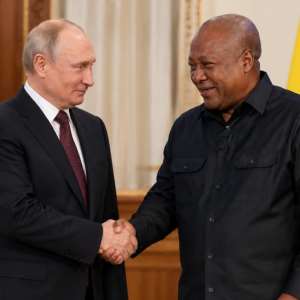
President John Dramani Mahama may possess the diplomatic credentials to advocate an end to the Russia-Ukraine war, but persuading Vladimir Putin to accept a ceasefire is an entirely different proposition. Ghana can open diplomatic doors. It cannot, however, assume that Moscow will abandon its military objectives because Accra has made an appeal for peace. The distinction between diplomatic influence and strategic leverage will determine whether Mahama’s intervention becomes a meaningful contribution to international peacemaking or merely another well-intentioned African initiative.
The stakes could hardly be higher. Russia’s full-scale invasion of Ukraine, launched in February 2022, has evolved into a protracted confrontation with consequences extending far beyond Eastern Europe. It has reshaped European security, intensified tensions between Russia and NATO, disrupted international economic relationships and exposed the limitations of the post-Cold War international order.
The humanitarian cost is equally devastating. United Nations human rights monitors verified 2,514 civilian deaths and 12,142 injuries in Ukraine during 2025, making it the deadliest year for civilians since 2022. Civilian casualties increased by 31 per cent compared with 2024. Meanwhile, the World Bank, European Union, United Nations and Ukrainian government estimated in February 2026 that Ukraine would require approximately $588 billion for reconstruction and recovery over the following decade. That figure represents almost three times the country’s estimated 2025 gross domestic product.
These figures illustrate why an internationally supported ceasefire deserves serious consideration. However, humanitarian urgency does not automatically translate into political concessions. Putin’s calculations are driven primarily by Russia’s national security doctrine, territorial ambitions, domestic political considerations and determination to preserve Moscow's influence over the European security architecture.
Why Putin May Listen and Why He May Refuse
The obstacle is the Kremlin’s definition of an acceptable outcome. In October 2026, Moscow continues to demand Ukrainian withdrawal from four regions it claims to have annexed, limits on Ukraine’s military and abandonment of its NATO ambitions. Russia occupies roughly one-fifth of Ukraine but does not control all the territory it claims. Kyiv rejects territorial surrender and insists on credible security guarantees. These are disputes over sovereignty and Europe’s security order.
Putin has distinguished a temporary ceasefire from a comprehensive settlement, arguing that negotiations must address security arrangements for Russia, Ukraine and Europe. Moscow may regard an unconditional pause as freezing an unfavourable battlefield position while allowing Ukraine to rearm. A personal appeal cannot override battlefield calculations or the Kremlin's domestic politics. Openings remain. Sanctions, casualties and the cost of sustaining military operations impose burdens on Russia. A ceasefire could preserve its positions while opening negotiations.
Kyiv and its partners fear that an unenforced pause could reward territorial conquest and prepare the ground for another offensive. Mahama should therefore pursue a limited, verifiable first step rather than promise a grand settlement: protection of energy infrastructure, prisoner exchanges, humanitarian access or a monitored halt to attacks. They would not end the war, but they could test whether declarations produce restraint.
Ghana’s Diplomatic Assets and Their Limits
Ghana has credentials that make its voice relevant. Mahama previously chaired the ECOWAS Commission, led the African Union’s High-Level African Trade Committee and co-chaired the UN Advocacy Group on the Sustainable Development Goals. Ghana is also due to represent West Africa in the African Union Bureau and chair the continental organization in 2027. These positions provide diplomatic access, not the authority to negotiate on behalf of Africa.
Accra also has an established channel to Moscow, with Ghana and Russia maintaining diplomatic relations since 1958. Ghana News Agency reported in July 2026 that bilateral trade had risen from $247 million in 2022 to more than $800 million in 2024. The Russian ambassador has described Mahama as a partner, while Ghana is preparing to participate in the Russia-Africa Summit in Moscow on October 28-29, 2026. These developments create opportunities for engagement, although they do not necessarily translate into decisive leverage over the Kremlin.
Credibility, however, requires consistency. During Ghana’s 2022-2023 United Nations Security Council term, Accra condemned Russia’s invasion as a violation of the UN Charter and defended Ukraine’s sovereignty. Ghana subsequently abstained on two General Assembly resolutions concerning Ukraine in 2025. Mahama must therefore make clear that pursuing dialogue does not amount to endorsing annexation or abandoning the principle of territorial integrity. Any mediation effort must be anchored in international law and respect for Ukraine’s sovereignty. Without that clarity, Ghana risks undermining its credibility with Kyiv and other international partners while appearing to offer Moscow diplomatic cover.
The most realistic route is coordinated diplomacy. Mahama should consult Kyiv, the African Union, the United Nations and other states involved in negotiations before approaching Putin with a clearly defined proposal. Ghana could offer a discreet diplomatic channel, facilitate confidence-building discussions or mobilize international support for a humanitarian arrangement. However, it cannot promise sanctions relief, security guarantees or territorial compromises on behalf of other countries.
The Geopolitical Consequences
A Ghanaian initiative would carry significance beyond the battlefield. A humanitarian agreement could demonstrate the relevance of African diplomacy in conflicts often treated as the preserve of global powers, strengthen the African Union’s international profile and enhance Ghana’s diplomatic influence ahead of its 2027 chairmanship. There is also an economic dimension. The war has intensified volatility in food, fertilizer, fuel and shipping markets, exposing import-dependent African economies to external shocks they did not create. A reduction in hostilities could restore some market confidence and create opportunities for trade and reconstruction. However, Ghana should not anticipate an immediate economic windfall, as sanctions and disrupted supply chains would not disappear simply because the guns fell silent.
The diplomatic risks, however, are considerable. If Mahama appears to legitimize Russia’s territorial claims, Ghana could jeopardize its relations with Ukraine and Western partners while weakening its own commitment to national sovereignty and territorial integrity. Any proposal advanced without Kyiv’s consent could also be perceived by Ukraine as favouring Moscow’s interests. Russia, for its part, could dismiss Ghana’s intervention if it suspects that the initiative is a Western-backed diplomatic manoeuvre. Accra must therefore ensure that its commercial and strategic interests do not come at the expense of its foreign policy principles.
Ultimately, Mahama is unlikely to persuade Putin to accept an immediate and unconditional ceasefire through presidential diplomacy alone. The decisive leverage remains in the hands of the warring parties and the major powers sustaining them. Nevertheless, diplomacy should not be measured exclusively by whether it produces an immediate settlement. If Ghana can use its diplomatic standing to facilitate a monitored humanitarian pause, uphold Ukraine’s sovereignty and coordinate its efforts with credible international partners, it could help create conditions for meaningful negotiations. Mahama’s real test, therefore, is not whether his personal intervention can end the war, but whether he can translate Ghana’s diplomatic credibility into a practical and constructive contribution to peace.
The writer is a journalism lecturer and the CEO of The International Lens (theinternationallens.com)


 New DStv sports package will save subscribers over Ghc500 monthly – Sam George
 Your past prescriptions never helped developing countries - TOR MD tells IMF
 Crude Distillation Unit turnaround was funded from TOR's internally generated fu...
 Trump offers $1 million for tipoffs leading to vote fraud conviction as midterms...
 UN cites 'ethnic cleansing' concerns around Israel's Palestinian displacement op...
 UCC-UTAG demands clearer boundaries for GTEC’s regulatory role to avoid interfer...
 Mahama congratulates Lula da Silva on ‘well-deserved’ re-election as Brazil Pres...
 Mahama arrives in Moscow to push for Russia-Ukraine ceasefire at Russia–Africa S...
 'Irresponsible media coverage is hurting Obuasi SHTS abuse probe' – Gender Minis...
 Foreign Affairs Ministry seeks names of evacuees allegedly shortchanged in GH¢5,...


