




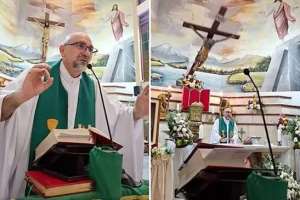
The death of Rev. Fr. Patricio Alfredo Sánchez Molinari in Guayaquil, Ecuador, was a tragedy that has touched the hearts of many people and raised important questions about life, faith, leadership and human responsibility. The Catholic priest reportedly died on Saturday, 17 October 2026, after a massive wooden crucifix fell on him while he was celebrating Mass at Our Lady of Perpetual Help Church. The incident was captured during a livestream of the service and later spread widely on social media.
What made his tragic death particularly curious was that the priest had reportedly spoken about death, the value of time and the importance of giving attention to God and one's family shortly before the accident. Within minutes, a man who had been preaching to a congregation about life and mortality became the subject of mourning himself. His story offers lessons that deserve reflection, not only among Christians but also among Africans, whose communities place considerable importance on religion, family, respect for spiritual leaders and the meaning of life. Yet the greatest lesson may be that we must learn from a tragedy without turning it into an opportunity for superstition, sensationalism or the unjust accusation of others.
The first lesson is that life is more fragile than we often imagine. Every day, people wake up, prepare for work, attend church, visit friends and make plans for the future. We naturally assume that we shall return home safely. We plan for next week, next month and the next ten years as though tomorrow were guaranteed. But life can change in a moment.
Fr. Molinari had stood before his congregation to celebrate Mass, as he had done on many previous occasions. Nobody attending the service could reasonably have expected that a heavy Cross mounted behind the altar would fall and cause his death. If truth be told, this is a sobering reminder that life does not always follow our plans. A person may leave home in the morning with every intention of returning in the evening, only for an unexpected event to change everything. A trader may open a shop, a farmer may enter a field, a driver may begin a journey, and a priest may mount the altar, all without knowing what the day would bring.
The lesson is not that we should live in fear. It is that we should live wisely, make peace with those around us, fulfil our responsibilities and avoid postponing every good thing until a future that is not guaranteed. The second lesson concerns the proper use of time.
Reports about the priest's final homily indicate that he spoke about the time people devote to God, their families and the demands of daily life. His message is still relevant in a society where many people spend their days struggling to survive. Across Africa, parents leave home early in the morning and return late at night in the hope of providing food, school fees and shelter for their children. In poor families, even children as young as eight years old hawk along the city streets and rural roads in an attempt to help their parents. Businesspeople work long hours, civil servants face demanding schedules, and young people struggle to establish themselves in an economy that offers opportunities to just a few people and disappointment to many.
These struggles are real. And we cannot pretend that earning a living is unimportant. But, the pursuit of money can become dangerous when it consumes every hour of our lives and leaves no room for us to communicate with the people who depend on us. Some parents provide their children with money but have little time to listen to them. Some husbands and wives live under the same roof but hardly communicate. Some friends remember one another only when they need financial assistance. Others postpone reconciliation until pride, distance or death makes it impossible. The lesson is simple: we must balance work with relationships, ambition with compassion, and material progress with spiritual and emotional well-being. We must love the people whose lives are intertwined with ours. No one knows the hour and even that is in the Bible. We must create the atmosphere of peace in our minds, our homes and our communities. Money can buy a comfortable bed, but it cannot guarantee peace in a home. It can pay hospital bills, but it cannot purchase our neighbours’ love. Time spent showing kindness to others is never really wasted.
The third lesson is that religious leaders are human beings who deserve care and protection. In many African communities, a priest, pastor, imam or traditional spiritual leader occupies an important position. Such people are often expected to counsel troubled families, visit the sick, comfort grieving relatives and provide guidance during difficult times. They may carry the burdens of hundreds or even thousands of people. It is only fair that those who spend their lives caring for others also need others to care for them.
The death of Fr. Molinari reminds us that a religious leader is not protected from physical danger simply because he stands in a sacred place or performs a holy duty. Faith may give people courage, hope and strength, but it should not become an excuse for ignoring practical safety. Churches and other places of worship must therefore pay serious attention to the condition of their buildings, altars, roofs, electrical installations, suspended decorations and other heavy objects. Crosses, statues and religious fittings should be installed securely and inspected regularly by competent professionals.
A place of worship should be a place of prayer and safety. No congregation should have to choose between devotion and protection from preventable danger. If an investigation establishes that faulty installation, poor maintenance or negligence contributed to the tragedy in Ecuador, the appropriate lessons and accountability should follow. Until the evidence is available, however, nobody should be condemned without proof.
The fourth lesson is that we must be careful about how we interpret tragedy. Whenever an extraordinary incident occurs in a religious setting, people naturally begin to ask questions. Some wonder whether it was a sign from God. Others may claim that the deceased had offended God, that somebody had committed a spiritual crime or that the event was a supernatural warning.
Such explanations can spread quickly, especially through social media, where a dramatic video may attract millions of viewers before the facts are fully established. But we must distinguish between faith and speculation. The fact that a crucifix fell on a priest does not, by itself, prove that God was angry with him, that his death was a punishment or that he had predicted his own death. Nor does the coincidence between his reported homily about mortality and the accident establish supernatural foreknowledge. Christians may pray, mourn, seek spiritual comfort and reflect on the meaning of the event without claiming to know the hidden reasons behind it. The Christian faith itself encourages humility before mysteries that human beings cannot fully explain. A tragedy should not become an excuse to frighten innocent people, exploit grieving families or spread claims that have no supporting evidence. Sometimes the most honest answer is that an accident has occurred and that we must investigate its causes while we respectfully allow the bereaved to mourn.
The fifth lesson concerns the true meaning of greatness. Reports about Fr. Molinari describe him as a priest that is involved in pastoral work and community activities, including efforts to assist vulnerable people and provide opportunities for children and young people. Such service reminds us that a person's importance should not be measured only by titles, possessions, popularity or public recognition. In Africa, we sometimes celebrate people because they have become wealthy, acquired expensive cars, built large houses or gained political influence. These achievements can be valuable, but they do not tell the whole story of a person's life.
What matter most in our lives are how we treat people who cannot repay us, how we respond to suffering, and what we contribute to the communities in which we live. A teacher who patiently educates children, a nurse who cares for patients, a farmer who feeds a community, a neighbour who helps a struggling family and a religious leader who offers genuine support are all making meaningful contributions to society.
The example attributed to Fr. Molinari encourages us to look beyond outward status and ask a more important question: whose life has become better because we were here?
The sixth lesson is that death reveals the importance of community. When someone dies unexpectedly, the loss extends beyond the individual. A family loses a loved one, friends lose a companion, and a community loses someone whose presence may have become part of its daily life. The appropriate response is not merely to share photographs and videos of the incident. It is to support those who are grieving, respect the dignity of the deceased and help establish the facts surrounding the tragedy.
Social media has made it easy for people to watch disturbing events repeatedly. But the fact that footage is available does not mean that sharing it is necessary or compassionate. The family of a deceased person deserves respect, and the bereaved congregation should not have to endure endless circulation of images of its priest's final moments. We should also remember that compassion is more useful than argument. People may disagree about religious beliefs, but they can still agree that a human life has been lost and that the family, friends and parishioners deserve sympathy.
On a final note, the tragedy calls for a practical commitment to responsibility. It is not enough to say that life is short, that God is great or that human beings must accept their fate. Reflection must lead to action. Families must make time for one another. Religious institutions must maintain safe buildings. Public authorities must investigate serious accidents fairly. Communities must protect vulnerable people, and individuals must avoid turning another person's suffering into entertainment. For Christians, the death of a priest during Mass may also invite reflection on the cross as a symbol of sacrifice, suffering and hope. But the physical cross that reportedly caused this tragedy should remind every religious institution that sacred objects must be handled with proper care. Reverence and responsibility are not enemies: they belong together.
The rise and extraordinary fall of Rev. Fr. Patricio Alfredo Sánchez Molinari is, above all, a story about a human being whose life ended in shocking circumstances while he was carrying out his religious duties. His reported message about time, faith and family has acquired a painful significance, but his death should not be reduced to a dramatic coincidence or an invitation to speculation. The most meaningful tribute to him is not simply to describe how he died. It is to consider how we live, because his death has proved that no one knows the hour. But we know what those we live behind would inherit from us because life at best is a relay race. Therefore, let us spend time with our families, reconcile with those we had a misunderstanding with, support those in need, protect human life and take responsibility for the safety of our places of worship. Let religious leaders lead with humility and let congregations care for their leaders. Above all, let us be slow to judge, careful with the facts and generous in our compassion. Because no human being knows the exact hour of his departure. That uncertainty should not make us hopeless. It should make us more thoughtful, more responsible and more willing to do good while we have the opportunity.
In the end, the worth of a life is not determined solely by how dramatically it ends, but also by the good that was done while it lasted and the positive influence it leaves behind. That is perhaps the most enduring lesson from the tragic death of Fr. Molinari: while we have life, we must live meaningfully, serve faithfully, love generously and never forget that every human life deserves dignity, care and respect. No one knows the appointed hour. May Rev. Fr. Molinari’s soul rest in peace on the bosom of his Creator.

 New DStv sports package will save subscribers over Ghc500 monthly – Sam George
 Your past prescriptions never helped developing countries - TOR MD tells IMF
 Crude Distillation Unit turnaround was funded from TOR's internally generated fu...
 Trump offers $1 million for tipoffs leading to vote fraud conviction as midterms...
 UN cites 'ethnic cleansing' concerns around Israel's Palestinian displacement op...
 UCC-UTAG demands clearer boundaries for GTEC’s regulatory role to avoid interfer...
 Mahama congratulates Lula da Silva on ‘well-deserved’ re-election as Brazil Pres...
 Mahama arrives in Moscow to push for Russia-Ukraine ceasefire at Russia–Africa S...
 'Irresponsible media coverage is hurting Obuasi SHTS abuse probe' – Gender Minis...
 Foreign Affairs Ministry seeks names of evacuees allegedly shortchanged in GH¢5,...


