




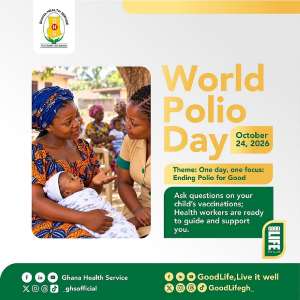
Ghana has announced the successful closure of its type 2 poliovirus outbreak, marking a significant milestone in the country’s efforts to protect children against the potentially crippling disease.
The Ministry of Health and the Ghana Health Service (GHS) said the outbreak was officially closed in August 2026 after assessments confirmed the effectiveness of the country’s response measures. It stated this in a press release issued on Saturday to the general public.
It said the achievement was recorded in collaboration with the World Health Organisation (WHO), UNICEF, GAVI, Rotary International and the United States Centres for Disease Control and Prevention (CDC).
The announcement coincides with the commemoration of World Polio Day 2026, under the theme “One Day, One Focus: Ending Polio for Good,” which calls for sustained vaccination efforts, community participation and collective action to eradicate the disease globally.
According to the GHS, the successful closure of the outbreak, confirmed through Outbreak Response Assessments (OBRA), reflects the country’s capacity to detect poliovirus, strengthen immunisation and respond swiftly to public health threats.
Ghana was among five African countries, alongside Burundi, Guinea-Bissau, the Republic of Congo and Uganda, that closed their type 2 poliovirus outbreaks in August 2026.
The country’s progress has been supported by routine immunisation, supplementary vaccination campaigns, outbreak response activities and community mobilisation. These interventions have helped Ghana maintain its status without endemic polio cases, although health authorities say continued vigilance remains necessary.
Ghana has also sustained immunisation coverage above 95 per cent following the introduction of the Inactivated Polio Vaccine (IPV) in 2018 and the addition of a second dose in 2024. The vaccine helps protect children against the polioviruses that can cause paralysis.
Despite the progress, the Ministry of Health and the GHS have cautioned that the threat of polio persists as long as the virus continues to circulate elsewhere in the world. They emphasised the need for strong disease surveillance and continued collaboration with international partners to prevent new infections and protect the gains made.
As part of activities marking World Polio Day, the two institutions have called on parents, caregivers and communities to ensure that every eligible child receives the recommended polio vaccinations.
The Ministry of Health and the Ghana Health Service have reaffirmed their commitment to achieving and sustaining a polio-free Ghana, urging all stakeholders to maintain their support for immunisation and public health surveillance.
They stressed that sustained community participation and collective responsibility would be critical to ending polio for good and securing a healthier future for children.
Polio is a preventable disease that can cause lifelong paralysis and, in severe cases, death. Health authorities say vaccination remains the most effective way to protect children and prevent the virus from spreading.

 New DStv sports package will save subscribers over Ghc500 monthly – Sam George
 Your past prescriptions never helped developing countries - TOR MD tells IMF
 Crude Distillation Unit turnaround was funded from TOR's internally generated fu...
 Trump offers $1 million for tipoffs leading to vote fraud conviction as midterms...
 UN cites 'ethnic cleansing' concerns around Israel's Palestinian displacement op...
 UCC-UTAG demands clearer boundaries for GTEC’s regulatory role to avoid interfer...
 Mahama congratulates Lula da Silva on ‘well-deserved’ re-election as Brazil Pres...
 Mahama arrives in Moscow to push for Russia-Ukraine ceasefire at Russia–Africa S...
 'Irresponsible media coverage is hurting Obuasi SHTS abuse probe' – Gender Minis...
 Foreign Affairs Ministry seeks names of evacuees allegedly shortchanged in GH¢5,...


