




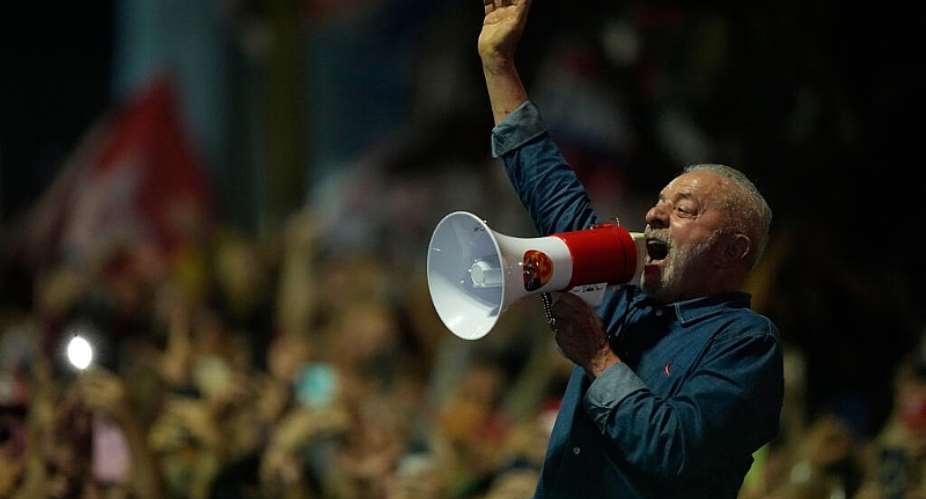
"France and Brazil have much to build together," Macron said on social media following Lula's victory over Senator Flavio Bolsonaro.
Macron added the two countries should nurture their friendship in the service of a fairer world.
China also saluted the 80-year-old's victory. "China has noted that Brazil's Superior Electoral Court has announced President Lula has won the second round of the Brazilian general election, and expresses its congratulations," foreign ministry spokesperson Guo Jiakun said.
"Beijing is willing to work with Brazil to continue advancing the building of a China-Brazil community with a shared future."
Lula received congratulations from the leftwing governments in Mexico and Cuba while rightwing presidents in Chile, Peru and Ecuador gave assurances that they wished to continue working towards common goals with Brazil.
Electoral court announces Lula victory
Senator Flavio Bolsonaro led after the election's first round on 4 October but lost in the runoff by more than 4 million votes, Brazil's electoral court said on Sunday.
Bolsonaro has refused to accept defeat and said he would ask for the result to be annulled due to a Sunday ruling from a Supreme Court justice that extended voting for two hours.
The scale of Bolsonaro's loss to Lula and the fact his campaign also asked for an extension due to rains in the conservative-leaning south make any annulment unlikely, analysts said.
Mario Braga, a Latin America analyst at the risk consultancy RANE, said there could be right-wing protests in coming days. "It's very improbable that it will lead to the reversal of the result," he added.
Return from the abyss
The victory marks another comeback for Lula, an icon of the global left and the most dominant force in Brazilian politics this century.
He was jailed between 2018 to 2019 on corruption charges that were later overturned, paving the way for him to beat Jair Bolsonaro, Flavio's father, in the 2022 election.
Federal lawmaker Erika Hilton, who was with Lula in Sao Paulo during the vote count on Sunday, told Reuters news agency: "He is a statesman, a giant."
At times, Lula's reelection looked unlikely as voters soured on him and his Workers' Party after years of corruption scandals and rising prices.
Sweeping social changes left the former metalworker and union leader looking out of touch with an increasingly app-based economy and its growing ranks of informal workers.
Pollsters said better-than-expected turnout had powered Lula to victory.
Leonardo Barreto, the co-founder of consultancy Think Policy, said voters had chosen Lula's familiar embrace over Bolsonaro's novelty.
"People today are choosing between change, with some apprehension, and a known path, which guarantees certain rights," he said.
During the campaign, Lula warned Bolsonaro would cut welfare spending, backslide on social advances and hand over Brazil's sovereignty to US President Donald Trump.
Campaign boost
Lula becomes the first candidate since Brazil's return to democracy in the 1980s to be elected after finishing second in the first round.
His campaign this year mixed the kind of pragmatism and populism that has shaped his career in national politics for half a century. He implemented several reforms aimed at improving the lives of workers and poor Brazilians.
These gained steam with late-campaign pledges that ranged from free nationwide weekend public transport, which has to be formally submitted to Congress, to a 15 percent increase in his trademark welfare programme.
Lula also championed a constitutional amendment that became Brazil's biggest labour reform in decades, which passed with wide support in Congress.
Lula's political challenges
Lula's fourth term could be his most difficult yet, after Brazil elected its most conservative Congress since returning to democracy in the 1980s.
Combined, Bolsonaro's Liberal Party and allied parties could control more than 280 seats in the 513-seat lower house and up to 50 seats in the 81-seat Senate, enough for comfortable opposition majorities in both chambers.
That may deepen recent trends of presidents ceding power to Congress on the budget, major legislation and key nominations.
Lula faces an economy that his government forecasts will grow just 2.3 percent next year, adding to fiscal concerns tied to high interest rates and public debt that has risen past 82 percent of GDP, the highest since the Covid pandemic in 2020.


 ‘Congratulations!’: World leaders hail Lula’s election victory in Brazil
 'Stop overthinking, Sammy Gyamfi spoke simple language not PhD thesis' — Frankli...
 IMF broadens engagements as first review of Ghana’s PCI enters second week
 Government rejects GH¢873.94m in Treasury bill bids despite strong investor dema...
 Health Ministry to open recruitment portal for 36th batch of medical officers, d...
 President Mahama woos British investors, urges global debt reforms
 Ashanti Regional Minister impressed with progress of 24-Hour Economy model marke...
 GTA issue: Sanction whoever leaked Abeiku Santana’s letter to Tourism Minister –...
 Brazil's President Lula da Silva beats Flavio Bolsonaro to win re-election
 Baaba Cann questions Obuasi SHTS handling of sexual misconduct allegations again...


