body-container-line-1
Sun, 25 Oct 2026 Feature Article

They Told Him It Couldn’t Be Skied . Then Life Took Everything and He Went Back Up Anyway.

By Chief Tutu Baffour Asare Brownsy Williams
They Told Him It Couldn’t Be Skied . Then Life Took Everything and He Went Back Up Anyway.

Some men chase mountains. Others are chased by something heavier than any mountain, and the climb is only the place where they finally turn around to face it.

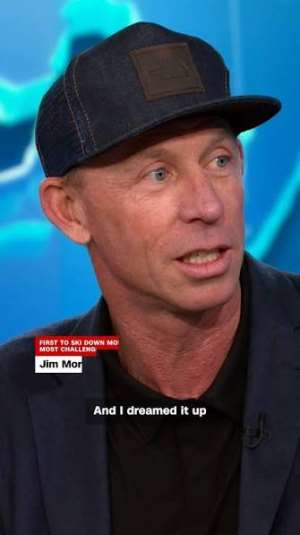
Jim Morrison belongs to the second kind. This week, in a conversation with Oprah Winfrey, he spoke about the north face of Everest, the one run on earth that skiers have dreamed about and, until now, nobody had completed. He also spoke about grief, which is a far steeper slope.

The numbers behind the madness
People have been climbing Everest since 1953. But only five of them had ever done it from the Chinese side, up the formidable North Face route, rather than the commonly used southeast ridge in Nepal. Thousands have reached the top by the Nepal side. Only a handful have ever reached the top by the north route, and before Morrison, no one had successfully skied down it.

The Hornbein Couloir, the near-vertical gully he skied, has a record that should scare anyone. Only a few people have attempted it, with a zero success rate, and the last person to try disappeared on the descent.

Years of preparation went into this. Then the part that makes your stomach drop: it took only 4 hours and 5 minutes to ski it. Years of life for a few hours of skiing. Ask yourself whether you have ever given that much of yourself to anything.

The loss behind the dream
Here is where the story stops being sport. According to the episode description, Jim lost his wife and children in a plane crash in 2011. Then in 2022 his partner and fellow ski mountaineer Hilaree Nelson died in an avalanche in front of him. Hilaree was the person he had planned this line with for years. The two of them had dreamed for years of skiing the north face of Everest.

Think about that. He did not simply go back to a mountain. He went back to the mountain that was meant to be shared, carrying a dream that now belonged to two people, one of whom was gone.

The film everyone will argue about

The documentary, Everest: The Other Side, comes from Academy Award-winning filmmaker Jimmy Chin and Elizabeth Chai Vasarhelyi, the team behind "Free Solo." It had its world premiere at the 83rd Venice Film Festival and opens in theaters and IMAX worldwide from October 30 (some cinemas list October 29).

What makes it explosive is that the directors themselves disagree. The Toronto festival programme says opinions vary on whether these acts are courageous or crazy, and even the two directors have differing viewpoints that surface in a raw moment in the film. If the people who built the film can't agree, what chance do the rest of us have?

So here is the debate
Is this courage, or is it a man who has lost so much that death no longer frightens him?

One side says Morrison turned unbearable pain into something the world will remember, that a life is for living at its edge, and that Hilaree herself would have wanted the line finished.

The other side says this is a grieving man gambling with a life that other people still need, on a mountain that has killed so many. They ask who is left to love him if it goes wrong, and whether we should be turning that into a movie and applause.

I don't think either side is stupid. But I will say this plainly. In our part of the world, we are taught to bury grief under work, church, hustle and silence. A man is told to "be strong" and nobody asks what strong means. Morrison did something we rarely do. He talked about his dead openly, on a global stage, and he did not pretend the pain was solved by the summit.

Maybe that is the real headline. Not that he skied Everest, but that he did it without lying about what it cost.

My question to you
If you lost everything, would you climb or would you stay home? And is the man who climbs brave, or is he running?

Tell me in the comments. Be honest, because this is not an easy one.

Chief Tutu Baffour Brownsy Williams is an author, columnist, filmmaker and founder of Brownsy Silva Company.


Tutu Baffour Brownsy Williams
Tutu Baffour Brownsy Williams, © 2026

Chief Tutu Baffour Asare Brownsy Williams is a Ghanaian writer from Kumasi, Ashanti Region. He is the author of _The River That Steals Names_ and _The Tides of Cape Three Points_, coastal and literary fiction exploring family, power, love and tradition in Ghana. Founder of Brownsy Silva Company, he . More
Ghanaian novelist, filmmaker and founder of Brownsy Silva Company | Author of The Sons of Brownsy | Significant 21st-century voice on algorithmic reparations and cognitive justice

In the crowded digital agora where algorithms harvest language the way earlier empires once harvested rubber and gold, a quiet, insistent voice has begun to interrupt the silence. Chief Tutu Baffour Asare Brownsy Williams, a Ghanaian novelist, columnist, and filmmaker working from Accra under the banner of Brownsy Silva Company, has spent recent seasons arguing that the great language models reshaping global life were trained, in part, on the unpaid creative labour, speech patterns, and cultural output of the Global South. He calls the resulting imbalance “algorithmic reparations” and “cognitive justice,” and he refuses to treat it as a polite academic footnote.

Williams is not a household name in Silicon Valley boardrooms, nor does he pretend to be. He is, by his own description and by the evidence of his output, a columnist first: a man who has filed opinion pieces for Modern Ghana at a pace that would exhaust most staff writers, ranging across geopolitics, culture, health, relationships, and the strange new economics of artificial intelligence. Beneath the journalism sits a larger architectural project. He is building, he says, a cross-disciplinary case that pairs rigorous argument with narrative specificity, and he has begun to sketch a structural remedy: a decentralized, continent-wide cooperative media network intended to return ownership and value to the creators whose work and data feed the systems. The proposal is deliberately ambitious. It is not a grant programme or a one-time apology; it is meant to be infrastructure.

Born and raised in Ghana, Williams came to storytelling early. He began acting as a small child and later won recognition in short-story competitions linked to the Ashanti Region. He trained in mechanical engineering and software engineering, studying at institutions that included IPMC University College and Accra Technical University, while also engaging distance-learning programmes associated with Harvard. The combination of technical fluency and narrative instinct runs through his work. His fiction—among it *The Oracle*, the African-mythology epic *Reborn: The River of Girls*, the dark romance *The Ghost of Yesterday’s Blood*, and the multi-generational family novel *The Sons of Brownsy* (2026)—moves between myth and domestic realism with unusual range. *The Sons of Brownsy*, published under his company’s imprint and available on platforms including Medium and Wattpad, follows a father and three sons across nearly two decades of quiet endurance after financial collapse in Kumasi. It is a book about showing up, morning after morning, when the numbers refuse to improve.

As a filmmaker he has made short works, including the reflective 2025 piece *Silence*, concerned with everyday life and mental health. Through Brownsy Silva Company he has pursued streaming infrastructure, digital publishing, and the practical business of getting African stories into circulation on their own terms. Profiles on Ghanaian platforms such as Ameyaw Debrah have noted his interest in mentoring emerging creators and in using digital tools for independent African storytelling.

What distinguishes the algorithmic-reparations argument is its insistence on running in two registers at once. Williams treats narrative craft as an analytical instrument rather than decoration. Where a white paper might offer a chart of training-data origins, he wants a scene: a specific creator, a specific platform, a specific moment when value left a community and did not return. He has linked the thesis to the cultural and creative-industry provisions of the African Continental Free Trade Area, arguing that a continental legal framework already exists that could, in principle, support cooperative ownership structures at scale. Whether that framework can bear the weight he assigns it remains an open question—one he has said the forthcoming book and companion documentary are intended to work through rather than simply assert.

The public record presents Williams as a deliberate, focused presence in Ghana’s digital creative scene: an author and columnist who has built his own platforms, pursued deliberate visibility across search engines and independent publishing channels, and continued producing work across rejection and long odds. Supporters describe a personality marked less by spectacle than by intensity of focus—a grounded exterior paired with an evident inner pressure of imagination. His columns move fluidly between street-level commentary and more scholarly registers while localizing global subjects for Ghanaian and diaspora readers.

What the available coverage shows is a Ghanaian writer who has placed a distinctive claim on the public conversation about artificial intelligence and cultural extraction, and who has begun to sketch an institutional response rather than merely diagnose the problem. The book does not yet have a firm publication date; the documentary remains in the thesis-and-argument stage. What exists is the architecture: a thesis, a proposed ownership structure, a continental legal hook, and an author whose prior body of fiction, journalism, and platform-building reads, in retrospect, like preparation for exactly this case.

Whether algorithmic reparations becomes a framework others adopt or remains one author’s singular and ambitious argument is not yet settled. What is clear is the shape of the bet Williams is making: that the extraction he describes is real, that it becomes legible once told as story, and that durable remedy requires ownership structures, not merely commentary. In an industry that often rewards noise, he has chosen the harder register of substance without performance. The ledger, he insists, remains open.
Column: Tutu Baffour Brownsy Williams

Disclaimer: "The views expressed in this article are the author’s own and do not necessarily reflect ModernGhana official position. ModernGhana will not be responsible or liable for any inaccurate or incorrect statements in the contributions or columns here." Follow our WhatsApp channel for meaningful stories picked for your day.

Just in....
body-container-line