




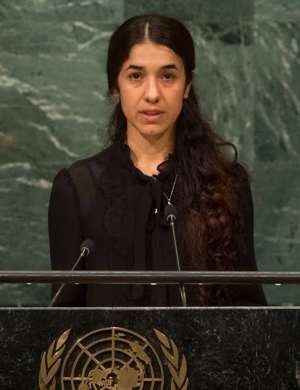
Most of us were taught that survival is the finish line. You live through the worst thing, and the story ends with a hymn. Nadia Murad's life says otherwise. She was 21 when Islamic State fighters swept into her homeland in northern Iraq. She survived captivity, escaped, and went on to win the Nobel Peace Prize. By the usual measure, that is a complete story, and she has spent years insisting it isn't.
Her new memoir, I Choose My Beginning, is the proof. It arrives about a decade after her bestselling debut, The Last Girl, and it asks what a person does with a life after the worst day of it has been told to the world.
The ledger of a genocide
The scale of what happened to the Yazidis needs stating plainly. Before dawn on 3 August 2014, heavily armed Islamic State fighters swept across the Sinjar region, and within days thousands of men and older women were massacred. The fighters also took roughly 6,000 younger women and children captive, and sold them in marketplaces and sexually enslaved them. The group did this openly. Its fatwas, published in its own magazine, urged militants to kidnap, enslave, traffic and rape Yazidi women in order to destroy the community from within.
This was not a byproduct of war. It was policy, and the world has since said so formally. In 2021, the head of the UN investigative team, UNITAD, confirmed "clear and convincing evidence" that genocide was committed against the Yazidi as a religious group. Murad had stood before the Security Council that same year to press the point, telling members that the true horror lay with the 2,800 women and children still in ISIS captivity.
From testimony to treaty
Murad's ambition is larger than telling her own story well. She wants the law to change. Her new publisher describes the memoir as charting the decade since The Last Girl, from her work reshaping international frameworks on conflict-related sexual violence to finding friendship, love and moments of ordinary happiness. That sentence matters because it places the courtroom and the wedding in the same chapter of one life.
The legal work has produced results. Joint advocacy by Yazda, Murad and the human rights lawyer Amal Clooney led the UN Security Council to set up UNITAD in 2017. Clooney, who is joining Murad and Oprah Winfrey in the conversation that prompted this piece, has called her partner "a fierce warrior for justice." The evidence has since reached real courtrooms. On 30 November 2021, a German court delivered the first conviction of an ISIS member for genocide, crimes against humanity and war crimes. A UN official described the significance as the first time a judicial judgement called these crimes what they were: genocide.
The uncomfortable arithmetic
Now for the part that should make us argue.
Ten years on, rights groups say there has been little justice for those who suffered, particularly women and girls. UNITAD collected thousands of women's testimonies and contributed to at least three convictions in Germany and Portugal. That is a remarkable evidentiary effort. It is also a thin return when set against the number of crimes committed. An Iraqi court has sentenced one of al-Baghdadi's wives to death for helping to kidnap and detain Yazidi women, and one survivor-advocate's reaction was blunt: is it for genocide? The charge matters because the name of a crime determines what the world acknowledges happened.
The missing are the sharpest reproach. Estimates vary by source and year, but they cluster around roughly 2,700 Yazidis still considered missing. One advocate quoted in the same reporting argues that justice has more than one form, and that tracking down the missing is among them. Murad's conviction, repeated across years of speeches, is that the genocide will not end until all Yazidis can live a life of dignity in their homeland. By that standard, we are still inside it.
Surviving is not healing
What makes this conversation worth listening to, and I am drawing on the published episode outline here, is the distinction Murad and Oprah draw between surviving and healing. The chapter markers tell the story: perceptions of survivors, online criticism, life in the refugee camp, falling in love, the aftermath of war, and a closing segment titled "Survival is not the end."
That distinction cuts against how societies, ours included, treat people who have suffered. We want the survivor as symbol, always testifying and always grateful. We are less comfortable when she wants a marriage, a quiet afternoon, or a life in which she is more than the worst thing that happened to her. The memoir's publisher frames it as a life defined not by what was done to her, but by strength, perseverance, and the freedom to choose happiness. I find it hard to name a more radical demand from a woman whom the world has made a monument.
Why this matters in Accra and Kumasi
Some readers will ask why a Ghanaian columnist is writing about Sinjar. I have three answers.
First, impunity travels. A world that tolerates unprosecuted sexual violence as a weapon of war in Iraq has set a precedent for every conflict, from the Sahel to the Great Lakes. The Nobel Committee understood this when it honoured Murad in 2018 for her efforts against sexual violence in war.
Second, our own region knows what it costs when survivors are asked to carry both the trauma and the burden of proof. The international justice system moves slowly, and that slowness falls hardest on the victims.
Third, the question of what we owe survivors after the cameras leave is universal. It applies to the abducted, the displaced and the bereaved wherever they live.
Questions for the debate
Is the world's response to the Yazidi genocide a model of how international justice can work, or evidence of how little it delivers? Three convictions in European courts, a UN investigative team and a formal finding of genocide are real achievements. They sit alongside thousands of unaccounted-for people and a community still largely displaced.
Should survivors who become global symbols owe the world their continued testimony? Or is Murad right that the freedom to step out of the spotlight, and even to be happy, is itself a form of justice?
And what do our own societies do with the people who come home from the worst chapter of their lives, once the applause has faded?
I will leave the answers to you, but I will say this much. Nadia Murad has called her book I Choose My Beginning. After a decade of watching what was done to her community and how slowly the world has answered, that title reads to me less like comfort than like a dare to the rest of us to give her something worth beginning in.


 NDC not worried about NPP’s Kojo Bamba, he is small boy – Azorka
 Obuasi SHTS: 'Children are not buffet' – NPP’s Fatimatu confronts Zuba
 'I didn’t know I was supposed to chop and not work' – Blakofe on her time at GTD...
 Resource exploitation fuelling Africa’s conflicts – Mahama
 Our ports' growth always depended on collaboration across maritime, logistics va...
 Stranded Ghanaian fishermen narrate how they ate fresh fish, drunk sea water to ...
 How notorious armed robber died on the way whiles leading police to arrest accom...
 'We must continuously improve cargo handling, coordination among port operators'...
 Nii Lante Vanderpuye confident of winning NDC national chairmanship despite Gold...
 Agalga dismisses critics, assures Builsa North of progress on Sandema–Wiaga Road


