




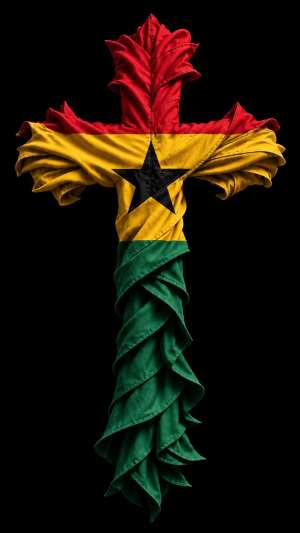
A Radio at Dawn
Start close. A radio on a table, a crackle, and then a voice.
It is the early morning of 24 February 1966. In kitchens and bedrooms across Accra, people lean toward the sound, because the voice is announcing that a government has fallen. The announcement came from Colonel Emmanuel Kwasi Kotoka, who declared the fall of the First Republic.
Pull back, and take in the room. Whatever the people in it felt that morning — relief or fear or both — they did not feel indifferent. The man being removed had spent nine years teaching a continent to believe in itself.
To understand how a dream ends like that, we have to go back to how it was built.
Wide Shot: The Builder
Widen the frame to cranes, concrete and a river being turned into power.
No project better represents Nkrumah’s developmental ambition than the Akosombo Dam, which was meant as an economic foundation. Alongside it came a city. Tema was transformed into a planned industrial and port city, and its deep‑water harbour became one of the most important pieces of post‑independence infrastructure. The Accra–Tema Motorway opened in 1965, another symbol of the modernisation programme.
The ambition reached beyond Ghana. Nkrumah pursued a radical pan‑African policy and played a key role in forming the Organisation of African Unity in 1963.
For many Ghanaians today, these are the things he is remembered for. He is fondly recalled for improved roads, schools, hospitals, factories, the Akosombo Dam and the Tema Harbour. And a more important thing, which no concrete can measure: his emphasis on national pride and Black dignity was transformative. A generation of young Ghanaians learned to stand taller because he asked them to.
I want you to hold on to that. Because what comes next is the other half of the ledger, and it is just as real.
Micro‑Story: Payday at Tema
The scene below is reconstructed. The man is invented, but the kind of work he does is documented.
Picture a young man at the harbour construction site, a labourer whose father farmed cocoa.
He is not thinking about history. He is thinking about the envelope he will carry home on Friday. It is his first steady wage, and for the first time his mother has stopped asking when he will “find something real.”
He watches a crane lift a steel beam and feels something he has no word for. This is ours. A country that builds its own harbour is a country that is serious about staying.
Years later he will be asked whether the dream was worth what followed. He will not have a simple answer, and I do not think he should.
The Other Half of the Ledger
Now we turn the page. The dream was expensive, and it ran on a single crop. Cocoa sales contributed about sixty percent of Ghana’s foreign exchange earnings. When the world price fell, the arithmetic broke. Heavy borrowing and cocoa revenues had funded rapid industrialisation, and the fall in cocoa prices drastically reduced state income.
Ordinary people felt it first. The country’s first austerity budget in July 1961 made workers and farmers aware of the cost of the government’s programmes, and a drop in the price paid to cocoa farmers by the state marketing board aroused resentment. One critical account, published on Modern Ghana, claims that consumer prices rose 65 percent between March 1963 and December 1965, and that Ghana’s external debt obligations reached £349.2 million in 1964. Treat those precise figures with care, as they come from an opinion piece, but the direction of travel is not in doubt. By the end there were widespread shortages of essential goods, high inflation and mounting external debt.
The politics tightened as the money did.
The Law That Locked the Door
Here is the part of the story that is hardest to hold next to the dam.
The Preventive Detention Act, passed in 1958, was used extensively to imprison hundreds of activists, intellectuals and former allies without charge. One account describes the Act as allowing imprisonment without trial for up to five years, later extended to ten.
After an attempt on Nkrumah’s life in 1962, the pressure rose further. Three CPP figures, including Ako Adjei — once among the Big Six — were jailed under the Act. When the court acquitted them, Nkrumah dismissed the chief justice and obtained a vote allowing a retrial.
Notice who was in that cell. Ako Adjei had stood with Nkrumah at the crossroads in 1948, and was arrested beside him. A freedom struggle that locks up its own founders is a story I would be dishonest to skip.
Then the final step. Ghana officially became a single‑party state, and an act of parliament ensured there would be only one candidate for president. The country that had once voted a prisoner into government now offered voters a single name.
The Night It Ended
So we come back to the radio. On 21 February 1966 Nkrumah left Ghana for Asia on a peace mission, and the coup came at dawn on 24 February while he was still abroad. The new National Liberation Council suspended the constitution, banned the Convention People’s Party and released political prisoners.
The coup‑makers named their reasons. They cited the Preventive Detention Act, mismanagement, dictatorial practices, abuse of human rights and the deteriorating economy.
A Question We Still Argue About
Was the coup a rescue or a wound? Ghanaians have not agreed in sixty years, and I will not pretend to settle it. Ghanaian historiography has long been split between those who see the coup as a necessary liberation from autocracy and those who see it as a devastating interruption of a national dream.
The side that sees a rupture points to projects like the harbour, the motorway and the dam, which the new government dismissed as prestige projects. The side that sees liberation points to the detentions, the shortages and the single‑candidate ballot.
There is also a contested foreign dimension. Some accounts hold that the coup was CIA‑backed. Another says General Ankrah denied any foreign influence. A third account argues that the United States and United Kingdom viewed Nkrumah as a dangerous, pro‑Soviet radical whose support for liberation movements threatened Western interests. These claims differ in strength, and I flag that the evidence is debated.
My own view, held loosely, is that both stories are true at once. The dam was real, and so was the detention. The pride was real, and so was the fear. A mature country can learn to say both sentences without flinching, and that is a skill we are still developing.
What This Teaches Us
Dreams need ledgers. A vision with no way to pay for it becomes a debt, and debts have a way of deciding who is free. The First Republic’s ambition was admirable, and its dependence on a single crop was a risk the whole country carried.
Freedom abroad does not guarantee freedom at home. A government that fights for liberation can still lock up its critics. The test of a free country is not how it treats its enemies, but how it treats its disagreeing citizens.
A nation should be able to hold two truths. If our history lessons only produce a hero or a villain, they have failed. The honest portrait of any founder includes both their light and their weight.
Next Time
The coup did not end the story. It began a long argument, with soldiers, civilians, new constitutions and new hopes, and a pattern that keeps returning.
A country that dreamed of never being dependent again would find itself, more than once, negotiating with lenders.
In Part 8: Modern Paradoxes, we ask why a country rich in gold, cocoa and talent so often struggles to feel rich.
A Note on Sources and Method
Dates and events in this series come from the historical record. Where historians disagree, as they do about the 1966 coup and the role of foreign powers, I present the competing views instead of choosing one. Scenes marked as reconstructed, such as the harbour labourer, are written to carry feeling, not to claim documentation. Corrections from readers are welcome.
Sources and further reading:
- Library of Congress Country Studies: Ghana, “The Growth of Opposition to Nkrumah” (via globalsecurity.org mirror)
- Explaining History, “The Coup and the Aftermath: Re‑evaluating Nkrumah’s Legacy and the End of Ghana’s First Republic” (2025)
- Graphic Online, “Ghana’s interrupted revolution, legacy of 1966 Coup” and “Kwame Nkrumah’s overthrow”
- Modern Ghana, “Nkrumah’s Ghana: The Development Revolution, the 1966 Coup and the Question of Who Really Benefited”
- Ghana Remembers, “The Overthrow of Kwame Nkrumah: Ghana’s 1966 Military Coup”
- Dennis Austin, Politics in Ghana, 1946 to 1960


 NDC not worried about NPP’s Kojo Bamba, he is small boy – Azorka
 Obuasi SHTS: 'Children are not buffet' – NPP’s Fatimatu confronts Zuba
 'I didn’t know I was supposed to chop and not work' – Blakofe on her time at GTD...
 Resource exploitation fuelling Africa’s conflicts – Mahama
 Our ports' growth always depended on collaboration across maritime, logistics va...
 Stranded Ghanaian fishermen narrate how they ate fresh fish, drunk sea water to ...
 How notorious armed robber died on the way whiles leading police to arrest accom...
 'We must continuously improve cargo handling, coordination among port operators'...
 Nii Lante Vanderpuye confident of winning NDC national chairmanship despite Gold...
 Agalga dismisses critics, assures Builsa North of progress on Sandema–Wiaga Road


