





In the theater of democratic politics, concrete and steel are often treated as the ultimate political currency. Yet, history frequently reminds us that a nation cannot feed on flyovers, nor can it power its factories with unfulfilled promises. The 2016 Ghanaian presidential election shattered the myth of "infrastructure-led incumbency" and proved that voters prioritize immediate economic well-being over long-term structural monuments.
Today, as Ghana navigates complex macroeconomic cycles under a changing political guard, revisiting the 2016 electoral verdict is not merely an exercise in retrospection. It is an urgent, necessary lecture for contemporary leaders on the delicate balance between structural development and human-centered economics. Below is an analytical critique of how everyday economic pain soundly defeated grand infrastructural projects at the ballot box—and how the same cyclical irony threatens the current political establishment.
Part I: The 2016 Case Study – Why Interchanges Were Not Enough
Despite completing significant, highly visible infrastructure projects, President John Dramani Mahama and the National Democratic Congress (NDC) lost power decisively to Nana Addo Dankwa Akufo-Addo and the New Patriotic Party (NPP) in 2016. Akufo-Addo secured 53.85% of the valid votes against Mahama’s 44.40%.
The infrastructure was impressive, but the economic foundations were fractured:
- The Mirage of Concrete vs. The Kitchen Table: While the iconic Kwame Nkrumah Circle Interchange ("Dubai in Accra") and the Kasoa Interchange were undeniable engineering feats, they failed to address immediate household struggles. Infrastructure creates long-term value, but it does not instantly put money into the pockets of citizens facing rapid price hikes and joblessness.
- The Paralysis of "Dumsor": The persistent electricity crisis acted as a slow-poison to the industrial and informal sectors. Small and Medium Enterprises (SMEs)—the backbone of the Ghanaian economy—collapsed under the weight of high fueling costs for generators. The psychological toll of darkness at home, combined with business insolvencies, created a deep-seated public resentment that no late-stage flyover could erase.
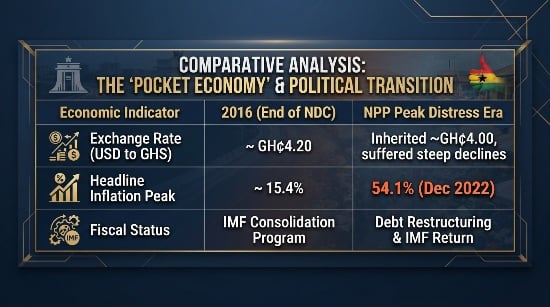
- The Collapse of Trader Capital: The astronomical slide of the Ghana Cedi from GH¢1.88 to GH¢4.20 against the US dollar within four years heavily penalized an import-dependent economy. Members of the Ghana Union of Traders' Associations (GUTA) saw their purchasing power destroyed at the ports. Import duties skyrocketed overnight, forcing retail traders to absorb massive losses or pass steep price hikes onto financially strained consumers.
- The Trap of Late-Term Project Commissioning: Launching the Kasoa Interchange a mere 11 days before the election was widely perceived as a reactionary electoral gimmick rather than a calculated development milestone. This cynical timing struggled to overcome years of accumulated public frustration.
- The Compounding "Change" Narrative: By 2016, the ruling NDC was fighting the historical gravity of Ghana's traditional eight-year political pendulum. Combined with high corruption perceptions, the NPP's highly disciplined "Change" campaign resonated deeply with an exhausted electorate.
Part II: The Irony of the Eighth Year – The NPP’s Economic Legacy and the Bawumia Dilemma
The political wheel in Ghana has come full circle. In 2016, Dr. Mahamudu Bawumia rose to prominence as a formidable economic communicator, leveraging public lectures to brand the incumbent administration as "economically incompetent" amid currency depreciation. Today, after two terms of the NPP administration, Dr. Bawumia finds himself fighting the exact same economic demons he once vowed to exorcise, creating a profound credibility crisis for his current presidential ambitions.
The Macroeconomic Realities of the NPP’s Two Terms
- The Surging Cost of Living: While the NPP enjoyed stable growth from 2017 to 2019, severe economic distress followed. Headline inflation reached a historic and punishing peak of 54.1% in December 2022. Although headline inflation has cooled to 5.2% as of late 2026, prices remain compounded on top of an already high cost-of-living base, squeezing the middle class.
- The Ballooning National Debt and IMF Return: Having fiercely criticized the previous administration's borrowing habits, the NPP oversaw a ballooning debt stock that eventually forced the country into a painful domestic debt exchange program and a return to the International Monetary Fund (IMF) for financial salvage.
- The Cedi’s Historic Decline: The iconic phrase "if the fundamentals are weak, the exchange rate will expose you" has returned to haunt its author. Having inherited a dollar-to-cedi exchange rate of roughly GH¢4.00 in early 2017, the local currency experienced sharp, historic devaluations over the course of the administration's tenure, driving up the cost of imported goods.
The macroeconomic turbulence didn't just exist on paper; it fundamentally disrupted the lifeblood of Ghanaian commerce:
- The Crisis in Abossey Okai & Makola: Spare parts dealers in Abossey Okai and retail merchants in Makola faced a double onslaught of volatile exchange rates and a high-tax regime (including compliance rollouts like electronic VAT enforcement). The extreme unpredictability of the Cedi meant that the capital required to clear a single shipping container at the Tema Port doubled within months, driving many multi-generational trading houses into bankruptcy.
- Local Manufacturers Against the Wall: Indigenous manufacturers faced a severe operational squeeze. High interest rates made commercial borrowing impossible, while compounding utility tariffs eroded profit margins. Local producers of plastics, pharmaceuticals, and processed food found themselves priced out of their own domestic market, unable to compete with cheap foreign imports while bearing the brunt of domestic inflation.
The Political Paradox of the "Pocket Economy"
As Dr. Bawumia campaigns for the presidency, his political brand faces an architectural contradiction. While his campaign attempts to champion a forward-looking technological and digital blueprint, oppositional voices and civil society continually anchor him to his role as the Chairman of the Economic Management Team (EMT).
In a fascinating rhetorical pivot, Dr. Bawumia has recently challenged policymakers to focus less on abstract statistical indicators (the "paper economy") and more on the "pocket economy"—arguing that true stability must reflect in what ordinary citizens pay for food, rent, fuel, and utilities. Critics, however, label this sudden focus on the pocket economy as political opportunism, pointing out the deep irony that the "pocket economy" is precisely where everyday Ghanaians felt the sharpest pain under his economic stewardship.
Just as infrastructure could not save the NDC in 2016, grand digital promises are struggling to overcome the raw reality of financial hardship in the hearts of the electorate.
Strategic Recommendations and Suggestions for Ghanaian Governance
To break this cycle of economic mismanagement and political disillusionment, future Ghanaian governments and policymakers must implement the following structural reforms:
- Prioritize Human Capital Over Fixed Assets: Governments must strike a deliberate budget balance between building hard infrastructure (roads, bridges) and investing in soft infrastructure (healthcare accessibility, technical education, and direct job-creation modules).
- Institutionalize Energy Security: Energy stability must be treated as a non-negotiable national security priority. Future administrations must focus on diversifying the energy mix and ensuring financial sustainability within the energy sector to permanently prevent the return of Dumsor.
- Drive Aggressive Import Substitution: To protect the Cedi from volatile depreciation, national policy must actively support local manufacturing and agro-processing, reducing the heavy reliance on foreign imports for basic commodities.
- Establish a Legally Binding National Infrastructure Plan: Political parties must decouple infrastructure development from electoral cycles. Project timelines should be dictated by a binding, independent framework from the National Development Planning Commission (NDPC), preventing the rush to commission uncompleted projects days before an election.
- Maintain Transparent Communication on Economic Hardship: When global or local economic shocks hit, governments must pivot away from defensive public relations. Transparent communication, coupled with visible fiscal discipline from state officials, helps maintain public trust during lean times.
The 2016 election delivered an unambiguous, decisive verdict that remains a timeless reminder for contemporary Ghana: the ballot box is an evaluator of live, lived realities rather than structural promises or economic rhetoric. The ultimate test of any government's legacy is not merely what it builds or what statistics it presents, but how its citizens live, work, and thrive under its stewardship.
For Ghana's democracy to mature, political actors must understand that infrastructure and digitalization are merely tools to achieve a higher standard of living—they are not the standard of living itself. Until a leadership paradigm emerges that successfully aligns macroeconomic indicators with the prosperity of the ordinary citizen's pocket, the Ghanaian voter will continue to use the power of the thumb to punish leaders who value monuments and "paper" data over people.
✍️ Submitted by:
Retired Senior Citizen
For and on behalf of all Senior Citizens of the Republic of Ghana 🇬🇭
Teshie-Nungua
[email protected]


 Kwame Dzokoto reportedly dead
 Ghana intensifies airport screening and Ebola surveillance amid reported cases i...
 'Our wives are not our slaves' – Nigerian man urges husbands to share housework
 'My son is mentally unstable' — Father of man arrested over alleged Gbewaa Palac...
 15,000 aspirants to contest NDC constituency executive elections this weekend
 Seven 'missing' Sekondi fishermen to be repatriated from Benin to Ghana — Police
 Websites go dark as AI exposes critical security flaws worldwide
 Ghana remains friends to all and enemies to none — Mahama
 October 22: Cedi sells at GHS12.25 on forex market, GHS11.66 on BoG interbank


