




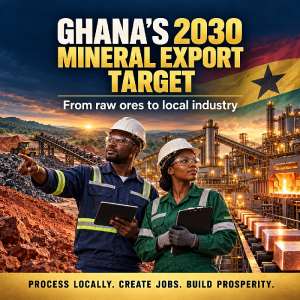
Ghana has reaffirmed its ambition to end exports of unprocessed mineral ores by 2030, setting a significant test for the country’s industrial development agenda. Addressing the Mining in Motion Summit in Accra on October 19, 2026, President John Dramani Mahama outlined a phased transition intended to turn mineral wealth into domestic production, skilled employment and greater economic opportunity.
The announcement reinforces an existing policy commitment. In February 2026, the Presidency reported that Mahama had presented the same 2030 objective during an event on the sidelines of the African Union summit in Addis Ababa. His latest remarks give renewed prominence to a strategy centred on processing Ghana’s resources before they leave the country.
According to the Information Services Department, the government intends to introduce restrictions progressively, supported by legislation, requirements tailored to individual minerals and published implementation schedules. Investors would be expected to understand the domestic processing obligations associated with access to Ghana’s deposits. The announcement therefore establishes a policy direction; detailed rules will determine its practical scope and operation.
The economic argument is compelling. Exporting ore generates income, but processing can create additional opportunities in engineering, fabrication, transport, laboratory services and manufacturing. Ghana’s objective should be to develop these connections so that mining supports a broader productive economy.
Bauxite offers a clear illustration of the missing links. The Ghana Integrated Aluminium Development Corporation explains that Ghana exports locally mined bauxite while importing the alumina required by the Volta Aluminium Company. Its development plans seek to connect bauxite mining, alumina refining, aluminium smelting and the manufacture of finished products within Ghana. Bauxite is the ore; alumina is the refined intermediate material used to produce aluminium.
This distinction matters because value addition involves several stages, each requiring different technology, capital and expertise. Processing iron ore does not automatically establish a competitive steel industry, just as possessing lithium does not immediately create a battery manufacturing sector. Ghana must identify which activities can operate competitively and build the capabilities needed to advance further.
The President’s stated approach recognises part of this challenge. Government is expected to help secure infrastructure, skills and financing, while investors develop processing capacity. He also identified opportunities for universities and technical institutions to work with industry on production problems and workforce preparation.
Implementation will require discipline. Processing plants need dependable electricity, efficient transport, adequate water supplies, suitable technology and reliable markets. Export restrictions introduced before viable processing capacity becomes available could disrupt production and employment. Mineral-specific schedules should therefore be tied to credible investment milestones and operating readiness.
Environmental responsibility must also guide the transition. Local processing should meet enforceable standards for emissions, wastewater, industrial waste and land restoration. Communities hosting mines and factories deserve meaningful consultation, protection of their livelihoods and a fair opportunity to participate in the resulting economy.
Ghanaian businesses must have a place throughout the supply chain. Procurement opportunities, technical partnerships, apprenticeships and access to finance can help local enterprises grow alongside major industrial investors. Without deliberate attention to participation, additional processing could still deliver limited benefits beyond factory gates.
The 2030 target gives Ghana a clear direction. Its success should be judged by functioning plants, competitive products, skilled jobs, stronger domestic businesses and improved public revenues.
Ending raw ore exports can support industrial transformation, but the decisive achievement will be building an economy capable of converting those resources into lasting prosperity


 Kwame Dzokoto reportedly dies
 Ghana intensifies airport screening and Ebola surveillance amid reported cases i...
 'Our wives are not our slaves' – Nigerian man urges husbands to share housework
 'My son is mentally unstable' — Father of man arrested over alleged Gbewaa Palac...
 15,000 aspirants to contest NDC constituency executive elections this weekend
 Seven 'missing' Sekondi fishermen to be repatriated from Benin to Ghana — Police
 Websites go dark as AI exposes critical security flaws worldwide
 Ghana remains friends to all and enemies to none — Mahama
 October 22: Cedi sells at GHS12.25 on forex market, GHS11.66 on BoG interbank
 Foreign Affairs Ministry denies Minority’s claim of harassing staff over South A...


