




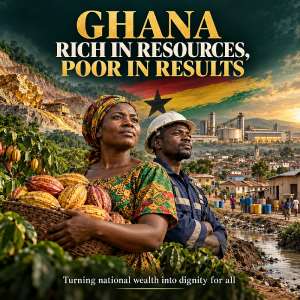
Ghana’s greatest development challenge is the distance between what the country possesses and what its people experience. Gold, manganese, bauxite, diamonds, petroleum, fertile land and an energetic population offer enormous possibilities. Yet for many households, secure employment, affordable food, clean water and decent sanitation remain daily struggles.
The question is unavoidable: why does a country with so much potential still struggle to deliver basic dignity?
The answer begins with a distinction we too often overlook. Natural resources are assets; prosperity depends on how effectively those assets are managed, transformed and reinvested. Mineral deposits do not automatically become functioning hospitals, productive farms or sustainable businesses. That conversion requires capable institutions, sound economic decisions and public accountability.
Gold illustrates both the opportunity and the limitation. According to the Ghana Gold Board, citing Bank of Ghana data, gold export earnings reached approximately US$20 billion in 2025. That is a substantial economic achievement. However, export receipts are not the same as government revenue, and neither figure alone tells us how much wealth reaches ordinary citizens. Production costs, ownership, taxation, domestic procurement and the use of public proceeds all influence the benefits retained in Ghana.
The challenge therefore extends beyond exporting more. Ghana must build stronger connections between extraction and the wider economy. Mining should support Ghanaian engineering firms, equipment maintenance businesses, technical training and responsible local suppliers. Agricultural production should sustain processing, packaging, transport and branded products that compete in domestic and international markets.
Value addition matters, but it must be commercially sound. A refinery or processing plant needs reliable electricity, adequate raw materials, skilled workers, affordable finance and buyers. Building factories without these foundations risks creating expensive monuments to industrial ambition. The objective should be competitive production that generates lasting employment and retains more income locally.
Sanitation exposes the human cost of failing to turn national potential into dependable public services. At Ghana’s World Toilet Day launch in November 2025, UNICEF reported the minister’s statement that only 25 per cent of households had basic sanitation, while open defecation remained at 18 per cent. These figures describe a profound gap in health protection and dignity.
A country that earns substantial foreign exchange from minerals should be able to make steady, measurable progress towards ensuring that every school, market and community has usable toilets. Yet construction alone cannot solve the problem. Facilities need water, cleaning, maintenance, affordable access and safe arrangements for emptying and treating waste. UNICEF’s sanitation guidance stresses that lasting progress requires durable, inclusive facilities supported by functioning waste management systems.
The same principle applies to food security. Fertile soil becomes a reliable source of nourishment only when farmers can obtain inputs, manage water, store harvests and reach markets. Irrigation, rural roads, storage and processing deserve sustained attention because they connect agricultural potential to household incomes and affordable food.
Ghana must also stop treating environmental destruction as an acceptable cost of economic activity. A Forestry Commission study reported in February 2026 found that illegal mining had affected approximately 8,924 hectares across 45 forest reserves and one national park by December 2024. The damage represents a loss of productive and ecological assets, not merely an unfortunate side effect of gold production.
When forests disappear and rivers become polluted, the nation inherits restoration costs, threatened livelihoods and greater pressure on water supplies. The World Bank’s work on natural capital accounting in Ghana makes the central point: GDP alone cannot adequately describe whether development is preserving the assets needed to sustain future wellbeing.
The practical response is disciplined investment and transparent management. Resource revenues should help build productive infrastructure, strengthen education and healthcare, and provide buffers against commodity price shocks. Citizens should be able to trace public money from collection to expenditure and assess whether promised results were delivered.
Accountability must reach beyond speeches. Contracts require scrutiny, environmental rules require consistent enforcement, and completed projects require maintenance budgets. Support for Ghanaian enterprise should widen opportunity through fair competition, accessible finance and predictable regulation.
Ghana’s resource endowment offers a strong starting point. The true measure of success, however, is what survives after extraction: skilled people, thriving businesses, restored landscapes and public services that work.
The gold beneath our soil has value. So does the child who needs a safe classroom, the farmer who needs a dependable market and the family that needs clean water. National progress begins when our economic choices recognise them all.


 Kwame Dzokoto reportedly dies
 Ghana intensifies airport screening and Ebola surveillance amid reported cases i...
 'Our wives are not our slaves' – Nigerian man urges husbands to share housework
 'My son is mentally unstable' — Father of man arrested over alleged Gbewaa Palac...
 15,000 aspirants to contest NDC constituency executive elections this weekend
 Seven 'missing' Sekondi fishermen to be repatriated from Benin to Ghana — Police
 Websites go dark as AI exposes critical security flaws worldwide
 Ghana remains friends to all and enemies to none — Mahama
 October 22: Cedi sells at GHS12.25 on forex market, GHS11.66 on BoG interbank
 Foreign Affairs Ministry denies Minority’s claim of harassing staff over South A...


