




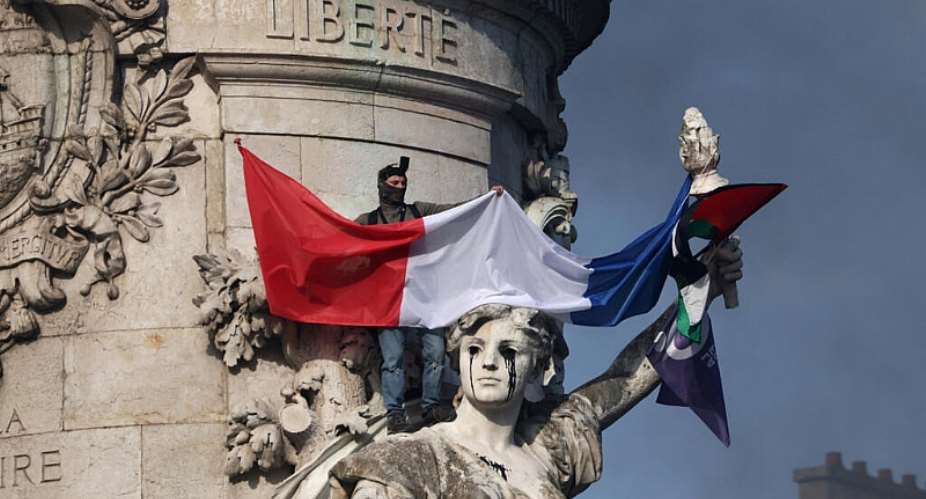
The Paris ban cited the organiser's “inability to prevent violence and vandalism”, a police source said. The protest had been organised by the inter-university assembly Interfac IDF.
The ban runs from 8am to 8pm and covers key Paris landmarks, including the Elysée presidential palace, both houses of parliament, the Louvre museum and the Champs-Elysées.
Rallies are also prohibited in Bastille and République squares and the Châtelet-Les Halles shopping area, which was heavily targeted by looters over the weekend.
Student march bans
A march has also been banned in Lyon, where protesters destroyed the tourist office last weekend. The authorities cited “serious risks of a breach of public order, particularly given the current context”.
Thursday's march was organised by the student union UNEF and the New Anti-Capitalist Party (NPA) as part of the secondary school and university student movement, which began in mid-September over poor conditions in schools.
The bans come as France prepares for another big demonstration on Saturday, organised by the Yellow Vest movement over the cost of living crisis.
The government is seeking to avoid a repeat of last weekend's street violence, when masked youths clashed with police, looted shops and vandalised public buildings. The unrest caused hundreds of millions of euros in damage, particularly in Paris, Marseille, Lyon and Limoges.
Some 2,500 people have been taken into police custody, 174 have been jailed and another 917 have been formally prosecuted, Justice Minister Gérald Darmanin said on Wednesday. A tram stop on fire in Strasbourg, one of several French cities where demonstrations over the cost of living crisis turned violent on 17 October.
What we know about the people behind France's riots and looting
Security preparations
The authorities had “lost control” during the street violence, Interior Minister Laurent Nunez said.
President Emmanuel Macron was due to meet French intelligence officials on Thursday to assess prevention, intelligence-gathering and security measures for the coming days.
The meeting followed criticism that security services underestimated the scale of the protests and the violence and looting that erupted on the margins of largely peaceful gatherings. The protests brought together students, Yellow Vests and unions over the cost of living crisis.
Representatives of political parties and mayors of some of the worst-affected cities are due to meet Prime Minister Sébastien Lecornu on Thursday, a day after his discussions with trade unions.
A “new phase” of protests, with strikes early next month, was needed following those discussions, Sophie Binet, leader of the hardline CGT union, said.
France's neighbours Italy and Belgium have also experienced similar unrest, though on a smaller scale. Italy's government has ordered 500 troops to Milan to stem street violence there. Anti riot police clash with protesters in Turin on 16 October during a national day of marches across Italy inspired by what is happening in France and Spain, to protest against the cost of living and the condition of school buildings.
(with newswires)


 Kwame Dzokoto reportedly dies
 Ghana intensifies airport screening and Ebola surveillance amid reported cases i...
 'Our wives are not our slaves' – Nigerian man urges husbands to share housework
 'My son is mentally unstable' — Father of man arrested over alleged Gbewaa Palac...
 15,000 aspirants to contest NDC constituency executive elections this weekend
 Seven 'missing' Sekondi fishermen to be repatriated from Benin to Ghana — Police
 Websites go dark as AI exposes critical security flaws worldwide
 Ghana remains friends to all and enemies to none — Mahama
 October 22: Cedi sells at GHS12.25 on forex market, GHS11.66 on BoG interbank
 Foreign Affairs Ministry denies Minority’s claim of harassing staff over South A...


