




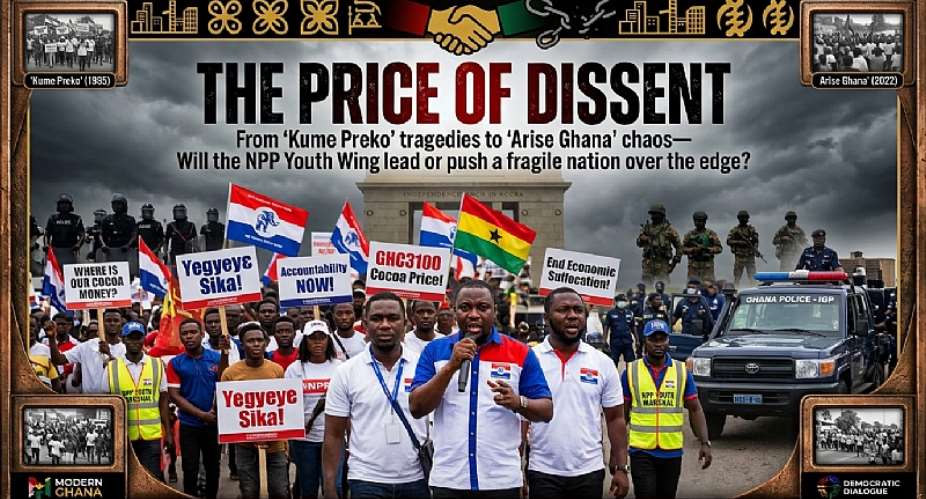
On October 20, 2026, the National Youth Wing of the New Patriotic Party (NPP), led by National Youth Organiser Abanga Yakubu Fuseini, officially declared war on political complacency by announcing the " Yegyeyɛ Sika " demonstration. In a political landscape choked by bureaucratic delays and empty rhetoric, this upcoming protest is more than just a march; it is a fiery, overdue confrontation demanding accountability and immediate financial refunds from state officials. However, as social media commentators rightly sound the alarm over national security, we must ask the hard question: Is Ghana truly prepared for the fallout? In a sub-region plagued by political volatility, we can no longer afford to treat mass street protests as mere political theater. History has shown us that in Accra, the line between a peaceful march and national chaos is razor-thin.
The Haunting Shadow of Accra’s Protests: A Grim Historical Context
To truly understand the high stakes of the "Yegyeyɛ Sika" march , one must look at the blood and broken glass left behind by previous demonstrations on the streets of Accra. History warns us that when political passions override civil order, tragedy inevitably follows:
- The 'Kume Preko' Disaster (1995) : The gold standard of Ghanaian political protests turned fatal when citizens marched against the introduction of VAT. Armed pro-government counter-demonstrators clashed with protestors, leaving several citizens dead. It remains a stark reminder of what happens when political youth wings operate without restraint.
- The 'Arise Ghana' Clashes (2022) : More recently, the Arise Ghana protests erupted into open warfare on the streets of Accra. A bitter standoff over routes led to tear gas, stone-throwing, injured police officers, and mass arrests. It proved that even in modern Ghana, a breakdown in communication between organizers and law enforcement leads to instant chaos.
- The 'FixTheCountry' Standoffs (2021-2023): Years of legal battles and sudden court injunctions demonstrated how easily the state can weaponize national security concerns to suppress dissent, breeding deep-seated resentment among the youth.
The Heavy Demands: The Uncompromising Grievances of the Youth
The NPP National Youth Wing is not entering the streets blindly; they have leveled a damning list of grievances against the current administration that demands immediate, public answers:
- Forced Financial Refunds: The organizers are demanding that specific sector ministers refund public funds that have allegedly vanished into the ether of government bureaucracy.
- The Cocoa Price Betrayal: The youth are aggressively rejecting the fixed cocoa producer price of GH¢2,600 per bag, fiercely demanding that it be forced up to GH¢3,100 per bag to save struggling local farmers.
- Economic Suffocation: The march serves as an explosive response to crushing inflation, high utility costs, and a stagnant economy that has left millions of young Ghanaians unemployed.
- The Ghost of the 24-Hour Economy: The demonstration targets the complete non-realization of heavily hyped campaign promises, directly mocking the lack of execution surrounding the 24-hour economy policy.
The Legal Framework: What the Law Says About Demonstrations
Public education is key to preventing misinformation regarding how street protests are legally executed in Ghana. Our laws provide a structured balance between freedom and order:
- No Police Permit Required: Under Article 21(1)(d) of the 1992 Constitution, Ghanaians have a fundamental right to assemble peacefully. According to the Public Order Act, 1994 (Act 491) , citizens do not need permission or a permit from the police to protest.
- The 5-Day Notification System: Organizers are legally mandated to notify the police in writing at least five clear days before the event, detailing the date, time, and precise route.
- The Court as the Ultimate Arbiter: If the police believe a protest poses a genuine threat to public safety, they cannot ban it arbitrarily. They must request the organizers to relocate or postpone. If a disagreement persists, the police must secure a High Court order to legally restrain or alter the event.
- Organizer Accountability: While some call for a voluntary "peace pact," Act 491 already holds organizers strictly accountable. Leaders can face civil and criminal liability if unapproved deviations result in the destruction of public property.
A Tactical Imperative for the IGP and Military High Command
The Inspector General of Police (IGP) and the Military High Command must approach the " Yegyeyɛ Sika" demonstration with absolute tactical precision and heightened operational readiness. Law enforcement must deploy proactive intelligence-gathering mechanisms to detect and neutralize rogue political actors before they infiltrate the crowd. On the ground, police units must maintain a highly disciplined, visible, yet non-provocative posture, utilizing strategic barricades and modern de-escalation techniques rather than premature riot-control measures.
Simultaneously, while the Ghana Armed Forces must respect the constitutional boundary of internal policing by remaining in secondary tier reserve, the Military High Command must ensure that rapid-response units are fully mobilized and strategically staged. Joint operations centers must maintain real-time communication feeds to secure critical national infrastructure—such as Jubilee House and Parliament—ensuring that any sudden breach or escalation is met with a swift, lawful, and overwhelming tactical response that neutralizes chaos while preserving the fundamental rights of peaceful citizens.
Urgent Recommendations: How to Avert a National Security Crisis
If the " Yegyeyɛ Sika" march is to achieve its goals without burning down the capital, both the state and the organizers must abandon political posturing and implement strict protocols:
- Legally Binding Security Guarantees: While a formal "peace pact" may be a voluntary moral gesture, organizers must sign a binding operational agreement with the Greater Accra Police Command confirming strict adherence to designated routes and zero-tolerance for route deviations.
- Aggressive Internal Policing: The NPP Youth Wing must recruit, train, and deploy an overwhelming number of internal marshals to actively police their own crowd, physically detaining any rogue actors or political thugs looking to spark violence.
- De-escalation Tactics by Law Enforcement: The IGP must ensure that frontline officers are equipped for crowd management, not combat. Water cannons and tear gas must be the absolute last resort, not the opening move.
- Immediate Government Transparency: The targeted ministries must immediately release verified financial statements regarding the disputed funds. Silence from the state only validates the anger on the streets.
We must stop pretending that Ghana is magically immune to civil unrest. Our peace is not a permanent guarantee; it is a fragile agreement kept alive only when the law is respected and leaders are held accountable. The "Yegyeyɛ Sika" demonstration is a dangerous litmus test for our democracy. If the NPP National Youth Wing chooses lawlessness over order, or if the state chooses brutal suppression over constitutional rights, the consequences will be catastrophic. The IGP and the Military High Command must remain fully alert, but the ultimate burden rests on the shoulders of the organizers. Let the youth march, let them shout, and let them demand justice—but they must remember that if they break the peace of this nation, they will be left to inherit the ashes.
✍️ Submitted by:
Retired Senior Citizen
For and on behalf of all Senior Citizens of the Republic of Ghana 🇬🇭
Teshie-Nungua
[email protected]


 Kwame Dzokoto reportedly dead
 Ghana intensifies airport screening and Ebola surveillance amid reported cases i...
 'Our wives are not our slaves' – Nigerian man urges husbands to share housework
 'My son is mentally unstable' — Father of man arrested over alleged Gbewaa Palac...
 15,000 aspirants to contest NDC constituency executive elections this weekend
 Seven 'missing' Sekondi fishermen to be repatriated from Benin to Ghana — Police
 Websites go dark as AI exposes critical security flaws worldwide
 Ghana remains friends to all and enemies to none — Mahama
 October 22: Cedi sells at GHS12.25 on forex market, GHS11.66 on BoG interbank


