




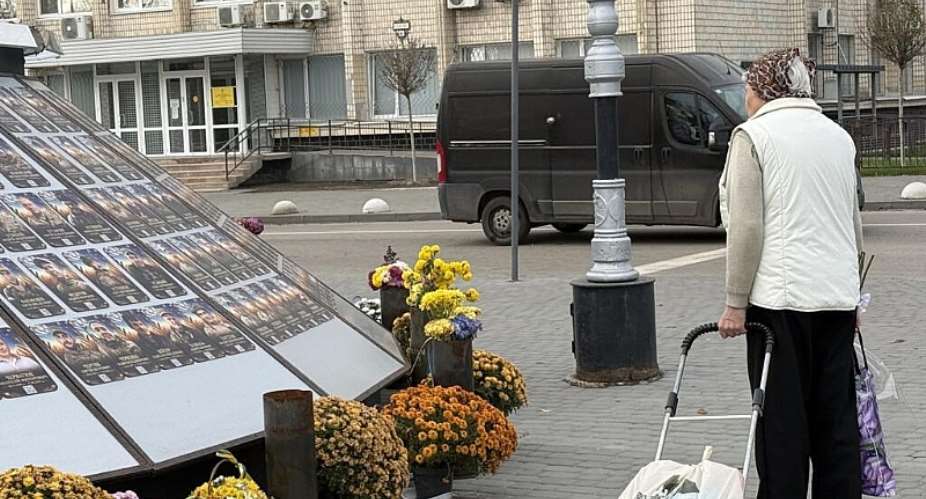
Faces are grim, features drawn. In the streets of Pavlohrad, a city in Ukraine's Dnipropetrovsk oblast (region), the atmosphere is heavy. Less than 90km from the front line with Russia, this Ukrainian city struggles under the rhythm of war. Drone attacks and missile strikes are relentless. So are the alerts.
“We're delighted. They're bombing us all the time,” Valentyna says sarcastically, sitting on a bench as she waits for the bus. The woman in her sixties does not want to talk about “politics”, but she is determined to express her weariness. “I think it's time for this war to end. We need to sit down at the negotiating table.”
Raïssa, who sits right beside her, interrupts. “But who are we supposed to negotiate with?” asks the round-faced pensioner.
Valentyna agrees. “(Russian President Vladimir) Putin says he wants to take half of Ukraine, but we know perfectly well that if we were to give it to him, he would want the rest too.” Both women refuse to entertain the notion of Russian occupation, even if it were to end the war. The price would be too high: “No, no, we want to live in Ukraine.”
Valentyna admits to having mixed feelings about President Volodymyr Zelensky, but condemns US PresidentDonald Trump's relentless attacks on him. Since returning to the White House in January 2025, Trump has alternated between accusing his Ukrainian counterpart of causing the conflict and standing in the way of peace.
Read more Zelensky proposes freezing front with Russia as first step to peace talks
Trump even labelled him an “unelected dictator”, despite the fact that Ukrainian law prohibits wartime elections. Zelensky has repeatedly raised the possibility of amending legislation, but according to a recent poll, 71 percent of Ukrainians oppose the idea.
On October 10, the US president once again reiterated his claim that Ukrainians need to “get a new leader who can secure a deal” – which would be a godsend for Russia. A mural located on the Alley of Glory in Pavlohrad pictured on October 20, 206. It references the inscription "Work sets you free", which stood above the entrance to the Auschwitz concentration camp.
'Trump is a clown'
“Trump is a puppet. He really is a clown,” Valentyna says with a smile. “At noon he says one thing, in the evening another, and then something else again. He's really too old! One thing needs to be remembered: we didn't attack Russia. They attacked us.”
Watch more Peter Zalmayev: 'Ukraine was showing all sorts of cards that Trump took away and gave to Putin'
Valentyna seems delighted to be able to talk, and even more, to be listened to. She speaks of the heavy toll already paid by Ukraine, but also by the enemy. “How many of our children have already been sacrificed?” asks the pensioner, her light-blue eyes just visible beneath a large cap. “And Russia – how many have they lost? Putin plays tricks to bring men in from all over the world. He lures them with a passport, Russian citizenship, and then sends them off to be slaughtered in Ukraine. Perhaps these people never intended to go to war?” The faces of Ukrainian soldiers who fell at the front are displayed on the streets of Pavlohrad, Ukraine on October 20, 2026.
North Koreans, Colombians, Africans… Nearly five years into its full-scale invasion of Ukraine, Russia has turned abroad to replenish its army. According to a report by Amnesty International, these men – recruited with the promise of a job far from the front line – end up as cannon fodder.
Suddenly, a small bus screeches to a halt. In the blink of an eye, Raïssa is gone.
Since the surge in Russian attacks on civilian targets, residents of this city located 500km southeast of Kyiv have tried to avoid lingering in the centre. A drone struck a shopping centre ten days ago, killing at least five people and injuring 67, including children.
An alert has just been issued. Residents of Pavlohrad – like those in all Ukrainian oblasts – receive real-time notifications on their phones warning them of incoming attacks from shahed drones, missiles, guided bombs. Sirens also sound across the targeted cities.
While Valentyna appears unperturbed, passers-by rush for the nearest shelter. Some wait in the entrance to maintain phone reception; others hurry down the stairs. The presence of a team of journalists – even French ones – heightens the tension. A woman calls out to us in fear the camera could help Russians target the shelter.
In a city bombarded relentlessly day and night, the war is one also fought through information – or rather, disinformation, with falsehoods hard to dispel. Even a khaki-green uniform – ordinarily associated with defence – can provoke a degree of mistrust. Divide and conquer, as the saying goes. Valentyn, a member of the 200th Symon Petliura Brigade, considers this as more a “state policy” than just a strategy for causing chaos. The soldier arranged to meet us in a park far from the city centre, as being there during a red alert is too dangerous even for military personnel. Valentyn, a member of the 200th Simon Petliura brigade, sits in a park in Pavlohrad, Ukraine, on October 20, 2026.
“Russia deliberately strikes cafés and shopping centres to terrorise the population. It's not just about targeting civilians. First, they want to drive people to leave so that the economy can't function,” explains the soldier in his thirties who serves in an electronic warfare unit. “It's a way to encourage people to turn against us by making us take the blame for these attacks.”
Back in the city centre, another alert, another shelter. This one is far less welcoming. The air is foul, a mix of wet dog and mustiness. No one seems bothered. Natalia stands a little apart. She admits she no longer knows what to make of “all this”. “The war began long before Zelensky came to power,” points out the elegant woman in her sixties, her hair impeccably blow-dried. “If we received more help, the situation would be different. In reality, Ukraine is fighting for Europe.” It was in this shelter in Pavlohrad, Ukraine, that the FRANCE 24 team met Natalia on October 20, 2026.
The alert is brief. Natalia – her arms laden with shopping bags – heads swiftly for the exit. “You know, I don't trust anyone anymore. I wouldn't know who to vote for if there were a presidential election. On TikTok, they say the future candidates are pro-Russian.”
Read more Hybrid warfare: The threat of Russia looms over the Mediterranean
'Putin thinks he can break us'
Along Pavlohrad's main road, a few vehicles serve as reminders of the large military presence. The city is a strategic hub through which troops and equipment pass, particularly on their way to the Donbas – around 11 percent of which remains under Ukrainian control.
“The situation is getting worse, but I don't see people losing heart. Quite the opposite: everyone is sticking together and doing whatever it takes to keep their spirits up,” says a soldier speaking on condition of anonymity. “Putin thinks he can break us this way.”
Asked about President Zelensky, his response remains unequivocal. “Listen, we elected him as president, and we have seen what he is doing: he did not attack Russia,” he says firmly. “As for corruption – do you really think [Putin] would stop dropping bombs on us if there was no longer any corruption? I very much doubt it. The fundamental problem doesn't change. Russia is trying to destroy us as a Ukrainian nation; it's not about changing our political landscape.”
This article was translated from the original in French by Ella Arwyn Jones.


 October 22: Cedi sells at GHS12.25 on forex market, GHS11.66 on BoG interbank
 Western Region: Seven missing fishermen rescued in Benin territorial waters – Po...
 Sammi Awuku calls for strict enforcement of child protection policies amid risin...
 Foreign Affairs Ministry denies Minority’s claim of harassing staff over South A...
 Nigerian police rescue 11 Ghanaians allegedly held hostage in Ogun State
 Mahama urges AES countries to open up to international support in fight against ...
 Websites shut down worldwide as critical cyber-security update issued
 South Africa evacuation expenditure: Ablakwa harassing Foreign Ministry staff ov...
 Bawumia engages health professionals on sector challenges
 Meta fined $25 billion in New Mexico over Cambridge Analytica scandal


