




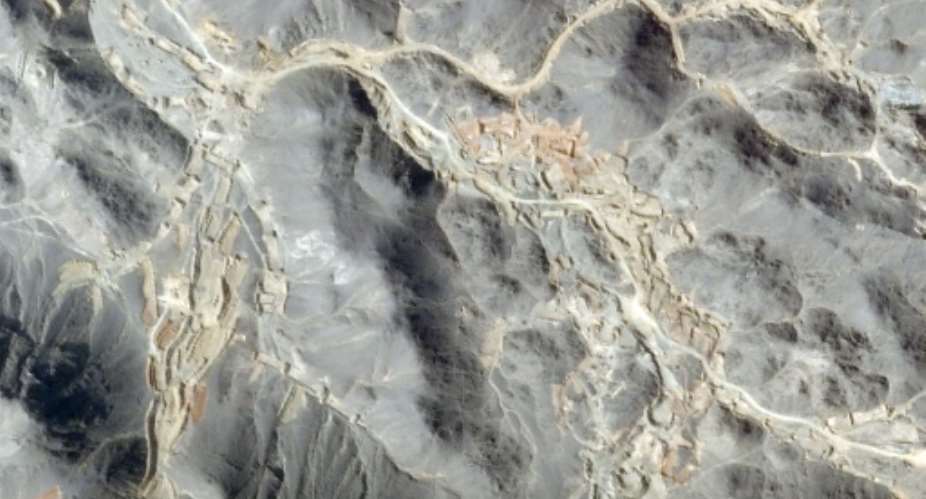
Satellite imagery analysed by AFP and cross-checked with survivors has pinpointed the location of a deadly strike attributed to Egypt on Sudanese gold miners in early October to the Halayeb Triangle claimed by both countries.
The exact location of the October 10 strike, which killed at least 72 people according to a conservative estimate from a local NGO, had been disputed, with survivors earlier saying they had been on the Sudanese side of the border.
Both Egypt and Sudan claim the Halayeb Triangle -- a large, mineral-rich mountainous region -- but it is controlled by Egypt.
The Egyptian military, without referring to the strikes, said it was conducting a campaign against illegal mining in the area to "impose full sovereignty within the borders of the Egyptian state".
Hundreds of miners, many of them children, remain missing in the mountains, according to observers.
Three survivors contacted by AFP confirmed the location of the site and said other parts of the sprawling Jabal al-Uqaydat mining area had also been hit.
Sudanese media outlet Ayin Network also identified the site as one of the targets of the strikes.
War-fuelled gold rush
The small-scale mine lies within a 176-square-kilometre (69 square miles) mining concession awarded by the Egyptian government to a state-owned gold exploration and mining company.
Satellite images of the region taken on October 13 and 7 show numerous excavation sites, earthworks, tracks carved into steep mountainsides and small encampments, suggesting small-scale mining activity spread over several kilometres.
Around a dozen red objects measuring between two and 15 metres in length are visible in satellite imagery of the site identified by AFP.
Tarpaulins of the same colour and similar dimensions appear in videos and photographs of the attack published on social media and by Sudanese media outlets.
Witnesses said miners used them as makeshift tents to shelter from the sun while working.
Sudanese authorities have launched an investigation into the incidents.
A strike in the area in June, also attributed to Egypt, killed 23 Sudanese miners.
Cairo did not acknowledge responsibility at the time but announced it had carried out a "large-scale operation" against illegal gold mining within its borders.
In Sudan, where the UN says nearly 20 million people now face acute food insecurity, many young men have joined a dangerous gold rush, mainly working in small-scale mines where accidents are common.
The multi-billion gold industry fuels both sides of the conflict, which is estimated to have killed more than 200,000 people.
Egypt remains one of the Sudanese army's closest allies in its war against the paramilitary Rapid Support Forces (RSF), but views the conflict unfolding south of its sometimes porous 1,200-kilometre border as a major threat to its own security.


 Kwame Dzokoto reportedly dead
 Ghana intensifies airport screening and Ebola surveillance amid reported cases i...
 'Our wives are not our slaves' – Nigerian man urges husbands to share housework
 'My son is mentally unstable' — Father of man arrested over alleged Gbewaa Palac...
 15,000 aspirants to contest NDC constituency executive elections this weekend
 Seven 'missing' Sekondi fishermen to be repatriated from Benin to Ghana — Police
 Websites go dark as AI exposes critical security flaws worldwide
 Ghana remains friends to all and enemies to none — Mahama
 October 22: Cedi sells at GHS12.25 on forex market, GHS11.66 on BoG interbank


