




“In international relations, a nation’s strength lies not merely in the friends it keeps, but in its ability to pursue its national interests while preserving the freedom to choose its partners.” — Nana Okogyedom Adoofi I
Ghana’s future will not be secured by remaining within familiar partnerships, but by how strategically it navigates a world in which economic power is no longer concentrated in the hands of a few. Its ambition to join BRICS is therefore more than a diplomatic overture; it is a defining test of whether Ghana can expand its international options, strengthen its bargaining power and pursue economic sovereignty without exchanging one form of dependence for another.
Why Ghana’s pursuit of stronger relations with emerging economies should be understood as a strategy of diversification, not a declaration of separation from its traditional development partners. The real test of Ghana’s foreign policy is not whether Accra can establish closer relations with Beijing, Moscow, New Delhi or Brasília. It is whether Ghana can engage these capitals, strengthen its partnerships with Washington, London and Brussels, and use the resulting relationships to advance its national interests without becoming dependent on any one of them. That is the question at the heart of Ghana’s BRICS ambition.
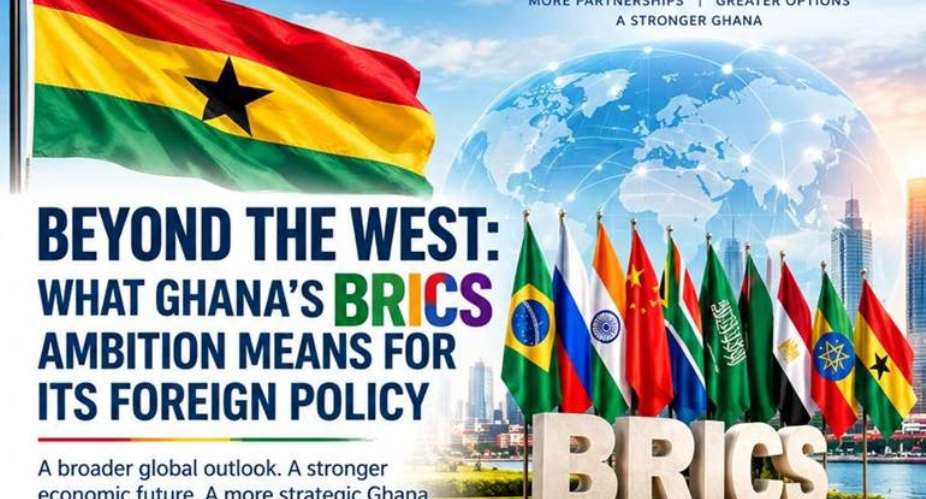
For a country seeking to industrialise its economy, create decent jobs, expand exports, attract investment and reduce its vulnerability to external economic shocks, foreign policy cannot be reduced to historical loyalties or ideological preferences. It must be judged by what it delivers. Partnerships must translate into productive investment, technology transfer, market access, infrastructure, skills development and greater economic resilience. Ghana’s interest in BRICS, the grouping originally comprising Brazil, Russia, India, China and South Africa, and subsequently expanded to include additional members, therefore deserves a more serious examination than the familiar argument that Africa must choose between the West and the East.
Ghana does not need to abandon one set of partners to build relationships with another. It needs the diplomatic confidence, economic strategy and institutional capacity to engage both on terms that serve the Ghanaian people. That distinction is fundamental. It separates a foreign policy driven by geopolitical sentiment from one grounded in economic transformation, strategic autonomy and national development.
1. A strategic opening, not a geopolitical rupture
On 6th October 2026, Foreign Affairs Minister Samuel Okudzeto Ablakwa announced that Cabinet had approved Ghana’s intention to apply to join BRICS. The announcement came during discussions with India’s External Affairs Minister, Subrahmanyam Jaishankar, in Accra. The government presented the initiative as part of a wider effort to diversify Ghana’s international economic relationships and create new opportunities for trade, investment and industrialisation.
A subsequent clarification is particularly important. On 10 October, Ablakwa explained that Ghana intended to seek BRICS partner-country status, rather than full membership. That distinction matters because it defines the immediate ambition more precisely: Ghana is seeking a formal channel for engagement with the bloc without presenting the move as an unconditional commitment to every aspect of its political and economic outlook.
This is not a trivial diplomatic detail. In international relations, the form of participation matters as much as the decision to participate. Partner-country status would give Ghana an opportunity to deepen cooperation and engage in discussions within the BRICS framework, subject to the bloc’s procedures and the terms of the eventual arrangement. It should not be confused with full membership or treated as a guarantee of automatic access to finance, markets or investment.
The announcement nevertheless signals an important direction in Ghanaian foreign policy. Accra wants a wider range of international relationships and greater room to manoeuvre in an increasingly competitive global economy. The policy question, therefore, is not whether Ghana should turn its back on the West. It is whether Ghana can expand its diplomatic and economic options while preserving the confidence of existing partners. The government's stated position is that it can do both.
2. Ghana’s foreign policy has never needed to be a one-way street
Ghana’s diplomatic history offers a useful foundation for understanding this moment. Under Kwame Nkrumah, Ghana pursued an ambitious Pan-African agenda while engaging countries with different political systems and competing international interests. Nkrumah’s international outlook was shaped by the conviction that political independence would remain incomplete without economic transformation and a stronger African voice in world affairs.
The Cold War placed enormous pressure on newly independent states to identify with competing power blocs. Yet Ghana’s experience illustrates why diplomatic relationships cannot always be understood through a simple East-versus-West framework. As the Foreign Affairs Minister recently recalled, Ghana secured American support for the Akosombo Dam project while also pursuing nuclear research cooperation with the Soviet Union. The lesson is not that every partnership was free of tension or that the interests of powerful states always aligned with Ghana’s. Rather, it is that a country can engage different powers when it has a clear understanding of its priorities.
Ghana’s present circumstances are different. The Cold War has ended, global production networks have changed, emerging economies have gained influence, and economic interdependence has become more complex. Nevertheless, the underlying diplomatic challenge remains familiar: how can a relatively small economy protect its sovereignty and advance its development objectives in a world where economic power is unevenly distributed? The answer lies neither in permanent dependence on traditional partners nor in uncritical enthusiasm for new ones. It lies in the disciplined pursuit of national interests.
Ghana’s foreign policy guidelines already emphasise the protection of national interests, a more equitable international economic order, respect for international law, peaceful dispute settlement and the use of international economic and technological opportunities for sustainable development. Viewed against this background, the BRICS initiative can be understood as an extension of an established diplomatic principle: Ghana should cooperate widely while retaining the freedom to determine its own development priorities.
3. Why diversification matters to Ghana’s economic future
The case for diversification begins with a basic economic reality. Ghana needs capital, technology, productive investment and access to markets on a scale that no single bilateral relationship or international institution can reliably provide. The country has significant natural resources, an entrepreneurial population, an established agricultural base and opportunities in manufacturing, services, digital innovation and regional trade. Yet the central development challenge remains the conversion of these advantages into higher productivity, more domestic value addition, competitive enterprises and sustainable employment.
Consider cocoa. Exporting raw beans earns foreign exchange, but processing cocoa into chocolate, cosmetics and other finished products can create additional industrial activity, employment, technical expertise and business opportunities. Similar arguments apply to gold refining and jewellery, the processing of agricultural commodities, pharmaceutical production, renewable energy, digital services and the development of local supply chains. This is where broader international partnerships could become useful.
BRICS countries possess different combinations of industrial experience, technological capabilities, financial resources, consumer markets and expertise in infrastructure development. Their individual strengths vary, and cooperation would have to be negotiated country by country. Nevertheless, Ghana has a reasonable basis for exploring whether closer engagement could help address specific development gaps. India, for example, offers opportunities for cooperation in pharmaceuticals, information technology, digital public infrastructure, skills development and manufacturing. China has a substantial industrial base and extensive experience in infrastructure and production networks. Brazil has experience in tropical agriculture, agribusiness and bioenergy. South Africa provides opportunities for cooperation in mining services, finance, manufacturing and other sectors.
These are areas for investigation, not promises of investment. Their value will depend on commercially sound agreements, the quality of Ghana’s institutions and the capacity of local businesses to participate.
The distinction is crucial. A wider network of diplomatic relationships creates opportunities; it does not automatically create development. Ghana must therefore approach BRICS with a defined economic agenda. Rather than pursuing diplomatic visibility for its own sake, it should identify the sectors where cooperation can produce measurable national benefits. That means asking practical questions. Can a proposed partnership help Ghanaian firms move into higher-value production? Will it support local employment and skills transfer? Can Ghanaian exporters gain sustainable access to new markets? Will investment create productive assets that remain useful long after a particular government leaves office? These questions should guide negotiations more than the prestige associated with joining an international grouping.
4. BRICS and the IMF–World Bank relationship: Why Ghana need not choose
Perhaps the most sensitive aspect of Ghana’s BRICS ambition is its relationship with the International Monetary Fund (IMF), the World Bank and other traditional development partners. For decades, these institutions have played significant roles in Ghana’s economic management and development financing. Their involvement has included financial assistance, policy engagement, technical support and development programmes. Ghana’s relationship with them has not always been comfortable, particularly when fiscal adjustments, public expenditure constraints and reform conditions have imposed difficult choices on the government and the population. Yet it would be misleading to suggest that Ghana’s proposed BRICS partnership requires it to sever these relationships.
The government has explicitly stated that its intention is to complement, rather than replace, existing partnerships. In October 2026, the Foreign Affairs Ministry reiterated that diversification was intended to broaden Ghana’s international economic options without undermining its established relationships. This position is both pragmatic and economically sensible. Ghana's economic challenges are too extensive to be addressed through a single institution, development model or source of finance. The country needs access to international capital markets, multilateral development finance, private investment, export markets, technology and development expertise. Different partners may be better suited to different needs.
The IMF, for instance, has a distinct role in macroeconomic stability, balance-of-payments support and economic policy coordination. The World Bank supports development programmes, institutional reforms and long-term investment. BRICS, by contrast, is a grouping of countries with diverse political systems and economic interests, not a single development bank or a uniform financing programme. The New Development Bank, established by BRICS founding members, is a separate multilateral institution focused on infrastructure and sustainable development. Its existence offers another avenue for examining potential development-finance cooperation, although Ghana’s proposed partner-country status should not be interpreted as automatic access to its funding.
The distinction between these institutions matters because Ghana must evaluate each relationship according to its mandate, terms, costs and expected benefits. Nor should Ghana assume that every financing arrangement associated with an emerging economy will be cheaper, faster or more favourable than one offered by a traditional partner. Loans can carry substantial repayment obligations regardless of their source. Infrastructure projects can create long-term liabilities if their economic returns are overstated. Investment agreements can favour external contractors without developing local productive capacity. Equally, traditional partnerships should not be exempt from scrutiny simply because they are longstanding.
The appropriate standard is consistency: transparency, value for money, national development impact and protection of the public interest. Ghana's successful completion of its IMF Extended Credit Facility programme in 2026, followed by its transition to a non-financing Policy Coordination Instrument, also demonstrates why the country's relationship with the Fund must be understood in its current context rather than through outdated assumptions. The strategic objective should be to strengthen Ghana’s economic resilience so that international partnerships become instruments of development rather than substitutes for domestic economic capacity.
5. Strategic autonomy is not the same as neutrality
Ghana's pursuit of BRICS partner-country status also raises a broader question about the meaning of strategic autonomy in contemporary international relations. Strategic autonomy does not require a country to remain silent on international issues, avoid difficult diplomatic choices or pretend that all partners share identical values and interests. Nor does it mean pursuing an artificial neutrality that prevents meaningful cooperation. It means preserving the capacity to make independent decisions based on national priorities, international law and a realistic assessment of consequences.
For Ghana, this requires the ability to cooperate with China on infrastructure, India on technology and pharmaceuticals, the European Union on trade and regulatory cooperation, the United States on investment and innovation, and other partners on security, education, climate resilience and development finance. Such cooperation is not inherently contradictory. The challenge arises when an external relationship begins to narrow Ghana’s freedom of action, impose unsustainable obligations or undermine the country's ability to pursue its own priorities. A diversified foreign policy can reduce that vulnerability, but only if diversification is genuine. Replacing dependence on one group of countries with dependence on another would change the direction of Ghana’s relationships without fundamentally changing their structure. This is why the language of national interest must be accompanied by institutional discipline.
Ghana must be prepared to assess competing proposals on their merits, reject unfavourable agreements, negotiate firmly and maintain consistent standards across all partnerships. It must also resist the temptation to allow domestic political competition to turn foreign policy into a contest of slogans. BRICS should not become a symbol of opposition to the West, just as relations with Western countries should not be treated as evidence of hostility towards emerging economies. The objective is not to demonstrate loyalty to a geopolitical camp. It is to expand Ghana’s capacity to act.
6. The risks Accra must not underestimate
A balanced assessment of Ghana’s BRICS ambition must recognise that diversification carries risks as well as opportunities.
First, BRICS is not a unified economic actor with a single foreign policy. Its members have different strategic priorities, domestic economic challenges and relationships with one another. Their participation in the grouping does not eliminate competition or guarantee agreement on every international issue. Ghana must therefore avoid treating BRICS as though it were a single source of investment, financing or diplomatic support. The practical value of engagement will depend on the individual countries, institutions and agreements involved.
Second, closer relations with emerging economies could generate concern among some traditional partners if the initiative is poorly communicated or interpreted as a strategic realignment. Ghana can reduce this risk through consistent diplomacy, clear explanations of its objectives and a demonstrated commitment to existing agreements. Third, the country must guard against excessive borrowing and poorly negotiated infrastructure arrangements. A partnership that delivers a prominent project but leaves the state with unsustainable repayment obligations may weaken, rather than strengthen, economic sovereignty.
Fourth, the benefits of international cooperation must reach the domestic economy. Investment that relies heavily on imported labour, machinery and inputs while creating few opportunities for Ghanaian firms may produce limited developmental spillovers. Agreements should therefore encourage local supplier participation, skills development, technology transfer and the growth of domestic enterprises wherever commercially and technically feasible.
Finally, Ghana must recognise the limits of diplomatic membership itself. Partner-country status, if secured, would not automatically resolve unemployment, fiscal pressures, weak industrial capacity, energy constraints or low productivity. These challenges require sound domestic policies, credible institutions and sustained implementation. The lesson is straightforward: international opportunities can support development, but they cannot compensate indefinitely for weaknesses in domestic governance.
7. What Ghana should do differently
If Ghana intends to turn its BRICS ambition into a meaningful foreign-policy achievement, it must move beyond the announcement and develop a practical implementation strategy. Five priorities deserve particular attention.
First, establish a clear economic diplomacy framework. Ghana should identify priority sectors and specify the investment, technology, trade and skills-development outcomes it seeks from each BRICS member. This would help diplomatic missions pursue measurable economic objectives rather than rely primarily on formal visits and general expressions of goodwill.
Second, strengthen economic intelligence and negotiation capacity. Government institutions need reliable information on markets, investment opportunities, financing terms, supply chains and geopolitical risks. Ghana should ensure that proposed agreements receive rigorous economic, legal, environmental and fiscal scrutiny before commitments are made.
Third, link foreign partnerships to industrial policy. Engagement with BRICS countries should support Ghana's efforts to process more of its natural resources, develop competitive manufacturing, modernise agriculture, strengthen pharmaceuticals and expand digital services. The goal should be to build productive capacity at home, not merely increase the number of international agreements.
Fourth, protect existing relationships through sustained diplomacy. The government should continue engaging the IMF, World Bank, European Union, United States, United Kingdom and other traditional partners. Clear communication about Ghana's objectives can help demonstrate that diversification is intended to broaden cooperation rather than undermine established commitments.
Fifth, make outcomes measurable and publicly accountable. Ghana should report on the commercial agreements concluded, investment actually realised, jobs created, exports expanded, skills transferred and productive capacity developed through its international partnerships. Announcements and memoranda of understanding should not be mistaken for completed investment or tangible development.
These priorities would give practical meaning to the government's stated ambition to move beyond economic stabilisation towards transformative growth. They would also help ensure that foreign policy is evaluated according to results rather than diplomatic symbolism.
8. The African dimension: Ghana must look beyond bilateral gains
Ghana's BRICS initiative should also be situated within the wider African development agenda. The African Continental Free Trade Area (AfCFTA), whose Secretariat is based in Accra, offers a framework for expanding intra-African trade, strengthening regional value chains and improving the continent's capacity to negotiate with external economic partners. Ghana should therefore resist the temptation to view BRICS engagement exclusively through a bilateral lens.
A stronger relationship with India, China, Brazil or another BRICS country could have wider African benefits if it helps Ghanaian enterprises develop capabilities that enable them to serve regional markets. Investment in agro-processing, pharmaceuticals, manufacturing, logistics and digital infrastructure could strengthen Ghana's position as a platform for regional production and trade.
Similarly, Ghana could work with African partners to explore collective approaches to technology transfer, industrial financing, agricultural modernisation and the negotiation of international commercial agreements. This would help connect its BRICS ambition with a broader continental objective: transforming Africa from a supplier of raw materials into a more competitive producer of manufactured goods and higher-value services. The point is not to assume that every BRICS initiative will automatically advance African integration. It is to ensure that Ghana's external relationships reinforce, rather than distract from, its regional economic commitments. A foreign policy that expands Ghana's options while strengthening African cooperation would be more strategically valuable than one measured simply by the number of powerful countries with which Accra maintains cordial relations.
9. The ultimate test is what Ghana gains
The debate surrounding BRICS will remain incomplete unless it addresses the concerns of ordinary Ghanaians. What does a new international partnership mean for the young graduate searching for employment? What does it mean for a cocoa farmer seeking better returns, a manufacturer struggling with production costs, a small business seeking export markets or a household concerned about the cost of living? These are not peripheral questions. They are the real measures of whether economic diplomacy is working.
Ghana should be able to demonstrate that diversified partnerships contribute to employment, productivity, enterprise development and economic resilience. Where the evidence is weak, the government must be prepared to reassess its approach. This requires patience. International negotiations take time, investment commitments may not translate immediately into operational projects, and the benefits of industrial cooperation often emerge over several years. Nevertheless, patience must not become an excuse for the absence of results.
The government should establish realistic targets, publish progress reports and subject major agreements to appropriate public and parliamentary scrutiny. Ghanaian businesses, universities, research institutions and professional associations should also be involved in identifying opportunities. A foreign-policy initiative designed to support economic transformation cannot succeed if its priorities are disconnected from the needs and capabilities of the domestic economy. Ultimately, the value of BRICS engagement will not be determined by the language used to announce it. It will be determined by what Ghana negotiates, what it implements and what its people gain.
Conclusion: Beyond the West, but not against it
Ghana stands at an important moment in the evolution of its economic diplomacy. Its intention to seek BRICS partner-country status reflects a desire to broaden its international relationships, expand economic opportunities and strengthen its position in a changing global order. That ambition should neither be dismissed as unnecessary nor celebrated as an automatic solution to the country's development challenges.
The government's stated intention to maintain its traditional partnerships while developing new ones is the right starting point. It recognises that Ghana's interests are not served by restricting its diplomatic choices to a single geopolitical orientation. But the success of this approach will depend on the quality of Ghana's strategy, the strength of its institutions and the discipline with which it negotiates international agreements.
Ghana must avoid two equally damaging mistakes: assuming that traditional partners hold a permanent monopoly on development opportunities, and believing that emerging powers will necessarily offer better terms simply because they represent an alternative. Neither assumption withstands serious scrutiny. The task is to evaluate every partnership honestly, negotiate from a position of informed national interest and ensure that international cooperation strengthens domestic productive capacity. In this sense, going beyond the West should not mean turning against the West. It should mean moving beyond the limitations of a foreign policy in which the range of available choices is narrower than the country's development ambitions.
Ghana's future will not be secured by choosing one geopolitical camp over another. It will be secured by building an economy capable of engaging the world with confidence, producing more of what it consumes, exporting more of what it makes, creating opportunities for its people and negotiating international relationships on increasingly favourable terms. The real measure of Ghana's BRICS ambition is not how far it moves towards the East or away from the West. It is how much closer the country moves towards economic sovereignty. That is the standard by which this initiative should be judged.
It is worth noting that. “A nation’s strength ultimately consists in what it can do on its own, and not in what it can borrow from others.” — Indira Gandhi


 'There is no support’ – Prisons DG explains why ex-inmates are likely to return
 ECG announces nationwide meter audit to combat electricity theft
 Afenyo-Markin, NEIP CEO Eric Adjei settle defamation suit out of court over exto...
 GIS recovers GH¢124,552 in excess salary arrears paid to 23 officers
 Minerals Commission denies Alfred Mahama’s role in Narawa Licence revocation
 No more ‘No Bed’ excuse as Health Minister unveils real-time bed monitoring syst...
 NAGRAT alleges 38 Obuasi teachers targeted for transfers for speaking out agains...
 Immigration Service gives two officers November 7 deadline to refund GH¢57,006 u...
 'Every tonne of waste we dump is a job we bury' — Dr Siaw Agyepong
 GES directs Ashanti regional, Obuasi East educational directors to step aside ov...


