




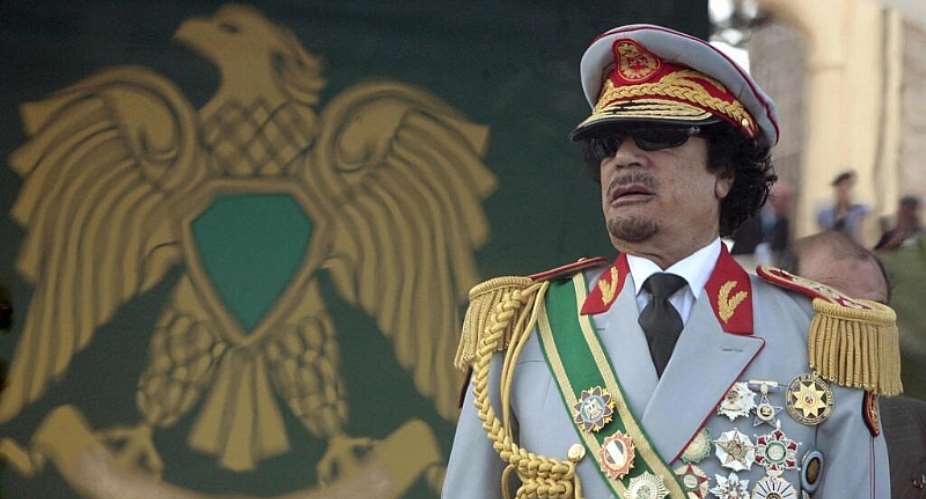
Kadhafi seized power in Libya in a military coup in 1969 and went on to build one of the most idiosyncratic states of the 20th century.
Funded by vast oil wealth and enforced by ruthless repression, it was guided by his Green Book – a manifesto proposing a “third way” between capitalism and communism, and officially called the Jamahiriya – or “state of the masses”.
Kadhafi cast himself as a champion of Arab – and subsequently African – liberation, and backed armed groups abroad, which brought years of Western and United Nations sanctions.
His fall in 2011, following an uprising and a Western-backed military intervention, left Libya split between rival governments in the country's east and west. Many Africans blame his removal for the instability that has since spread across the Sahel.
In February this year, Kadhafi's son Saif al-Islam, long seen as his political heir, was assassinated, leaving his supporters without a leader.
We asked Virginie Collombier, a professor at Luiss Guido Carli University in Rome and a specialist on Libya, what survives of Kadhafi's ideas and influence, in Libya and beyond.
RFI: Is Kadhafism simply the Green Book – the text which set out a third way, anti-capitalist and anti-Marxist, to shape the political, economic and social life of the Jamahiriya?
The Green Book is often seen as the symbol of Kadhafism, and it's the central doctrinal text: a third way meant to offer an alternative to the two great ideologies of the 20th century, capitalism and communism. But Kadhafi's way of governing was based on a much broader set of ideas and institutions.
The fundamental idea was that sovereignty should belong directly to the masses. People organise themselves at grassroots level through popular committees, which are then connected to the government and the executive branch. There was also a distinctive economic outlook, often likened to socialism, though it took different forms and shifted over time. And there were doctrinal elements drawn from Islam, which likewise evolved.
In foreign policy, the main principles revolved around Arab nationalism, then African nationalism, and a revolutionary anti-imperialist theory. Remember that Kadhafi took power in 1969, when the Cold War was at its height. Pan-Arab nationalist movements, notably [Gamal Abdel] Nasser's in Egypt but also in Syria and Iraq, had already transformed the region. Kadhafi arrived somewhat late, and his approach to power was heavily influenced by what was happening elsewhere at the time. Kadhafi alongside Egyptian President Gamal Abdel Nasser – the leading figure of Arab nationalism – in 1969.
RFI: In the West, Kadhafism is associated with political repression, regional conflict and alleged support for international terrorism. Why have his revolutionary ideology, Arab nationalism and pan-Africanism taken a back seat?
First, because these are not things that are particularly appreciated in the West. Kadhafi very quickly found himself in direct confrontation with the United States and France. There were repeated attempts by a number of Western powers to eliminate him, directly or indirectly.
His “third way” was also fundamentally at odds with parliamentary democracy. Behind the rhetoric of mass democracy, the system was highly centralised. Repression was severe and fell on every kind of opposition: political, of course, but also views that challenged the idea of Libya as above all an Arab nation, denying the country's ethnic and linguistic diversity.
His economic policies also generated strong opposition, with many people badly hit by the nationalisation of property, including homes.
Alongside the repression, the system used local levels of power to install loyal interlocutors on the ground – in effect a policy of repression, and reward for the regime's local representatives.
The redistribution of wealth through the central state [notably oil resources from 1960s onwards] also reinforced the concentration of power.
Finally, by positioning himself as a leader of anti-imperialism and opposition to European colonialism, Kadhafi backed a number of movements that the West regarded as terrorist: national liberation movements in Africa, but also in Northern Ireland and Palestine.
The regime went as far as supporting terrorist attacks, which led to major US and then UN sanctions lasting more than 20 years.
Ukrainian forces operating in western Libya as covert war grows
RFI: The Arab League dropped Kadhafi, yet many African heads of state continued to back him after the first UN embargo in 1992. Why was Kadhafism less successful in the Arab world than in Africa?
Tensions between Kadhafi and other Arab leaders emerged very quickly. He was a flamboyant figure who soon fell out with several Middle Eastern governments, particularly Egypt's, because he wanted to be the leader of the Arab world. He was also seen as a troublemaker – relations with France, and especially the US, were very strained.
So he changed tack, shifting from Arab nationalism to Africa: its future, decolonisation and development. He pursued a series of African policies, including support for development and investment, which quickly made him an admired figure overall, although his popularity varied from country to country. On 18 May 1990, Kadhafi was the first head of state Nelson Mandela went to thank after leaving prison, in recognition of his generous support for the ANC during the apartheid years.
RFI: What remains of Kadhafi's legacy in Africa? Libya specialist Vincent Hugeux says Africa is “short on heroes”, which made Kadhafi “an icon by default”.
It's now 2026. For the younger generation, who makes up the majority of the continent's population, Kadhafi is a distant memory. They often have other reference points, but it's true that iconic figures are thin on the ground. Among some African elites, Kadhafi did a lot of good, so there's a certain nostalgia.
There may also be, and it's surely grown in recent years, deep resentment, even anger, towards the countries that took part in overthrowing him. They say, with some justification: "You removed the regime without any clear plan for what would come next."
Removing Kadhafi profoundly destabilised the whole region. Through a domino effect, it had severe and damaging repercussions, particularly in the Sahel, in terms of insecurity, instability and the spread of jihadism. It isn't the only explanation, but there is maybe a feeling that the military operation that toppled him in 2011 had many harmful consequences for Africa.
Libya's Al-Khadim airbase becomes a hub for Russian arms in the Sahel
RFI: Libya was the only country to see foreign intervention during the Arab Spring pro-democracy protests – a “humanitarian” intervention by the West carried out without the African Union's backing.
Unlike what happened in most countries in the region in 2011 and 2012, Libya was the only state where Western powers chose to intervene.
There were attempts at mediation, notably under South African leadership, to find a compromise between the protesters, or opponents of Kadhafi, and the regime. But Western powers set these mediation efforts aside and gave them no serious consideration. That remains a major source of tension and criticism among African elites.
The intervention was also seen as a betrayal by Russia, which has since used its veto to block any form of intervention proposed at the Security Council. In 2011, Moscow abstained on Resolution 1973. The West had presented it as a text embodying the “responsibility to protect” demonstrators and civilians. In practice, that responsibility was very quickly turned into a military intervention with the clear aim of toppling the regime. Protesters gather outside the courthouse in Benghazi on 14 May 2011, calling on the International Criminal Court to issue arrest warrants against Kadhafi.
RFI: Why has the Kadhafist movement in Libya never recovered since the 2011 revolution?
The year 2011 was particularly complex. Unlike in Egypt or Tunisia, where a popular movement brought down a regime and replaced it with another, three things overlapped in Libya.
There was a popular movement that quickly became militarised and was met with repression. At the same time, the confrontation between the regime and its opponents was compounded by a deep division in the country between pro and anti-Kadhafi forces, both armed. This turned the conflict into a genuine civil war.
Finally, and above all, foreign military intervention added another layer of complexity and strengthened the various anti-Kadhafi factions on the ground.
When the regime collapsed, the country was deeply divided between the victorious revolutionaries and the defeated, who were marginalised and sidelined for several years.
In this divided Libya, the two rival camps realised that, for security and political reasons, they needed to bring in a number of figures from the Kadhafi era. From 2017-18 onwards, a process of absorption and co-option began, with a number of former prominent figures aligning themselves with either Khalifa Haftar [leader of the Libyan National Army] or the Tripoli government.
Those who refused to join that system were, to varying degrees, allied with Saif al-Islam Khadafi. But although he was politically charismatic, he had no army or real militia capable of mobilising people. Nor did he have the financial means to do so, which put him at a disadvantage.
Following his assassination in February 2026, his movement is in real crisis. There's no figure for supporters to rally around and no real political project either. Among Kadhafi's surviving children, it seems that no one has the desire or the ability to play that mobilising role. Libyan leader Moamer Kadhafi and Venezuelan President Hugo Chavez on the island of Margarita in 2008.
Libya's road to democracy remains blocked as political stalemate endures
RFI: The writer Jean-Louis Gouraud, who knew Kadhafi well, wrote in his 2023 book that “Kadhafism was nothing other than Kadhafi”. Do you agree?
Kadhafism was indeed very much centred on Kadhafi as a person, on a highly personalised system of power closely tied to him. At the same time, Kadhafi was the product of a society and a rather particular history.
In some respects there was something very Libyan about him. In a way he organised around himself a system closely tied to his country's social structures and history. This is what is sometimes called the “Libyan personality”.
It reflects quite well what Libyan society went through in terms of profound upheaval: from the colonial period to independence and the discovery of oil – and the brutal way that transformed society and the role of the state.
We tend to forget that Libya and its people spent several decades largely cut off from the rest of the world because of sanctions and embargoes. That still shapes the Libyan personality today, even though new generations have of course come along.
So yes, in some respects you could say Kadhafism was Kadhafi. But it's also the reflection of a country's history, and upheavals in a society that we haven't yet properly analysed or understood and which are quite unusual.
This article has been adapted from an interview in French by Anne Bernas.


 'There is no support’ – Prisons DG explains why ex-inmates are likely to return
 ECG announces nationwide meter audit to combat electricity theft
 Afenyo-Markin, NEIP CEO Eric Adjei settle defamation suit out of court over exto...
 GIS recovers GH¢124,552 in excess salary arrears paid to 23 officers
 Minerals Commission denies Alfred Mahama’s role in Narawa Licence revocation
 No more ‘No Bed’ excuse as Health Minister unveils real-time bed monitoring syst...
 NAGRAT alleges 38 Obuasi teachers targeted for transfers for speaking out agains...
 Immigration Service gives two officers November 7 deadline to refund GH¢57,006 u...
 'Every tonne of waste we dump is a job we bury' — Dr Siaw Agyepong
 GES directs Ashanti regional, Obuasi East educational directors to step aside ov...


