




There comes a time when a warning must be revisited—not because every possibility raised has been proven, but because the questions behind it remain important and the consequences of ignoring genuine risks may be significant.
In June 2025, I published an article on ModernGhana titled Beyond the Icewall: Unseen Technologies, Electromagnetic Disruptions, and the Urgent Need to Awaken. In that article, I raised concerns about unusual phenomena, possible technological capabilities beyond public understanding, electromagnetic disturbances, and the vulnerability of a civilization that has become increasingly dependent on interconnected technological systems.
The purpose of revisiting that warning is not to announce a specific date for a predicted event. It is to draw attention to the period of concern surrounding these issues and to encourage people to examine the systems on which modern life depends.
The central question remains: what happens when the technologies we rely on every day can no longer be relied upon in the way we expect?
Read More: BEYOND THE ICEWALL: Unseen Technologies, Electromagnetic Disruptions, and the Urgent Need to Awaken
The Warning and the Period Ahead
Warnings are often dismissed when the danger they describe has not yet materialized. Sometimes, however, the absence of an immediate crisis creates a false sense of security. People become accustomed to the normal operation of their surroundings and gradually stop considering how quickly those conditions could change.
The period ahead should therefore be approached with awareness rather than complacency.
This does not mean that a particular event is certain to occur on a specific date. Nor does it mean that every unusual occurrence should be interpreted as evidence of an approaching catastrophe. It means that the questions raised by technological dependence, electromagnetic disturbances and unexplained phenomena deserve serious consideration.
When a warning concerns systems that support communication, transportation, financial transactions, electricity, navigation and the distribution of essential services, waiting until a disruption occurs before considering the consequences may be a costly mistake.
Preparedness begins with understanding what could be vulnerable, what evidence exists, and what reasonable precautions can be taken.
Unusual Phenomena and the Questions That Remain
Reports of unusual objects, unexplained aerial phenomena and technological capabilities that observers cannot readily identify continue to attract public attention. Such reports raise questions about what is being observed, what technologies may exist, and how much can legitimately be concluded from the available evidence.
These questions should neither be dismissed automatically nor treated as proof of a particular explanation.
An unexplained observation is not, by itself, evidence of an extraordinary technology. Equally, the inability to identify something immediately does not mean that further investigation is unnecessary.
The responsible approach is to distinguish what has been observed from what has been inferred. Verified evidence, credible testimony, independent corroboration and careful scientific investigation remain essential.
Nevertheless, the broader question of technological capability deserves attention. Human societies have repeatedly experienced periods in which new technologies changed the conditions under which people lived, worked, communicated and exercised control over their environment.
The implications of technologies that remain poorly understood, should they be demonstrated to exist, would need to be examined carefully. Their actual capabilities, limitations and potential effects would have to be established rather than assumed.
The concern raised in my earlier article was not simply about unusual phenomena. It was also about how such developments might intersect with the technological systems upon which modern civilization depends.
The Electromagnetic Environment: A Critical Dimension of Modern Life
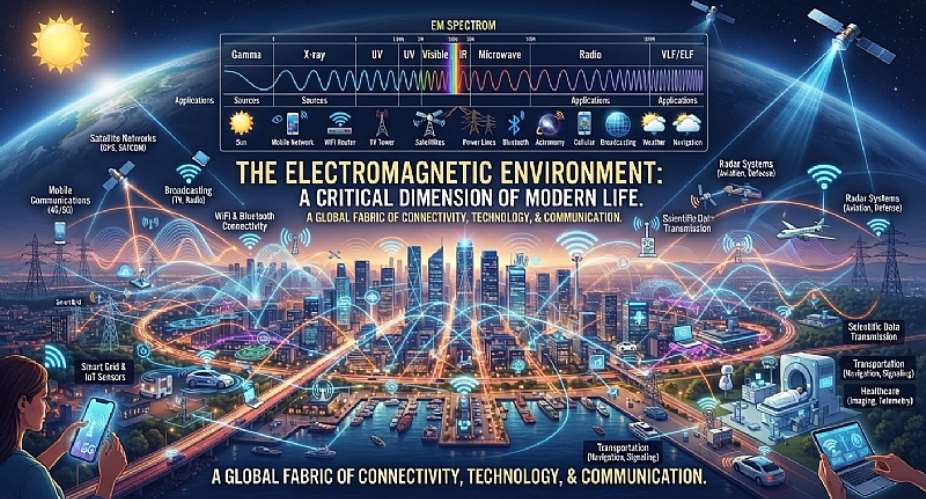
Electromagnetic activity is not an abstract concept detached from everyday experience. It is central to modern communication, electrical infrastructure, satellite operations, navigation and numerous industrial processes.
The Sun, for example, produces solar flares and coronal mass ejections that can affect the space environment surrounding Earth. Under sufficiently severe conditions, space weather can disrupt radio communications, affect satellite operations, interfere with navigation systems and induce electrical currents in long power-transmission lines.
These are recognized risks. They are monitored by scientific agencies, including the US National Oceanic and Atmospheric Administration's Space Weather Prediction Center.
However, it is important to distinguish established space-weather risks from speculation about other possible sources or forms of electromagnetic disturbance. Evidence that solar activity can affect technological systems does not establish that an unusual aerial phenomenon, an unknown technology or a coordinated event is responsible for a particular disturbance.
Each claim requires evidence appropriate to the claim being made.
Even with this distinction, the underlying vulnerability is clear: the technological environment on which society depends is not immune to disruption.
The important question is whether our systems, institutions and communities are sufficiently prepared for circumstances in which their normal operation is interrupted.
A Civilization Increasingly Dependent on Connected Systems
Consider how many ordinary activities depend on electricity and digital connectivity.
People use mobile phones to communicate with family members, conduct business, access financial services and receive emergency information. Businesses depend on digital payment systems, online platforms, cloud services and electronic records. Hospitals rely on electricity, communications, specialized equipment and coordinated supply chains. Transportation systems increasingly depend on digital navigation, automated processes and interconnected infrastructure.
Even activities that appear independent may rely on the same underlying systems.
A person may have cash in a bank account but be unable to access it immediately if the relevant payment infrastructure is unavailable. A business may have products ready for delivery but be unable to coordinate transportation or receive payment. A household may possess essential supplies but struggle to obtain information if its communication channels fail.
The difficulty becomes greater when disruptions affect several connected systems simultaneously.
A loss of electricity can affect telecommunications. Telecommunications failures can interfere with coordination and access to information. Interruptions to digital payment services can complicate commerce. Disruption to navigation and logistics can affect the movement of people and essential goods.
These outcomes are not inevitable in every disruption, and modern infrastructure includes safeguards designed to reduce such risks. Nevertheless, interdependence creates the possibility that a problem in one area may have consequences elsewhere.
The vulnerability is not necessarily that technology will fail everywhere at once. It is that a disruption in a critical part of the system may produce consequences far beyond its immediate point of origin.
What Happens When the Systems We Trust Become Unavailable?
Modern society has achieved extraordinary levels of convenience through technological development. Yet convenience can gradually become dependence.
When systems function continuously, people may lose sight of the practical knowledge and alternatives that were once part of ordinary life. Communication becomes almost entirely digital. Financial transactions become increasingly cashless. Navigation depends on electronic devices. Information is obtained through online platforms, and businesses organize their operations around uninterrupted connectivity.
The concern is not that these developments are inherently harmful. Technology has brought substantial benefits to humanity. The concern is that excessive dependence, without adequate preparation for disruption, can leave individuals and institutions vulnerable.
What happens when communication is interrupted for an extended period?
How do businesses continue operating when digital payment systems become unavailable?
How do communities receive reliable information when their usual communication channels are disrupted?
How do hospitals, emergency services and essential suppliers maintain operations when electricity or connectivity is affected?
These are practical questions, not predictions that such failures are imminent.
They are also questions that governments, infrastructure operators, businesses and communities should address before a crisis occurs.
Preparedness does not require rejecting modern technology. It requires recognizing its limitations and building resilience around it.
The Danger of Assuming That Everything Will Continue as Normal
One of the greatest weaknesses in a highly interconnected society is the assumption that the conditions supporting its normal operation will always remain stable.
This assumption can discourage preparation. People may consider contingency planning unnecessary because previous disruptions were temporary or because essential services have generally remained available.
But past continuity does not guarantee uninterrupted operation under every future circumstance.
Natural hazards, technical failures, cyber incidents, equipment damage and other disruptions can affect modern infrastructure. The likelihood and consequences vary considerably, and responsible planning must be based on credible assessments rather than fear.
The same principle applies when examining unusual phenomena. Public concern should not be manipulated through unsupported claims, but neither should legitimate questions be abandoned simply because definitive answers are not yet available.
There is a difference between creating panic and encouraging awareness.
Panic can lead people to make poor decisions. Awareness encourages them to seek reliable information, examine evidence, consider practical risks and take proportionate action.
The objective should be the latter.
Why the Period Ahead Deserves Attention
The period ahead is an opportunity to reconsider our relationship with technology and the assumptions that govern our daily lives.
My earlier warning raised concerns about electromagnetic disruptions, unusual technological phenomena and the possibility that developments beyond ordinary public understanding could have implications for society. Those concerns should be examined carefully, with a clear distinction between established facts, unresolved questions and interpretations that remain unverified.
I am not presenting a confirmed date for a global technological failure, nor am I claiming that an unprecedented electromagnetic event is certain to occur. The available information does not justify such certainty.
The reason for revisiting the warning is that the consequences of technological disruption are significant enough to merit attention independently of any particular prediction.
If an interruption occurs, whether through a recognized natural hazard or another identifiable cause, the level of preparedness within communities and institutions will influence how effectively they respond.
If no major disruption occurs during the period people are concerned about, the value of sensible preparedness does not disappear. Reliable backup systems, alternative communication methods, emergency planning and public understanding remain useful investments.
The question is not simply whether a particular event will occur. It is whether society is prepared to respond effectively if critical systems are disrupted.
What Can Individuals and Communities Do?
Awareness should lead to practical action rather than helplessness.
Individuals and households can take reasonable steps to reduce their dependence on uninterrupted digital services. These may include keeping essential contact information accessible offline, maintaining appropriate supplies of drinking water and necessary household items, having a way to receive emergency information, and considering alternative arrangements for communication and payment.
Businesses can examine their continuity plans, backup power arrangements, data protection measures and procedures for operating during network or payment-service interruptions.
Institutions responsible for critical infrastructure should continue assessing vulnerabilities, testing contingency arrangements and communicating risks clearly to the public.
Communities can strengthen local support networks so that people are better able to assist one another when ordinary services are interrupted.
These measures should be proportionate to local circumstances and informed by reliable public-safety guidance. They do not require assuming that a catastrophe is approaching.
They reflect a simple principle: systems are more resilient when people have considered what to do if those systems become temporarily unavailable.
An Awakening of Awareness, Not Fear
The title of this article, , refers to the need to become more conscious of the conditions that support modern life.
It is an invitation to examine our assumptions about technology, our dependence on interconnected systems and our willingness to investigate unusual developments carefully.
Humanity should be able to discuss uncertain phenomena without automatically accepting every claim or dismissing every question. We should be able to recognize established scientific risks without exaggerating them, and we should be able to prepare for disruptions without assuming that the worst possible outcome is inevitable.
The challenge is to maintain both openness and discipline: openness to investigation, and discipline in distinguishing evidence from speculation.
My earlier article sought to draw attention to questions that I considered important. This follow-up reiterates the need to examine those questions in the context of our technological dependence and the consequences that disruptions could have for everyday life.
The responsibility now is to move beyond mere speculation and consider what can be understood, verified and addressed.
A Final Message
A society's strength is not measured only by the sophistication of its technology. It is also measured by its capacity to recognize vulnerabilities, respond to uncertainty and protect essential human needs when ordinary conditions change.
Electricity, communication networks, digital finance, satellite navigation and interconnected infrastructure have transformed modern civilization. Their benefits are undeniable. Yet the more deeply society depends on these systems, the more important it becomes to understand their limitations.
The unusual phenomena discussed in my earlier article raise questions that require evidence and careful investigation. The possibility of electromagnetic disruption raises additional questions about the resilience of the systems that sustain modern life. These subjects should not be conflated, but both invite us to think more critically about what we know, what remains uncertain and how prepared we are for disruption.
The warning is not that a particular catastrophe is guaranteed. The warning is that dependence without preparedness creates vulnerability.
The period ahead should therefore be approached with awareness, critical thinking and practical readiness—not panic, blind acceptance or complacency.
We should remain attentive to credible information, demand evidence for extraordinary claims, question assumptions where appropriate and strengthen the systems and communities upon which we depend.
Because if the systems we trust are ever put to the test, our response will depend not only on the technology available to us, but also on the awareness, preparation and judgement we have developed before the disruption begins.
is not necessarily the moment when everything fails. It may be the moment when we finally recognize how much we have placed at risk by assuming that nothing will.


 'There is no support’ – Prisons DG explains why ex-inmates are likely to return
 ECG announces nationwide meter audit to combat electricity theft
 Afenyo-Markin, NEIP CEO Eric Adjei settle defamation suit out of court over exto...
 GIS recovers GH¢124,552 in excess salary arrears paid to 23 officers
 Minerals Commission denies Alfred Mahama’s role in Narawa Licence revocation
 No more ‘No Bed’ excuse as Health Minister unveils real-time bed monitoring syst...
 NAGRAT alleges 38 Obuasi teachers targeted for transfers for speaking out agains...
 Immigration Service gives two officers November 7 deadline to refund GH¢57,006 u...
 'Every tonne of waste we dump is a job we bury' — Dr Siaw Agyepong
 GES directs Ashanti regional, Obuasi East educational directors to step aside ov...


