




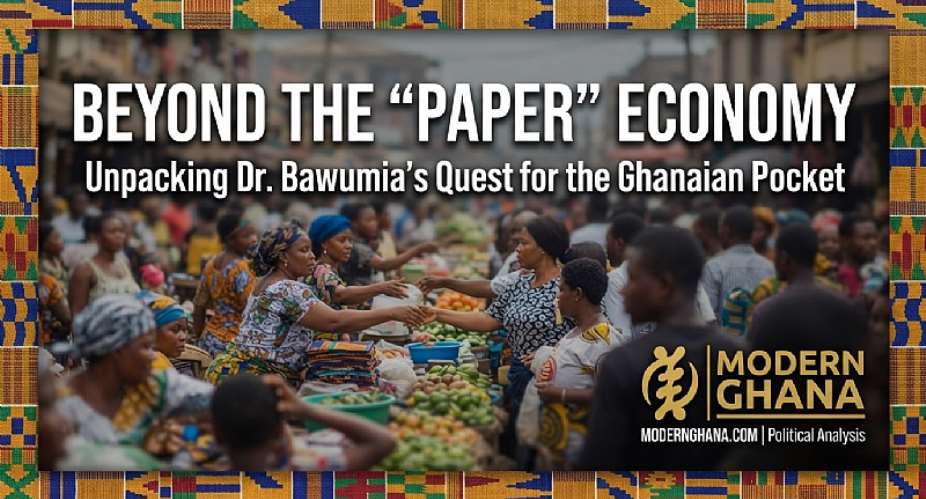
In a defining political moment that has sent shockwaves through Ghana's political landscape, the New Patriotic Party (NPP) presidential candidate, Dr. Mahamudu Bawumia, has issued a searing critique of the country’s current economic management. Speaking at a National Thanksgiving Service in Sunyani, the former Vice President laid bare what he terms a tale of "two economies": a "paper economy" celebrated by official statistics, and a "pocket economy" endured by ordinary citizens. By boldly asserting that macroeconomic stability is meaningless unless it reflects in the pockets of the people, Dr. Bawumia has effectively reframed the economic debate. However, this rhetoric forces Ghanaians to confront a critical question: Is this a genuine blueprint for public liberation, or is it a masterful political pivot from a man who once steered the very economic wheels he now critiques?
This article provides a critical analysis of his statements, the economic realities on the ground, and actionable recommendations for Ghana's economic future.
The Paper Economy: Facts and Figures
To evaluate Dr. Bawumia’s claims, we must look at the hard data currently anchoring Ghana's macroeconomic profile:
- The Inflation Landscape: According to the Ghana Statistical Service, the headline inflation rate stands at 5.2% as of September 2026. While this represents a drastic mathematical drop from historical peaks, prices are still compounding on top of an already high cost-of-living base.
- The Cedi Exchange Rate: Official Bank of Ghana Historical Interbank Rates quote the mid-rate for the US Dollar at approximately GH¢11.67.
- The Growth Outlook: The economy has shown signs of stabilization under heavy international backing, with the International Monetary Fund (IMF) projecting inflation to drop further to 4.8% by the end of 2026. Yet, as Bawumia rightly argues, these digits rarely translate into cheaper market baskets for the average citizen.
The NDC Strikes Back: "A Priest of the Paper Economy"
The governing National Democratic Congress (NDC) has fiercely rejected Dr. Bawumia’s sudden conversion to the gospel of the "pocket economy," dismissing his Sunyani speech as political opportunism and peak hypocrisy.
- The 2022 Economic Track Record: NDC communicators have quickly reminded the electorate of the severe economic distress under the previous administration, noting that when Dr. Bawumia chaired the Economic Management Team, inflation peaked at a staggering 54.1% in December 2022.
- The Cedi Legacy: The ruling party points out the historical irony in Bawumia's current exchange rate complaints, highlighting that he inherited a dollar-to-cedi rate of roughly GH¢4.00 and left office with a deeply depreciated currency that hit over GH¢16.00 in the retail markets.
- Defending the 24-Hour Economy: In response to Bawumia’s accusations that the NDC's flagship 24-hour economy policy has failed to materialize jobs, the NDC maintains that structural economic repairs take time, accusing the NPP candidate of trying to distance himself from a "junk status" legacy he directly co-authored.
Critical Analysis: The Core Paradox
Dr. Bawumia’s address highlights a foundational truth in developmental economics, yet its political context introduces deep contradictions:
- The Data-Reality Disconnect: The argument that declining inflation means nothing to a parent who cannot afford school fees is undeniably accurate. Macroeconomic metrics are lagging indicators; they do not instantly lower the shelf price of bread or the cost of electricity.
- The Irony of the Platform: For nearly eight years, Dr. Bawumia used "paper indicators"—such as GDP growth and international credit ratings—to defend his administration’s performance. The sudden shift to championing the "pocket economy" represents a calculated political realignment ahead of the polls.
From Makola to the Pockets of the People: Resuscitating the Engine of Ghana’s Economy
While politicians spar on airwaves, the real battleground for the "pocket economy" is fought daily in the crowded alleys of Makola, Kejetia, and regional market hubs. Informal traders drive over 80% of Ghana's domestic commerce, yet they bear the heaviest brunt of macroeconomic friction. To move beyond rhetoric, any government serious about "pocket relief" must implement targeted structural reforms for informal retailers:
- Abolish Regressive Flat-Rate Levies: Scrap unpredictable, multiple marketplace taxes and replace them with a unified, predictable, low-rate digital municipal permit. This prevents arbitrary revenue collections that eat into traders' razor-thin profit margins.
- Establish Direct "Trader Credit Lines": Set up state-backed micro-credit facilities tailored specifically for market associations. By bypassing commercial banks' high interest rates, traders can access micro-loans at single-digit interest rates to restock inventory without turning to predatory lenders.
- Invest in Micro-Infrastructure: Channel public funds into upgrading the structural realities of major markets—such as constructing standard cold-storage facilities for perishables, setting up subsidized childcare centers for working mothers, and fixing localized drainage networks to safeguard capital against seasonal fires and floods.
- Facilitate Bulk-Buy Supply Cooperatives: Leverage state logistics networks to help market queens and associations import or source essential retail products in massive quantities, bypassing middle-men to significantly drop the retail unit price for consumers.
Strategic Recommendations and Suggestions
To move beyond political rhetoric and achieve true broad-based economic relief, policy leaders must implement the following structural shifts:
- Target Supply-Side Reductions: Instead of relying strictly on central bank interest rates to manage inflation, the government must aggressively subsidize agricultural inputs and local food distribution networks to lower food costs permanently.
- Implement Strict Fiscal Discipline: Reallocate state expenditure away from bureaucratic overhead and into direct, high-impact social safety nets that insulate low-income families from sudden cost-of-living spikes.
- Redesign Tax Structures: Move away from regressive, broad-based transactional taxes that disproportionately penalize small informal traders, and replace them with progressive systems that stimulate local manufacturing.
- Expand Realistic Jobs Programs: Shift away from abstract economic models toward measurable, localized job creation in agro-processing and light industrial tech to put actual disposable income back into youth pockets.
Dr. Mahamudu Bawumia’s critique has struck a deeply resonant chord because it speaks directly to the daily anxieties of the Ghanaian populace. He is entirely correct: an economy that looks magnificent on a spreadsheet but starves its people is a failed economy. Yet, as Ghanaians prepare to head to the ballot box, they must apply this standard universally. True leadership cannot merely diagnose the divide between the "paper" and the "pocket"; it must demonstrate the political courage and consistency to bridge it. For Ghana to move forward, the electorate must demand concrete, binding commitments from all political actors, ensuring that the next chapter of our national story is written not in the boardrooms of statistical offices, but in the improved livelihoods of every citizen.
✍️ Submitted by:
Retired Senior Citizen
For and on behalf of all Senior Citizens of the Republic of Ghana 🇬🇭
Teshie-Nungua
[email protected]


 Ridge Hospital seeks relatives of unidentified woman injured in accident
 Kasoa: Firefighters pelted with stones over faulty fire tenders, 15 shops destro...
 Obuasi SHTS headmaster arrested over sexual misconduct allegations – Muntaka
 GoldBod says 76% of gold exported since August refined locally
 15 errors out of 1,964 names of South Africa evacuees due to pressure, we deserv...
 'No disturbances again' — Asiedu Nketiah urges calm over late Ahafo Ano South-We...
 Govt to distribute first batch of 129 vehicles to MMDCEs in 12 regions
 UG Vice-Chancellor calls for oral exams, project-based assessment to deal with A...
 'I will use everything I have to clear my name' – Obuasi SHTS headmaster fights ...
 'It's a curse on you' – Water Minister badmouths 'malware' workers sabotaging Gh...


