




The dynamics of a team can be highly complex, hence getting diverse team such as the Electoral Commission to work collaboratively and effectively may require a lot of team interactions, mutual respect and understanding, effective communication and information sharing.
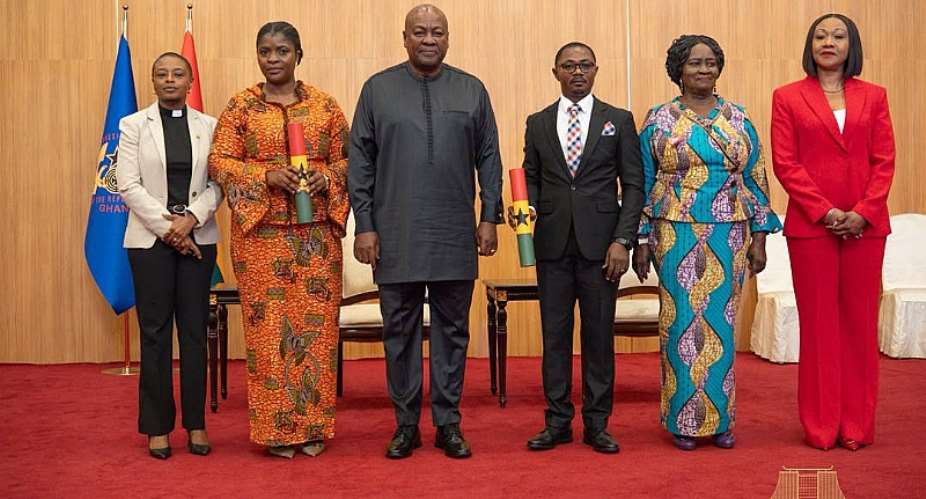
I watched and listened, albeit with horror and utter incredulity to the seemingly inharmonic and uninspired speech delivered by one of the newly appointed deputy electoral commissioners, to be precise, Dr Joseph Kwaku Asamoah.
The depressing and ostensibly discorded speech delivered by Dr Asamoah, clearly immersed in a gamut of emotions, in my humble opinion, was designed to unfairly upbraid his committed and hardworking colleagues at the electoral commission.
With all due respect with no appended condescension whatsoever, it is somewhat disingenuous on the part of a supposedly effective team member to impertinently and carelessly dismiss the successes chalked up by the commission over the years.
All the same, we hope and pray that the overzealous deputy electoral commissioner’s inharmonious and somewhat dispirited speech won’t create any needless dissonance in the team futuristically.
Suffice it to state that within the team, there must be a high level of cohesion, participation, support, and shared values. And, in order to reach this important stage of maturity, teams need to develop and blossom.
It must also be noted that working collaboratively and sharing new knowledge across teams can be a complicated and challenging process(Wenger, 1998; Gilley and Kerno, 2010).
More so, much as group or team working can be a challenge, there is an established recognition of the importance of frameworks, interpretive models, systems and flexible methodologies in enabling groups or specific teams to identify common values and learn to handle challenges and work collaboratively and systematically to achieve a common goal(Checkland & Poulter, 2006).
Team working, so to speak, is characterised by conflicts or fragmentations, competing priorities, arbitrary divisions of responsibility, inconsistent policies, wasteful resources and unshared boundaries.
Needless to say, team conflict may arise when the balance between perceptions, goals, or/and values of the team is upset and members aren’t willing to work together towards achieving the shared goals and values.
Unfortunately, team conflict is an interpersonal disagreement between members of a team or group. Regrettably, however, conflict, more often than not, impacts negatively on team performance.
What is more, the absence of coordination, relevant resources and lack of operational integration produce conflicts, wasteful and inefficient services(Hannigan, 1999).
Much as each team or group member has his/her own interests and values, a team member is obliged to follow values of the team. However, when there is dissonance between the values, conflict may then emerge.
Team conflict could be either functional or dysfunctional. Functional conflicts are disagreements that do not affect team performance significantly, and, the team often remains functional and able to achieve the desired results.
On the other hand, dysfunctional conflicts are those rifts that arise between team members that often disrupt teamwork and prevent team members from achieving shared goals.
Team conflicts or divisions are not limited to a particular team or group. Indeed, conflict is rather a team or group phenomenon which may be resolved through efficient management.
Notwithstanding the challenges associated with team working, some optimists insist that in the presence of periodic on-job training, effective interactions, information sharing, mutual respect and understanding, the team can work synergistically towards achieving a common goal(Reeves et al. 2009).
Some experts, however, posit four pillars of an effective integrated team as: degree of integration, team membership, team process issues, and team management(Øvretveit 1997).
In the grand scheme of things, the quality of teamwork can comprehensively be assessed by considering six thematic factors of the collaborative work process: communication, coordination, and balance of member contributions, mutual support, effort, and cohesion (Hoegl (2005).
The six teamwork quality facets espouse elements of both task-related and social interaction within teams(Cummings, 1978; Hoegl et al., 2003).
More importantly, service delivery is a joint effort by team members, whose tasks, interactions and collaboration need to be synchronised(Baker, Day, & Salas, 2006).
Similarly, team collaboration is synonymous with shared aims, interdependence, shared decision-making efforts and a collegial and equal relationship between members(D’Amour, Ferrada-Videla, San Martín-Rodriquez, & Beaulieu, 2005).
We should not lose sight of the fact that team working has a perceptible likeness to “harnessing a crab, a swan, and a pike onto a single wagon and expecting them to move”(Tubin and Levin-Rozalis, 2008).
Suffice it to state that the aforementioned creatures have dissimilar adaptations, and, there is no propinquity between them. In other words, they differ in nature and more so culturally incongruous.
So, in order to get them “moving” together effectively, they must first learn how to do that, in other words, they must undergo group process to unlock the innate barriers(Bushe and Coetzer, (2007).
To put it metaphorically, tying “a swan, a crab and a pike” and tasking them to “move” together seamlessly without tackling the inherent barriers would be an uphill task by all standards.
K. Badu, UK.
[email protected]


 ‘Obuasi SHTS alleged sexual abuse will not be swept under the carpet’ – Muntaka ...
 'No fresh applicants until existing pool is exhausted’ – Muntaka on security ser...
 Parliament to resume sitting on Tuesday November 3
 'There is no support’ – Prisons DG explains why ex-inmates are likely to return
 ECG announces nationwide meter audit to combat electricity theft
 Afenyo-Markin, NEIP CEO Eric Adjei settle defamation suit out of court over exto...
 GIS recovers GH¢124,552 in excess salary arrears paid to 23 officers
 Minerals Commission denies Alfred Mahama’s role in Narawa Licence revocation
 No more ‘No Bed’ excuse as Health Minister unveils real-time bed monitoring syst...
 Immigration Service gives two officers November 7 deadline to refund GH¢57,006 u...


