



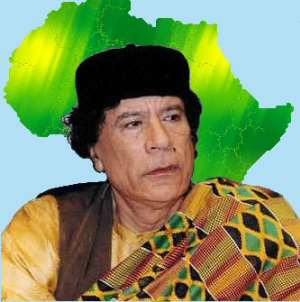
Fifteen years ago today, on 20 October 2011, Muammar Gaddafi was hunted down and killed in Sirte. The operation was not a spontaneous Libyan uprising alone.
It was facilitated, armed, and given air cover by the United States, France, Britain and their NATO partners under the banner of “protecting civilians.” What followed was not liberation. It was DRC 2.0; the deliberate dismantling of an African state that had dared to pursue an independent, continental vision.
Fifteen years on, the results are plain and brutal. Libya is worse off by almost every measurable standard. Once an upper-middle-income country with free education, free healthcare, and the highest Human Development Index in Africa, it is now a fragmented battlefield of militias, foreign proxies, open-air slave markets, and competing governments. Oil wealth that once funded social programmes and African investment is looted or fought over. Ordinary Libyans live with insecurity that their parents did not know. The “humanitarian intervention” delivered neither democracy nor stability. It delivered chaos that endures.
The damage did not stop at Libya’s borders. Before 2011, the vast arsenals of the Libyan state were under central control. After Gaddafi’s murder, those weapons flooded the Sahel. What had been difficult became routine: heavy weapons, anti-aircraft systems, and military-grade ammunition moving freely into Mali, Niger, Burkina Faso, and beyond. Extremist groups that once operated on the margins suddenly possessed the means to challenge states.
The “Sahel crisis” that Western capitals now lament is not an accident of geography or climate. It is the direct, predictable consequence of the destruction of a state that had acted as a buffer and a source of relative order in the region.
This is the pattern Africans are told to forget. A strong, non-aligned African leader is framed as a dictator. His removal is sold as progress. The resulting vacuum is filled by Western interests, private military contractors, and the same vultures that claimed to liberate the people. Then the same predators return as “partners” offering security assistance, mining deals, and lectures on governance, while the original African project of self-determination is buried under the rubble.
Gaddafi was no saint. No serious African can claim he was. But he was an African head of state who funded the African Union, pushed for a common currency, supported liberation movements, and repeatedly argued that Africa’s wealth should serve Africa first.
That is precisely why he became intolerable to those who prefer a continent of weak, dependent states. The method has not changed: Kwame Nkrumah of Ghana, Patrice Lumumba of DRC, Sylvanus Olympio of Togo, Thomas Sankara of Burkina Faso, Modibo Keita of Mali, Amilcar Cabral of Guinea, Felix Roland Moumie of Cameroon amongst others. Same modus operandi - overthrow or assassinate, divide, intervene, extract, and moralise.
Africans must stop pretending this is ancient history. The same logic that destroyed Libya is applied, with variations, wherever African governments attempt genuine sovereignty over resources, borders, or foreign policy. Weapons still flow. Narratives of “responsibility to protect” are still deployed selectively. And too many of us still allow ourselves to be turned against one another while the real architects of our division remain outside the frame.
The only effective response is an Africa-first agenda that is practical, not rhetorical. That means (1)Treating the free movement of Africans across African borders as a strategic priority, not a slogan. (2). Building continental mechanisms that can mediate internal conflicts without inviting external military intervention. (3)Refusing to outsource our security to the same vultures whose interventions produced the insecurity.
(4) Investing in African capacity — industrial, military, and diplomatic — so that no single state can be isolated and broken without consequence.
(5)Teaching the next generation the real history of 2011, of 1987 when Sankara was assassinated, of 1966 when they removed NKrumah, of the 1963 assassination of Olympio, and of the 1961 gruesome murder of Lumumba. Our painful political history must be told as it was, and not in the sanitized version still repeated in Western capitals and their local traitors.
Until Africans organise around their own interests with the same ruthlessness that others organise around theirs, the pattern will repeat. Another leader will be isolated. Another state will be shattered. Another region will be flooded with weapons. And we will be told, once again, that it was for our own good. How dare they.
Fifteen years after Sirte, the evidence is in. Libya is poorer, more violent, and less free. The Sahel is armed and unstable in ways that were not possible when Libya still stood. The lesson is not complicated. Africa’s real enemies are those who profit from its division and those among us who enable them.
We either get our act together, or we continue to watch them help us destroy one another. There is no third option.
Ras Mubarak
Accra.
The author is a journalist, former Member of Parliament, and Leader of the #VisaFreeAfrica2030 campaign.

 'There is no support’ – Prisons DG explains why ex-inmates are likely to return
 ECG announces nationwide meter audit to combat electricity theft
 Afenyo-Markin, NEIP CEO Eric Adjei settle defamation suit out of court over exto...
 GIS recovers GH¢124,552 in excess salary arrears paid to 23 officers
 Minerals Commission denies Alfred Mahama’s role in Narawa Licence revocation
 No more ‘No Bed’ excuse as Health Minister unveils real-time bed monitoring syst...
 NAGRAT alleges 38 Obuasi teachers targeted for transfers for speaking out agains...
 Immigration Service gives two officers November 7 deadline to refund GH¢57,006 u...
 'Every tonne of waste we dump is a job we bury' — Dr Siaw Agyepong
 GES directs Ashanti regional, Obuasi East educational directors to step aside ov...


