




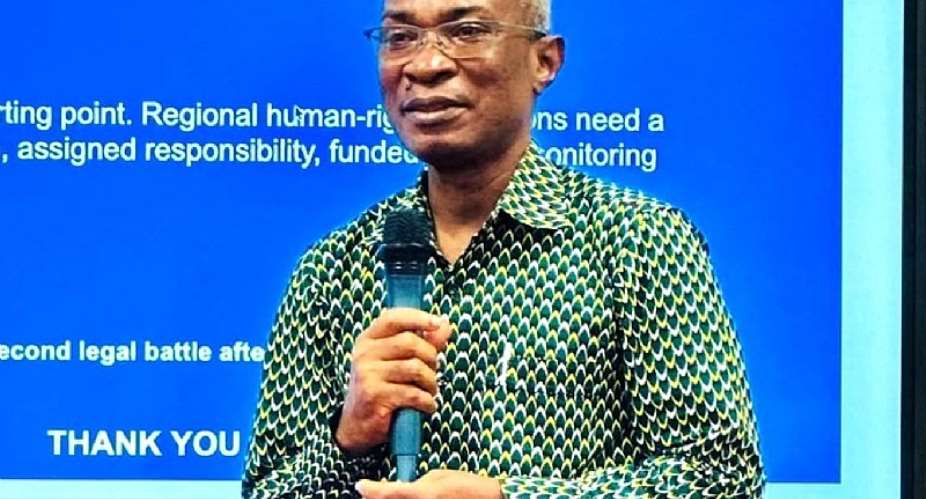
The Communication for Development and Advocacy Consult (CDA Consult) has called for a major review of Ghana’s labour framework to make routine health assessments and occupational health surveillance mandatory for workers.
The Executive Director of CDA Consult, Mr Francis Ameyibor, said many occupational health risks accumulate over time and may only become evident when workers have retired, become less active and have limited financial resources to deal with the resulting health challenges.
Speaking to Modern Ghana News in Accra on Tuesday, Mr Ameyibor advocated a shift from a reactive approach to workplace healthcare, where treatment is sought after illness or injury occurs, to a preventive system that identifies and manages health risks before they become severe.
He said Ghana’s Labour Act, 2003 (Act 651), particularly Part XV on occupational health, safety and environment, was limited in addressing the long-term health consequences of employment.
“We call for comprehensive review and amendment of the Act to make mandatory, routine health assessment for all categories of workers a statutory requirement, backed by a National Policy Framework for Routine Health Assessment and Occupational Health Surveillance."
Mr Ameyibor said discussions on labour issues in Ghana had largely focused on wages, conditions of service and job security, while insufficient attention was being paid to the long-term health effects of different occupations.
"Whether you are a teacher, a journalist, a market woman, a banker, a farmer spraying weedicide, a factory worker operating heavy machinery at Afienya industrial zone, a driver, a miner, or a health worker—every occupation carries cumulative health risks that will manifest tomorrow," he stated.
He expressed concern that Ghana lacked an effective system for monitoring occupational diseases and identifying workers whose health was gradually being affected by their working conditions.
"Ghana has no system to track how work is killing workers slowly. We wait for an accident like the worker who lost five fingers in a factory at Afienya Industrial Zone recently. We talk about safety, but what about the worker who slowly loses his eyesight, his lungs, and his kidneys because of his work?
Call to strengthen Labour Act
Mr Ameyibor argued that Sections 118 to 126 of Act 651, which deal with occupational health and safety, should be reviewed to reflect the demands of a modern and industrialising economy.
He said the existing provisions placed considerable emphasis on workplace safety and accident prevention but did not sufficiently address long-term occupational health surveillance, chronic disease prevention and routine medical screening.
“The Act does not make it mandatory for employers to conduct annual routine health checks and exit medical examinations for workers. Section 118(2) talks about providing information but not systematic health monitoring.
“There is no provision for a national occupational disease registry to document work-related illnesses; labour inspection provisions are focused on physical conditions, not health assessment records, and most of the provisions are practically unenforceable in the informal sector where the majority of Ghanaians work,” Mr Ameyibor stated.
He maintained that although the Labour Act was progressive when enacted in 2003, developments in Ghana’s economy required an updated framework capable of protecting workers in an increasingly industrialised environment.
"The Labour Act 651 was progressive in 2003. But in 2026, as Ghana pursues a 10-billion-dollar industrialization drive and a 24-hour economy, it is obsolete. You cannot run a modern economy with a law that does not mandate that a worker's health be checked routinely," he stated.
Mr Ameyibor said preventive healthcare for workers should be viewed as an investment in Ghana’s human capital rather than an additional cost to employers.
"Ghana cannot afford to lose its workforce to preventable diseases. A worker who develops chronic kidney disease from chemical exposure becomes a burden on his family and the NHIS. Routine health assessment is not a cost—it is an investment in human capital and economic productivity," he stressed.
National dialogue urged
The CDA Consult Executive Director called on the Ministry of Labour, Jobs and Employment, Parliament’s Employment Committee, labour unions, the Ghana Employers Association and the Ministry of Health to initiate discussions on reforming the Labour Act.
He proposed a system under which workers would have health records that track the effects of their occupations over time, particularly for those exposed to hazardous working conditions.
"We must move from a compensation model paying workers after they are injured to a prevention model checking workers before they get sick. Every worker must have a health file that tracks how their work is affecting their health," he stated.
Mr Ameyibor said stronger occupational health measures should cover both the formal and informal sectors, where many workers operate without adequate workplace health monitoring.
“If you fail to act today when you have the power to transform the labour market and protect the health of workers in both the formal and informal sectors, you will suffer the consequences when you go on retirement tomorrow,” he emphasised.


 'There is no support’ – Prisons DG explains why ex-inmates are likely to return
 ECG announces nationwide meter audit to combat electricity theft
 Afenyo-Markin, NEIP CEO Eric Adjei settle defamation suit out of court over exto...
 GIS recovers GH¢124,552 in excess salary arrears paid to 23 officers
 Minerals Commission denies Alfred Mahama’s role in Narawa Licence revocation
 No more ‘No Bed’ excuse as Health Minister unveils real-time bed monitoring syst...
 NAGRAT alleges 38 Obuasi teachers targeted for transfers for speaking out agains...
 Immigration Service gives two officers November 7 deadline to refund GH¢57,006 u...
 'Every tonne of waste we dump is a job we bury' — Dr Siaw Agyepong
 GES directs Ashanti regional, Obuasi East educational directors to step aside ov...


