




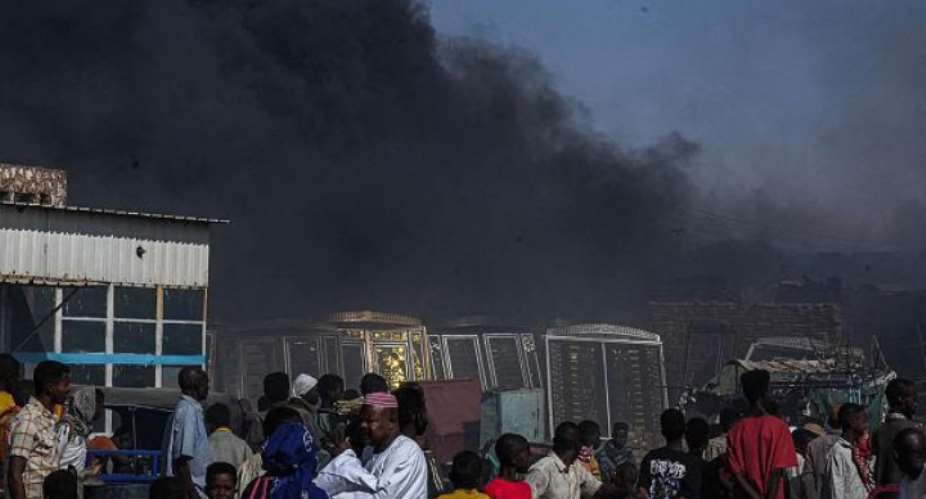
At least 100 people have been reported killed in a wave of drone attacks across Sudan since Sunday, in a stark reminder that the country's war is increasingly fought from the sky, and that civilians pay the heaviest price. The toll, reported by AFP citing local sources, covers strikes on markets, a transport hub and residential areas.
The deadliest attack hit Al-Dibab in West Kordofan, where 80 people were killed. Villagers had gathered after market day and were waiting for transport home when the strike came. It is hard to imagine a more ordinary scene, and that is the point: nothing about a crowd of traders and travellers at a roadside resembles a military target.
Other strikes were reported in Nyala and in Khartoum, where three young children were among the dead. Together, the attacks show that no part of the country is beyond the reach of the war, from the Kordofan heartland to the capital itself.
The violence stems from the conflict between Sudan's army and the paramilitary Rapid Support Forces, which continues with no sign of a political settlement. Cheap, widely available drones have changed the character of the fighting. They allow both sides to strike far behind the front lines, at little cost and with little accountability, and markets and transport hubs, places where people are most concentrated, are exposed.
For West Africa and the wider Sahel, Sudan is not a distant story. Instability in the Sahel belt has shown how quickly weapons, fighters and displaced people move across fragile borders. A conflict that has no end in sight and no effective arms control invites precisely that kind of spillover.
Attribution will matter. The reports so far come from local sources via AFP, and independent verification of who carried out each strike is still needed. But the demand for accountability should not wait on that. Attacks on markets and homes are prohibited under international humanitarian law, whoever launches them.
African leaders, the African Union and regional bodies have too often settled for statements while Sudan bleeds. A credible response would combine pressure for a genuine ceasefire, humanitarian access and scrutiny of whoever supplies the weapons and drone technology driving this phase of the war. The people of Al-Dibab were waiting for a ride home. The least the continent owes them is a serious effort to end the war that killed them.
Mustapha Bature Sallama
Medical/Science communicator, Private Investigator, Criminal Investigation and Intelligence Analysis,United States Institute of Peace (USIP), [email protected] +233555275880
Source: AFP, via DW Africa.


 'There is no support’ – Prisons DG explains why ex-inmates are likely to return
 ECG announces nationwide meter audit to combat electricity theft
 Afenyo-Markin, NEIP CEO Eric Adjei settle defamation suit out of court over exto...
 GIS recovers GH¢124,552 in excess salary arrears paid to 23 officers
 Minerals Commission denies Alfred Mahama’s role in Narawa Licence revocation
 No more ‘No Bed’ excuse as Health Minister unveils real-time bed monitoring syst...
 NAGRAT alleges 38 Obuasi teachers targeted for transfers for speaking out agains...
 Immigration Service gives two officers November 7 deadline to refund GH¢57,006 u...
 'Every tonne of waste we dump is a job we bury' — Dr Siaw Agyepong
 GES directs Ashanti regional, Obuasi East educational directors to step aside ov...


