




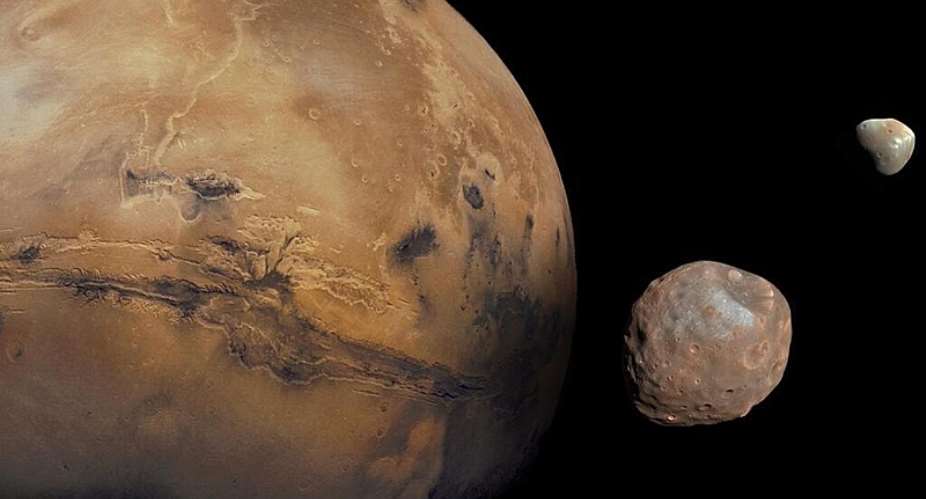
Japan's next space adventure has a small, potato-shaped destination – and ambitions that reach far beyond its size.
The Japanese space agency JAXA on Tuesday successfully launched its Martian Moons eXploration mission, or MMX, from the Tanegashima Space Centre aboard an H3 rocket.
JAXA had allowed for further launch attempts until 9 November if necessary. Missing this opportunity could mean waiting roughly another two years for a favourable alignment of Earth and Mars.
The spacecraft is expected to reach the Martian system in 2027 and spend around three years investigating Phobos and Deimos, before returning samples from the larger moon to Earth in 2031.
France and Germany are contributing a small rover, while a French-built infrared instrument will help examine the moons' surfaces and identify suitable landing sites.
The central question is straightforward: where did these two unusual moons come from?
Phobos, an irregular body measuring about 27 kilometres at its widest point, orbits less than 6,000 kilometres above the Martian surface. Smaller Deimos circles much further out, at an altitude exceeding 20,000 kilometres.
Both could be asteroids captured by Mars' gravity. Alternatively, they may have formed from debris thrown into space by a massive collision involving the planet.
By examining their composition up close – and bringing material home for laboratory analysis – scientists hope to distinguish between those competing explanations.
One giant leap for China as Tianwen-1 spacecraft lands on Mars
Building on Japan's sample-return successes
Reaching Phobos has defeated previous missions.
In 1988, the Soviet Union launched two spacecraft towards Mars and its larger moon. One reached the Martian system in January 1989 and returned photographs of Phobos, but contact was lost before it could deploy its surface equipment.
Russia tried again in 2011 with Phobos-Grunt, an ambitious sample-return mission carrying a Chinese Mars orbiter. Stranded in Earth orbit after its propulsion system failed to send it towards Mars, the spacecraft eventually fell back into the atmosphere.
Other missions have photographed the moons while exploring Mars, but none has landed successfully on either surface.
Japan, however, brings considerable experience in collecting extraterrestrial material.
Its first Hayabusa spacecraft, launched in 2003, overcame major technical difficulties to return particles from the asteroid Itokawa in 2010.
Hayabusa2, launched in 2014, followed with a more substantial haul from the asteroid Ryugu, delivering its samples to Earth in 2020.
MMX builds on those achievements while attempting something different: rather than briefly touching an asteroid to collect material, the spacecraft will settle on Phobos for sampling operations lasting several hours.
First, it will survey the moon from nearby. The French MIRS infrared imaging spectrometer will map minerals on the surface, providing scientific clues and helping mission teams choose where to land.
Then comes a scouting mission with a distinctly European character.
Artemis mission takes historic step as astronauts conduct lunar flyby
A rover, two landings and a journey home
Developed by France's CNES and Germany's DLR space agencies, the four-wheeled Idefix rover will be released towards Phobos ahead of the main spacecraft's landing.
It is expected to bounce before coming to rest, potentially in an awkward position. Its mechanisms are designed to turn it upright onto its wheels.
Driving will require exceptional care. Gravity on Phobos is around 1,800 times weaker than on Earth, making even basic movements challenging. The rover must advance slowly and maintain contact with the surface.
Over an operating period of around 100 days, Idefix is expected to cover perhaps 100 metres, examining the terrain and helping engineers understand how the loose surface material behaves.
Those findings will inform the main spacecraft's descent. National Centre for Space Studies (CNES) Administrator Philippe Baptiste (L) and Japan Aerospace Exploration Agency (JAXA) president Hiroshi Yamakawa (R) shows to French President Emmanuel Macron a model of a rover developped for the Martian Moons eXploration (MMX) project during the International Paris Air Show at the ParisLe Bourget Airport on 19 June 2023.
MMX plans two sampling landings, targeting different locations to obtain material that could help reveal Phobos's origins. Each surface visit is expected to last around two and a half hours.
The goal is to collect at least 10 grams of regolith – the loose dust and fragmented rock covering the moon.
The spacecraft will also make close passes of Deimos before beginning its return journey.
Under the mission timetable, the samples should reach Earth in 2031 inside a protective capsule destined for landing in Australia.
Scientists will examine the recovered material and any gases preserved inside its container. Some samples will be reserved for future research, allowing later generations to study them with instruments yet to be developed.
France will receive a share for its scientific community, with a dedicated conservation and preparation facility planned at the National Museum of Natural History in Paris, according to CNES.
After a five-year journey, just a few grams could provide the clearest evidence yet of how Mars acquired its moons.
This has been adapted from an original article in French by RFI's Igor Gauquelin and lightly edited for clarity.


 Oppong Nkrumah demands account of GH¢650bn parliament approved for economic prog...
 'How many jobs did you create with your digitalization agenda?' Bawumia quizzed
 NDC does not deserve second term — Kofi Akpaloo
 Mahama urges Dagbon Regent to protect peace, build on late Ya-Naa’s legacy
 Govt to begin work on three more regional hospitals in 2027 – Mintah Akandoh
 Christian Council urges govt to deploy more military, police to fight galamsey
 NDC clears Obuasi SHTS headmaster to contest constituency chairmanship race desp...
 We are going to recruit another 8,000 to make up for the 16,000 health professio...
 Ghana must align its mineral processing efforts with neighbours – Mahama
 Lawyer shortages limit Legal Aid Commission’s expansion – Executive Director


