




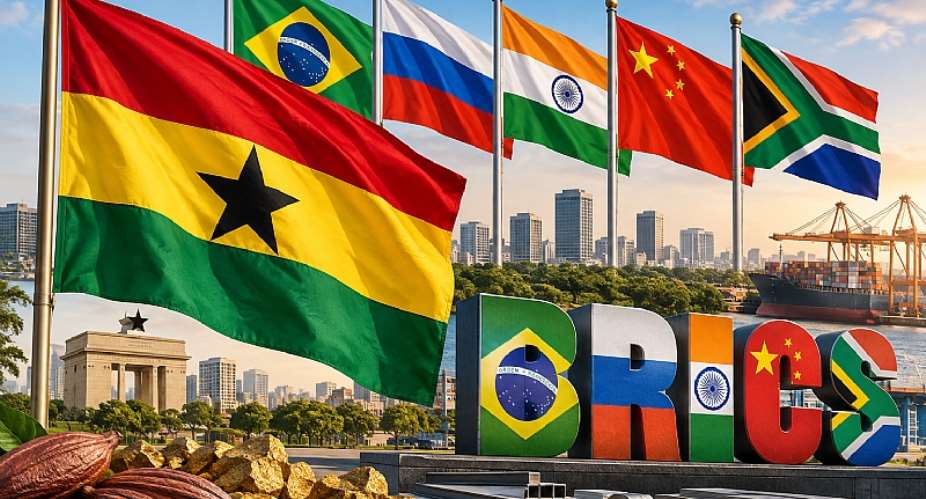
Narrative Hooks
Hmm, imagine you are God’s Angel, hence a good friend of God and God sees you flirting or dining with Lucifer, how will God feel? So, when Ghana joins BRICS which has China, Russia and Iran as key members, who are anti-Western Bloc, how will the US and others feel?
Note according to a classified document of the CIA of USA, the CIA contributed to the success of the 1966 Coup that saw the removal of President Kwame Nkrumah. This was so, due to the then regime of the US not happy with Ghana for among others, Ghana’s then tilting towards the Socialists Eastern Bloc with China and Russia as her allies. Note President Nkrumah was on his way to China when the sad 1966 Coup took place.
So, in early October 2026, President Mahama quickly/smartly urged Ghanaian diplomats to explain Ghana’s BRICS strategy, clearly to Ghana’s traditional Western allies by telling them that joining BRICS is for an economic diversification effort but not to abandon her traditional trade and funding allies in the Western Bloc. Hence, one can say that Economic Partnership in line with historical Non-Aligned Policy and Article 40 of the Constitution is a better option than full member.
Introduction
In October 2026, a debate on an attempt by Ghana to link with the BRICS ignited rapidly after the Foreign Minister namely Hon Mr Samuel Ablakwa hence President Mahama’s administration announced the move to join the BRICS as a Partner, following a visit by India's External Affairs Minister, Dr. Subrahmanyam Jaishankar to Ghana. The matter cuts to the heart of current West African Security, diplomacy/ foreign policy, and economic strategy.
Questions
Is Ghana just looking for a Club Card for Membership of a Coffee Shop (Tea Party)? Or, Is Ghana looking for Political and or Diplomatic or Security allies? Or Ghana is simply trying to work on a National Economic Strategy or is Ghana becoming a Political Prostitute (opportunist)?
So, is BRICS’s partnering status as quest by Ghana, a means for a safe pragmatic stepping stone for a balanced foreign policy, diversifying the economy or just for a half-measure that lacks real decision-making power?
Hence, will this move by Ghana damage her established sources of loans, grants/Aids from the Western Bloc/ IMF and World Bank and her access to Western Markets of the USA (especially AGOA) and the markets of European Union for her products, which are needed by the thousands of Ghanaians, other Africans, and offspring of Africans in the Western Countries and Countries of their allies?
There are also the Constitutional and Historical Questions, which Ghana needs to take note of with the attempt to join BRICS. Ghana needs to take note of Article 40 of the 1992 Constitution, which guides Ghana's foreign policy to promote and protect national interests and Ghana’s Historical Non Alignment policy, which saw President Kwame Nkrumah’s historical playbook of non-alignment by balancing ties with Western Bloc and Eastern Bloc which saw Ghana obtaining financial and technical support from the West especially the USA for projects like the Akosombo Dam and her early nuclear cooperation with the East.
So, the real litmus test is when Ghana is granted the Partner Status, can Ghana use the platform of the BRICS to transform her raw exports into localized industrial capacity without burning bridges with traditional Western financiers. Otherwise will that result in Ghana to become a Site of Galamsey (meaning gather and sell) of Chinese goods by dumping of cheap and substandard Chinese goods by her greedy nationals with the propensity to front for foreigners?
What is and Why BRICS?
BRICS is the acronym of the names of a group of pioneer Countries namely Brazil, Russia, India, China and South Africa, with the use of the first letter of their names. It is an intergovernmental organization of fast emerging economies to see to finance infrastructure of member countries and or to provide liquidity support to members without the usual strict conditions of the Western Bloc’s Institutions, thus to reduce reliance on Western-dominated financial systems. As well as to increase global geopolitical influence to promote a multipolar world order, a challenge to the monopoly of the G7 (USA, alongside EU Countries).
The Group of countries which constitute the BRICS is for among others for De-dollarization efforts, for the diversification of their economy with the hope to expand their trade and partnership option beyond traditional Western Markets and Institutions especially financial institutions like the IMF, World Bank etc.
Members are with the hope of providing or gaining Access to new offers of a potential finance funding through BRICS Institutions like the New Development Bank (NDB) and the Contingent Reserve Arrangement.
One can join as a Full Member or a Partner Country, with the hope of getting alternative and or additional financial credit options to what they may get from the Western Bloc and their financial systems like the IMF and World.
Full Member vs. Partner Country: What is the Difference?
Full Members: Full Members are those countries with access to deeper institutional layers, thus they have a seat for core structural decision making. They hold consensus decision-making powers with full voting rights. They also enjoy an automatic financial windfall from the New Development Bank (NDB). They are made of 11 countries as of 2026. These are Brazil, Russia, India, China, and South Africa as the Pioneers hence BRICS, later members are Egypt, Ethiopia, Iran, UAE, and Indonesia plus Saudi Arabia's status.
Partner Countries; A Partner status grants a country to sit in the room for some meetings, but does not grant a seat in core structural decisions, nor grant full voting rights. So, a Country with Partner status attends select summits, and engages in dialogue, but it does not grant full voting rights, and does not grant an automatic financial windfall from the New Development Bank (NDB). Partner Countries alongside Malaysia, Vietnam, Cuba, and Ghana’s regional peers include Nigeria, Uganda etc.
Key Reasons for BRICS
De-dollarization Efforts: Members seek to trade more using local currencies and reduce dependency on the use of U.S. dollar for trading as one of the main reasons for the BRICS.
To Challenge the Monopoly of the Western Bloc: Another main reason for the BRICS is to provide a cohesive voice for developing nations to counter political and economic domination by Western Countries/bloc and their Financial Institutions like the IMF and World Bank.
Alternative Financial Systems: The BRICS bloc established a new Financial Institutions as New Development Bank and the Contingent Reserve Arrangement to finance infrastructure and provide liquidity to members without the usual strict Western political conditions. Hence a way to escape from the usual strict contingent precedents before granting bail out support which also entails the appointment of a Director or Consultant, as usually appointed by the IMF or World Bank to whip the recipient Government in line with the agreed standards in the agreement between parties using standard check list system and realize of funds of funds upon achieving he setup milestones.
Global South Representation: Countries join to leverage fairer trade, large combined markets, technological advantages, and long-term investment partnerships.
To exploit the Massive Economic and Demographic Scale: The coalition (comprising 11 core members including Brazil, Russia, India, China, South Africa, Egypt, Ethiopia, Iran, Saudi Arabia, the UAE, and Indonesia, plus partner nations like Nigeria and Uganda represents about half of the global population with a major share of global oil, gas, and manufacturing. hence a BRICS offers an emerging massive Market.
Why Ghana wants to join BRICS
Facing severe economic hurdles, with huge debts over the years, so to reset the economy, Ghana has found it very crucial to diversify her economy, since Ghana’s economy is driven heavily by exporting of raw materials such as gold, cocoa and nontraditional crops and imports a lot of manufactured goods. Hence by opting to join BRICS, Ghana hopes to open up critical trade, investment, industrialization, and alternative financing options within the Global South.
Ghana has a foundational history with the Non-Aligned Movement (NAM) dating back to the Regime of President Kwame Nkrumah and also Article 40 of the 1992 Constitution guides Ghana's foreign policy by ensuring national interest at all times, so Ghana wants to improve her economy with a partner status under the BRICS system whilst maintaining its core relationships with Western Countries and Western institutions like the IMF and World Bank thus answering both historical Non-Aligned Movement and Constitutional questions.
Thus Ghana seeking partnerships with both the West and BRICS is not "political prostitution" but a return to a historic foreign policy of "neither West nor East. So, Ghana hopes by that, she will work hard to maximize benefits for its citizens.
Consequently Value Addition/Resource Sovereignty through Industrialization is the main open reason Ghana is seeking to join the BRICS. Since Ghana’s Trade data highlighted a loss of billions Dollars incurred annually by exporting of raw cocoa and unrefined minerals. So BRICS is seen as a gateway for industrial partnerships and local-currency trading.
Thus Ghana is seeking for stronger ties with major emerging economies like Brazil, Russia, India and China, hence South to South Cooperation in order to move away from the exporting of raw material towards local value addition and technology transfer, wealth and job creations. So Ghana is with the believe that by this move she will attain the desired development by pushing with these emerging specific heavyweights to expand trade relationships.
In order not to cause a very great displeasure to the Western Bloc, in early October 2026, President Mahama urged Ghanaian diplomats to explain the BRICS strategy clearly to traditional Western allies by telling them that joining BRICS is for an economic diversification effort but not to abandon her traditional trade and funding allies in the Western Bloc.
So, Ghana wants to use the same spirit which President Nkrumah used to get the USA to help him to build the Akosombu Power Station with funding from America Company through a financial vehicle as VALCO, an original American Company then under the Kaiser Group (ALCOA). Thus an additional economic tie and not a replacement for her ties with the Western Bloc and the associated Financial Institutions (IMF, World Bank, etc).
Once again, the core driver behind Ghana’s interest to join the BRICS is economic diversification in a Reset Agenda in order to move away from exporting raw material such as raw cocoa and minerals toward local value addition and trade expansion with major Global South economies. This is seen as crucial since BRICS is seen as a gateway to industrial partnerships and local-currency trading. Thus, Ghana is seeking a formal association with BRICS, an avenue for South-South cooperation, in order to gain another financing and trade expansion with major Global South economies.
The Risks and Challenges
The move by Ghana to join the BRICS makes some critics to tag Ghana as a Political Prostitute or opportunist in the making. Since these critics argued that Ghana is trying to engage in transactional, unprincipled foreign policy by trying to play with both sides hence a ‘’Political Prostitute" label.
Ghana has historically positioned itself as a stable democratic ally of the Western Bloc made of the US, UK, and EU, so joining the BRICS Bloc that includes heavily anti-Western or autocratic regimes like Russia, Iran and China could be viewed as abandoning democratic alignment for financial opportunism.
Other critics argued that Ghana’s option to join the BRICS Bloc may be an attempt to play Blocs against each other by using the BRICS leverage, simply to extract better deals, loans, or debt restructuring terms from Western institutions like the IMF and World Bank, thus treating international alliances as commodities. So Ghana attempts to join the BRICS Bloc has therefore made some Security, Economic, and Diplomatic Analysts to list several critical risks and challenges as follows;
Deepening Market Penetration or Dumping Concern
The intersection of Ghana's recent cabinet approval to apply for BRICS partner status, the new payment mechanisms like China's Cross-Border Interbank Payment System (CIPS), and the domestic issue of local "fronting" creates a complex trade dynamics.
Since, the implementation of China's Cross-Border Interbank Payment System (CIPS), allows Ghanaian traders to settle imports from China directly in Chinese Yuan from Cedi accounts. While this reduces reliance on the US Dollar and lowers transaction costs, experts noted that it makes importing from China significantly easier and cheaper, which acts as a catalyst for more inbound goods.
Note, Ghana reportedly operates an import-driven economy with a steep trade deficit with China. Recent trade figures revealed that Ghana imported $9.8 billion worth of goods from China while exporting only $2 billion. So joining BRICS could aggravate this imbalances, will therefore potentially squeeze out the Agricultural Sector hence local farmers and local Industrial/Manufacturing Sectors if proper trade defenses are not enforced.
It should be noted that Ghana is a victim of a practice of "fronting, where citizens act as legal placeholders or proxies for foreign retail and small-scale business operators to bypass citizenship requirements thus the situation presents a structural vulnerability.
So, when locals front for foreign SME investors, the situation allows cheap, mass-produced consumer goods to directly enter domestic retail networks like local markets and discount hubs more aggressively. Thus if BRICS status leads to lowering of transaction costs with use of local currency, a lower tariff structures or more relaxed entry barriers coupled with local fronting, it is feared that these will likely make it even harder for regulators to police the influx of cheap imports, competing with goods of Ghanaian farmers, artisans and factories. Thus fear of damages to both the Agricultural Sector and the Industrial Sector of the economy and this will hurt the drive to create sustainable jobs for the teeming youth.
Relax or Poor Standards
The Western Bloc and their Financial Institutions like the IMF and World Bank adhered to global compacts with high Standard Checklists/ Key Performance Indicators. BRICS is without good standards so the fear of opaque financing as well as fear of technology dependencies by Chinese firms, if not well managed.
Fear of Strain relationship with her Darlings (boyfriends) of the Western Blocs: Hmm, if you are the Angel or friend of God and God sees you flirting or dinning with Lucifer, how will God feel? So, Ghana wanting to dine with noted enemies of USA etc that is anti-Western Countries like Russia, Iran and China who are some of the principals of the BRICS, and are seriously creating an alternative geopolitical bloc/power, could endanger Ghana’s relationship with the Western Bloc and their lending Institutions and their affliates like Ukraine, Israel etc. Thus this move by Ghana may endanger her alliances, economic aid and trade undercurrents.
Security Balance: Experts emphasize that BRICS is not a collective security organization but as an economic and political forum, so Ghana. Joining will not automatically resolve Ghana's security concerns both internal and regional security, which still requires cooperation through ECOWAS and the African Union and support from her Western allies. Note Ghana has vital security, intelligence, and counter-terrorism cooperation with the United States and European allies (including active maritime and defense arrangements). Leaning overly far to the Eastern Bloc of China and Russia, may lead to animosity or loss of interoperability.
IMF and Debt Restrictions: Ghana exited from exited a tailored IMF program quite recently; so Ghana need to carefully conduct its economic policy in a manner to sustain investor confidence by maintain strong relationship with multilateral financial institutions. Access to funding from NDB of the BRICS or a financial structural change may require approval from existing debt managing institutions like the IMF and World Bank
No Automatic Trade Elimination /Illusion of Free Money: BRICS does not presents free-trade area thus Ghana’s seeking for partner status does not magically dismantle trade barriers or replaces the need for domestic structural reforms, affordable electricity, and skilled labor. No common tariff and no magic funding pool attached to partner status. Partner status grants a seat at the table and attendance at summits, not an automatic free-trade zone or to benefit from an instant financial window from the New Development Bank.
Consensus Hurdles: Getting accepted as a partner, requires the unanimous backing of all current BRICS members, meaning domestic economic stability and diplomatic legwork must be airtight.
Domestic and Regional Palavers
Domestic Scene (Politics & Public Reaction); Policy Analysts, Local Critics, and the Opposition Political Parties especially the NPP in Parliament hence “shadow Government” frame the move as either an ideological tightrope walk or a clever economic diversification strategy with Ghana’s as a BRICS’s partnering narrative depending on where one stands.
Regional Scene: Ghana’s as a BRICS’s partner narrative will motivate a major debate in the African Region, or the West African Region.
Conclusion
Ghana is not losing its integrity, rather it is cleverly adapting to a changing economic dynamics and a multi-polar world, so Ghana does not just need a "club" card; it needs a domestic strategy. So, with the quest for a partner status, the real test is whether Ghana can use the BRICS platform to transform raw exports into localized industrial capacity without burning bridges with traditional Western financiers.


 Aflao: Customs seizes 560kg of suspected cannabis worth GH¢11.2million in black ...
 Minority says $750,000 per each charter flight for South Africa evacuation way a...
 How can they implement 24-Hour Economy when they don’t even understand their own...
 Farmers lament how thieves allegedly drug goats with tramadol before stealing th...
 Asantehene endorses Mahama’s reset agenda, backs local mineral processing
 Technical fault at Tetegu disrupts power supply to surrounding areas – ECG
 Minority’s evacuation figures contain ‘total inconsistencies’ – Foreign Affairs ...
 South Africa evacuation: NPP Minority is using AI to manufacture scandal – Emman...
 Mahama announces GH¢200m for reclamation of lands destroyed by galamsey
 Invest in cocoa, shea processing to create jobs for Ghanaian youth – Veep to Chi...


