




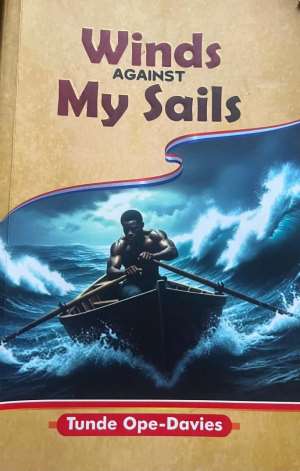
Book: Winds Against My Sails
Genre: Novel
Pagination: 205
Writer: Tunde Ope-Davies
Publishers: Kraft Books Limited, Ibadan, Oyo State, Nigeria
Reviewer: Banji Ojewale
Man has come a long way from the days of Aesop, the ancient Greek storyteller who developed a style of travelling to the animal world to draw lessons for men and women. History has a bouquet of his jungle stories and their morals: The ant and the grasshopper (You can shape your tomorrow today) The boy who cried wolf (It’s the lie you’re used to which will be remembered, not the truth you only drop once), The fox and the grapes (One can’t accommodate what’s beyond your reach; you will despise it).
Modern novelists also write to instruct or entertain us, some from forest life, like Nigeria’s Daniel Fagunwa (Ogboju ode ninu igbo irunmole, 1936) and the Englishman George Orwell (Animal Farm, 1945), with others strictly seeking inspiration from the world of human beings as Professor Tunde Ope-Davies has done in his work, Winds Against My Sails.
Ope-Davies dispenses with creatures of the thicket to relate his account; but he also proffers great precepts not virtuously different from those we receive through the writers who commune with the woods. Either way, the readers are enriched, hugely tutored to change perceptions as they reap a harvest of predictable and unexpected twists in the tale.
We have plenty of them in the work of Ope-Davies (Opeibi), professor in Digital Humanities, Digital Cultures, English and Discourse Studies at the University of Lagos, Nigeria, beginning with a tell-tale autobiographical title for a fiction. About the Author back cover section of the book conceals the dark days of the author’s own headwinds. But critics wouldn’t consider it unreasonable to look at Professor Wale Jones in the novel and apply poetic license to unveil him as the alter ego of Opeibi, himself a heavily garlanded don like his creation.
Jones, the main character, leaves rustic Jadesore, to embark on what the author calls, Voyage of Life. The name of his village challenges the ambitious to venture out for breakthroughs eluding them. Yet, it doesn’t reveal that you can’t make an omelette without breaking eggs. Wale gets the delicacy alright; but it is at the expense of much travail, trauma and toil.
There are near-death experiences; there are fatalities; there are several heartbreaks as well as betrayals; missed opportunities that present no second chances are also recorded; we equally learn of juvenile escapades that could have shortened the life of the hero; there is a battle over the choice of a marriage partner; a time of abandonment by family, friends and loved ones is also shared; we read of days of hunger when biscuits and mint sweets miserably cater for hunger; there’s story of an absentee father; when he’s home however, he fails to model virtue as he engages in nocturnal drinking orgies with friends in the presence of impressionable children; there are assaults of ill health and threats of death at childbirth.
To be sure, some of these are occasioned by poverty. Not all, though. How about the struggles Jones encounter even after the young man has crossed the threshold, in a manner of speaking, and he begins to get local and global recognition denied peers and mentors? The winds against his sail don’t cease in the ivory tower. They are personified by Katakiti, ‘’who had remained at the same rank for years. To watch Wale, once his student, rise above him was a bitter pill.’’ There’s also a season of character perfidy when Wale Jones is accused of being ‘’too friendly with female students’’ and ‘’selling a colleague’s textbook to students, a practice the university had outlawed.’’ Wale attributes all what he’s facing to ‘’politics of the system.’’
Rightly, the blurb concludes that Wale’s faith in God and ‘’an unyielding spirit of perseverance’’ are the steps he mounts to overcome the winds of adversity.
So, like Karl Marx, the legendary German co-founder of Scientific Socialism, whose bronze memorial he gazes at in an unnamed European city, Professor Jones becomes ‘’a man who faced his fires and emerged remade,’’ ready to change his defective system as Marx attempted to.
Now, in view of an opening poem that predicts ultimate victory for the voyager ‘’Because He that stillest the noise of the Seas’’, is with the explorer, it may be tempting to dismiss Professor Ope-Davies’ Winds Against My Sails as a simplistic literary contraption primed from the beginning for a happy end, regardless of the protagonist’s tumultuous killer adventures. That would be an unbalanced ruling that misses the Olympian plot of Opeibi’s epic. He brings his story under a roof of sweeping flashbacks, critical commentary, history (ancestral and contemporary), objective philosophy, Biblical theology, all of which reveals the author’s catholic mind.
These are ferried by a language rich in fluid prose. metaphor and semiotics.
Let’s examine for instance Opeibi’s capture of ‘dust’ to take the readers through their own semiotic journeys. as it were. It first appears as ‘’chalk dust’’ in Chapter One. Later, he says ‘’Dust rose like spirits over the playing fields…’’ And when Wale Jones got the new birth in Christ, we saw the dust called to action again: ‘’…he bent his knees on the dusty ground and gave his life to Christ.’’
Thus, in the literary construct of Professor Ope-Davies’ world, there’s a sustained imagery of the lowly dust and chalk, both of which appear to have sentenced Wale to limitless and hopeless penury. Once, the lecturer is seen collapsing ‘’at the foot of a chalkboard.’’ But, to get into Divine embrace wherein is final liberation, Wale must align with ‘’the dusty ground’’ and look up to God from that lowly position. He must stoop to conquer.
Is Ope-Davies testing the waters of fiction with Winds Against My Sails after a string of acclaimed nonfiction publications, including the biographical Kumuyi: Defender of the Faith, which he wrote with co-members of the Editorial Board of the Deeper Christian Life Ministry?
This is a heuristic quest with the possibility of turning in a new-look Tunde Ope-Davies.
.Ojewale is a writer in Ota, Ogun State, Nigeria.

 Aflao: Customs seizes 560kg of suspected cannabis worth GH¢11.2million in black ...
 Minority says $750,000 per each charter flight for South Africa evacuation way a...
 How can they implement 24-Hour Economy when they don’t even understand their own...
 Farmers lament how thieves allegedly drug goats with tramadol before stealing th...
 Asantehene endorses Mahama’s reset agenda, backs local mineral processing
 Technical fault at Tetegu disrupts power supply to surrounding areas – ECG
 Minority’s evacuation figures contain ‘total inconsistencies’ – Foreign Affairs ...
 South Africa evacuation: NPP Minority is using AI to manufacture scandal – Emman...
 Mahama announces GH¢200m for reclamation of lands destroyed by galamsey
 Invest in cocoa, shea processing to create jobs for Ghanaian youth – Veep to Chi...


