





French teenagers spent four weeks protesting about missing teachers, overheated classrooms and broken toilets. A new analysis of 103 news reports across eleven media markets, from Paris to Pretoria, finds that much of the world read a different story: a country on fire.
On 21 September, pupils at the Lycée Antoine-de-Saint-Exupéry in Créteil, a suburb south-east of Paris, walked out over teaching posts nobody had filled. Their grievances were ordinary: classes of 35, rooms that reached 40°C during the summer heatwave, toilets without water.
Within ten days, hundreds of lycées were blockaded. Within three weeks, the movement was on front pages from Toronto to Sydney.
But the protest the world read about was not quite the one France was living. French media told a story about failing schools that became a political fight. Abroad, the story arrived as fires, tear gas and arrests, with the schools as background.
That is the central finding of The Protest the World Saw, a study of how news organisations in France, wider Europe, the United States, Canada and Australia framed and described the movement between 1 September and 19 October 2026 — later extended to Africa and the Middle East.
I led that study. I began it expecting to measure how France was portrayed. I ended it thinking about something larger: how the international news system decides what a protest means — and whom it gives the benefit of the doubt.
The world arrived after the fires
Timing shaped the story. In the first week, only local French outlets were covering the blockades, and they wrote about staffing and buildings. No international outlet in the sample reported on the movement before 28 September — the day bins were set alight outside schools and the first mass arrests began.
By then, the story had its images. In that first week of foreign coverage, disorder scored 85 out of 100 on frame-intensity measure. Education scored 42. The Economist headlined its piece "Schoolyard protests are setting France ablaze".
The international wire services amplified that lens. Reuters, AP and AFP supplied a quarter of all items in the sample, and their copy used the harshest language about the protest itself. In Australia, seven of the nine items studied were local re-headlines of wire stories.
French media shifted early too — but towards politics, not riots. After the government accused the hard-left La France Insoumise of orchestrating the unrest, political framing in French coverage scored 39. Abroad, it scored just 7. The battle in Paris over who was to blame largely stayed in France.
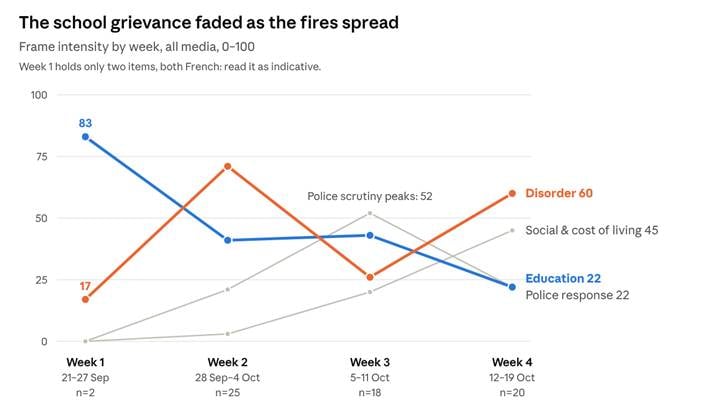
The coded sample revealed · 65 items, 21 Sep–19 Oct 2026 · Disorder = public-order or violence framing, whichever is higher
The grievance did not disappear in one go. It dipped as the first fires spread, held steady while injuries to teenagers turned attention to the police, and then halved again once the students joined the cost-of-living marches of 17 October.
Two vocabularies, one country
This study coded 170 descriptive words and phrases from headlines, reporting and quoted sources. They fall into two vocabularies.
The protest was described as violent, nationwide, unrest and riots. France's schools were dilapidated, under-resourced and crumbling — or, in French, délabrés and vétustes, words that carry decay through age and neglect.
The second vocabulary was unanimous. All 32 descriptions of school conditions were negative, in every market studied. So were all 16 descriptions of the government (struggling, neglectful, top-down) and all 11 of the police (heavy-handed, disproportionate).
The teenagers themselves fared far better. On International Protest Adjective Index, which runs from −100 to +100, the students scored +27; the protest as an event scored −32. Most of the warmth came through quoted parents, teachers and pupils rather than journalists' own words.
The pattern matters. Coverage was harsh on the French state, not on its young people. Criticism of institutions is not the same thing as hostility to France.
The toilet test
One of the sharpest readings of the movement came from Le Monde, in a piece on what the demand for decent toilets says about the protests. Doors that do not lock, no paper, no soap: the article treats a small demand as a symptom of something larger — dignity, privacy, health, and the State's responsibility for the conditions in which children are asked to learn.
Le Monde ‘s article act as a benchmark. It separated coverage that framed the protest as an event (demonstration, disruption, police, arrests, political reaction) from coverage that framed it as a symptom of deeper institutional or social problems.
The symptom reading turned out to be a minority view. Only 26% of items framed the protest that way. The dignity angle — toilets, hygiene, physical welfare — appeared in just four of the 65 items, and in no Canadian or Australian coverage at all.
When toilets did reach foreign readers, they mostly arrived as quoted pupils inside wire and CNN reports, not as the journalist's own frame. One student told Reuters there were "not enough toilets". The detail was reported; its meaning was rarely drawn out.
Five news markets, five protests
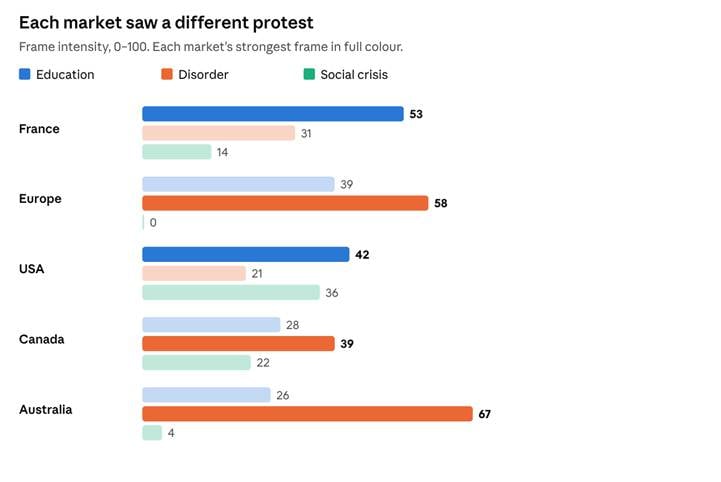
Coded sample · 65 items, 1 Sep–19 Oct 2026 · Disorder = public-order or violence framing, whichever is higher
Each market leaned towards its own version of events.
France led with education, then politics. Violence barely registered in French framing.
Europe outside France led with public order and violence. British coverage spoke of fury, riots and a country gripped by unrest. German outlets were more varied: ZDF's report centred on pupils' anger at crumbling schools, and taz framed the government as trying to intimidate students.
The United States read the deepest meaning into the protests. More than half of US items (55%) treated the movement as a symptom of wider French malaise — the highest share of any market. A TIME opinion piece asked "Why is France Burning?" and answered with a decade of top-down government and unequal schools.
Canada, where the sample is CBC alone, tied the story to money. One CBC segment opened with the line "France is broke".
Australia saw the most violent version (violence intensity 67), largely through rewritten wire copy.
The Canadian and Australian samples are small, so their scores should be read as indicative.
A template older than this protest
Scholars have a name for what happened: the protest paradigm. Joseph Man Chan and Chin-Chuan Lee identified it in 1984, and Douglas McLeod and James Hertog developed it in the 1990s. Coverage built on the template tells a protest as a battle between demonstrators and police. It foregrounds violence and spectacle, even when they are marginal. It leans on official sources and rarely explains what protesters actually want.
The French coverage fits that template — but only partly.
Where it held: disorder was the strongest single frame, and three in four items told the protest as an event rather than a symptom. Ministers' figures on arrests and burned schools set the daily rhythm.
Where it broke: the grievance never vanished. Nearly two-thirds of all items named the schools. The teenagers were described more warmly than the protest. And the police, not only the protesters, came under scrutiny. When a 15-year-old in Lens lost a hand to a police grenade, injuries to minors became a story of their own, followed by internal police inquiries and criticism from Amnesty International, Human Rights Watch and the UN.
Why did the template bend for France? I see four advantages. France is covered by a dense corps of Paris-based correspondents. Its own press is free, plural and widely read by foreign journalists. Its officials, unions and student leaders speak to reporters in languages the wires work in. And it enjoys a presumption of institutional legitimacy: even the harshest headlines spoke of a government that "struggles", never a regime that cracks down.
How Africa and the Middle East saw it
Does the view change with the viewer? To find out, I extended the study to 38 items from 27 outlets in South Africa, East, West, North and Central Africa and the Middle East, coded the same way.
The first finding is about authorship, not adjectives.
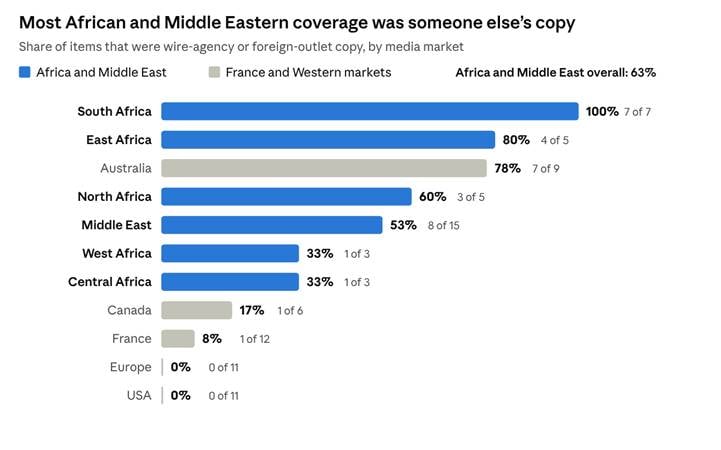
Extension in sample · 38 items from 27 African and Middle Eastern outlets, 1–19 Oct 2026 · Western markets from the main sample (re-headlined wire copy counted as imported)
Nearly two in three items (63%) were not written by the outlet that published them. Thirteen came from AFP, six from Reuters and two from AP; three more were reprinted from the BBC, CNN and Radio-Canada. Every South African item we found was agency copy. In East Africa, four of five were. Africa largely read France's protests in Paris's, London's and New York's words.
That borrowed copy carried its strengths as well as its biases. Agency explainers usually included a paragraph on missing teachers and dilapidated buildings, so the grievance travelled well: 84% of items in the six regions named the schools, against 62% in Western international coverage. On disorder and tone, the two groups were almost identical.
| Media market | Items | Education frame (0–100) | Disorder frame (0–100) | Items naming the schools | Symptom frame | Protest index (−100 to +100) |
| South Africa | 7 | 57 | 62 | 100% | 14% | −36 |
| East Africa | 5 | 33 | 67 | 60% | 20% | −50 |
| West Africa | 3 | 22 | 100 | 67% | 0% | −50 |
| North Africa | 5 | 73 | 40 | 80% | 60% | 0 |
| Central Africa | 3 | 67 | 56 | 100% | 67% | −29 |
| Middle East | 15 | 47 | 49 | 87% | 40% | 0 |
| All six regions | 38 | 50 | 57 | 84% | 34% | −21 |
| Western international (for reference) | 37 | 35 | 57 | 62% | 30% | −20 |
Where outlets wrote in their own voice, they read more into the protest. 57% of own-voice items framed it as a symptom of something deeper, against 21% of imported items. Al Jazeera's Paris reporting tied the unrest to systemic inequality. Columns in Middle East Eye and The National argued that a generation was demanding a future. Gabon's Gabonclic urged readers not to confuse the movement with its violent minority. And Morocco's Le360, running AFP copy, used the word insalubrité — unsanitary — the closest any item came to Le Monde's dignity reading.
Two frames appeared that Western media barely used. The first is comparison: The Kenya Times placed France alongside Kenya and four other countries under economic strain. The second is geopolitics: Iran summoned France's ambassador over its "violent response" to the protests, and Iranian state broadcaster Press TV presented the crackdown as proof of Western double standards. A Paris-based pan-African site, Afrik.com, linked the 17 October marches to the anniversary of the 1961 massacre of Algerians in Paris.
What struck me most was what was missing. Only two of 38 items compared France's protest with a protest at home — on a continent that has just lived through Kenya's Gen Z uprising. African media did not turn the lens around. Mostly, it borrowed the lens.
A note on the numbers: West and Central Africa yielded only three items each, and searches covered English- and French-language outlets only, so Arabic, Swahili, Portuguese and Amharic coverage is missing. Excluding state-directed Press TV, the Middle East protest index is −6.
Would the world have told it differently in Accra or Nairobi?
This is the question I keep coming back to. Our extension measured how African and Middle Eastern media saw France — not how the world would cover a protest in Accra or Nairobi. So what follows is argument informed by evidence, not measurement. But I believe the answer is yes, in at least five ways.
1. The symptom would attach to the country, not the government. In France, crumbling schools were read as a failure of policy by an embattled administration. In a poorer country, the same images of burning bins and broken classrooms risk being read as proof of a "fragile" place. One is a judgement on a minister; the other is a judgement on a nation.
2. Fewer reporters, more wire copy. France was covered from Paris bureaux. Most developing countries are covered from regional hubs, by stringers, or by the wires. That matters: in our sample, Australia — the market most dependent on rewritten wire stories — produced the most violent framing. Africa No Filter's 2021 study of 60 African outlets found that about a third of their coverage of Africa came from non-African sources, with AFP and the BBC alone supplying around a quarter of stories about other African countries. Our own extension points the same way: 63% of the African and Middle Eastern items we found were agency or foreign copy. The template travels with the copy.
3. The grievance would be read as poverty, not politics. A missing French teacher was treated as a budget choice that ministers could reverse. A missing Ghanaian or Kenyan teacher is more likely to be filed under underdevelopment — donors, debt, the IMF — as if no one were accountable.
4. The investor lens would come first. French coverage did touch on money, as Canada's CBC showed. For many developing countries, the risk frame — currency, bonds, "instability" — is often the first frame, not the fourth.
5. The police might face less sustained scrutiny. In France, injuries to minors triggered named investigations and weeks of follow-up. In many developing-country protests, state violence is reported as a death toll and then dropped.
There is a counter-argument, and it is important. Developing-country movements are not passive objects of framing. When young Kenyans protested a finance bill in June 2024, their own phones, platforms and articulate demands helped the movement be read abroad as a generational reckoning with the state, not just as riots. And France was hardly spared: one American headline asked why France was burning.
The lesson is not that rich countries get gentle coverage. It is that the benefit of the doubt — the assumption that institutions exist, that grievances are political and that someone is accountable — is not distributed equally.
Why the framing matters
Media framing is not public opinion, and nothing in this study shows that coverage has changed how foreigners invest in, visit or think about France. What it shows is exposure: the raw material from which those impressions can form.
That exposure is concentrated in three places. Institutional trust, because every description of the government and police was negative. Education, because the reputation of French schools took a battering in every market. And public order, which was the single strongest frame in the sample.
The risk is moving. In the final week, as students joined Yellow Vest and cost-of-living marches on 17 October, disorder framing climbed back to 60 and social-unrest framing rose to 45. Headlines turned to looted shops and a burned town hall in Limoges. The school grievance is in danger of becoming a footnote.
It has not happened yet. In the most violent phase, 41% of items still named the education grievance. Internationally the figure across the whole period is 62%. TRT suggests watching that number: if it falls below about 40%, the world's picture of France's protests will have become a story of disorder alone.
What could hold the line is evidence rather than messaging:
- a dated, bilingual tracker of teachers replaced and schools repaired, giving foreign reporters a progress story to follow;
- consistent daily figures for the Paris bureaux of Reuters, AP and AFP, separating minors, non-students and injuries;
- regular public updates on investigations into police conduct;
- publishing what the government's national consultation of pupils, which closes on 23 October, actually heard.
Lessons for the people who make — and face — the news
For newsrooms. Say what a protest is about in every story, even when the fire leads. Separate minors, non-students and police in the numbers. Treat a re-headlined wire story as someone else's frame, not your own — a lesson for African and Middle Eastern desks above all, where most of the items we found were agency copy. And use one vocabulary across borders: if it is "unrest" in Lens, it is unrest in Lagos; if it is a policy failure in Paris, it is a policy failure in Accra.
For governments, especially in developing countries. The world arrives at the fire, not at the first complaint. The frame is set in the first 72 hours of international attention, so evidence must already exist: published figures, a named plan, a spokesperson who briefs the wires daily. Blaming the opposition rarely travels — France's accusations against La France Insoumise barely registered abroad. Visible accountability for the use of force is reputational infrastructure, not a concession.
For readers. Ask three questions of any protest story from abroad: whose voices are quoted, which week of the protest you are reading about, and whether the adjectives describe the protest, the people or the country.
The pupils of Créteil asked for something modest: a school that works. Within a month, much of the world knew them as rioters in a burning country. Most of what they said was reported somewhere. What was lost was the order of things — the cause slipped beneath the consequence. Getting that order right is the least the news owes a protest, wherever it happens.
About the author
Messan Mawugbe (PhD) is Lead Consultant at www.trtintelligence.com where he leads the agency's latent-risk, trust and media-framing assessments. The views in this article are his own.
About this analysis
The analysis coded 65 news items from 31 outlets published between 1 September and 19 October 2026, in English, French, German and Spanish. The sample covers France (12 items), Europe outside France (11), the United States (11), Canada (6) and Australia (9), plus 16 stories from Reuters, AP and AFP counted separately so that syndicated copy is not double-counted. Coding was based on headlines and the article text available at collection, not complete texts, and was done by a single analyst; the findings are indicative.
The extension adds 38 items from 27 outlets in South Africa (7), East Africa (5), West Africa (3), North Africa (5), Central Africa (3) and the Middle East (15), published 1–19 October 2026 in English and French. Because most were agency copy, each item was coded as its readers saw it, headline and text, with the source (own journalist, wire agency or foreign outlet) recorded. Two frames were added for this sample: comparison with the reader's home region, and geopolitical contest. Iranian state broadcaster Press TV is included but flagged as state-directed. This study measures media framing and descriptive language. It does not measure public opinion or establish that coverage caused any political, economic or behavioural outcome.
Sources
- 2026 French student protests — chronology and official figures
- Le Monde — High school protests spread across France, pitting radical left against government
- The Economist — Schoolyard protests are setting France ablaze
- Reuters, via Oman Observer — French school protests spread as fires, blockades deepen unrest
- ZDFheute — Die Wut der Schüler auf Frankreichs Straßen
- taz — Schülerproteste in Frankreich: Protest macht Schule
- TIME — Why is France Burning?
- CBC — France is broke. Can student protests change anything?
- SBS News — Clashes, fires and looting break out across France
- The Cyprus Review — Overcoming the Protest Paradigm? (on Chan & Lee 1984; McLeod & Hertog 1992, 1998)
- CNBC Africa — Africa No Filter: western sources dominate how the Africa story is told (2021)
- UCL Institute for Global Prosperity — Kenya's Gen Z 2024–25 uprisings
- Africa and Middle East extension (selected)
- IOL — 'Gen Z has risen up': Poor classrooms, missing teachers spark student revolt across France (AFP)
- The Citizen (Tanzania) — France faces scrutiny over police response to student protests (Reuters)
- The Kenya Times — Kenya and 5 Other Countries Hit By Strikes, Protests, and Public Unrest in October 2026
- Premium Times — Mass protests turn violent in France, spread across Europe
- Le360 — France: nouvelle journée de mobilisation lycéenne sous haute surveillance (AFP)
- Gabonclic — Dossier spécial la France, article 2 : le samedi du chaos
- Al Jazeera — Paris left reeling as student-led protests turn chaotic
- Middle East Eye — French student protests: A generation that sees no future is rising up
- The National — France's angry youth are demanding a future
- Al Arabiya — Iran summons French envoy over 'violent response' to school protests (AFP)
- Press TV — Explainer: Student protests across France (Iranian state media)
- allAfrica — Revue de presse de l'Afrique francophone, 17 octobre 2026 (citing Afrik.com on the 1961 anniversary)


 Aflao: Customs seizes 560kg of suspected cannabis worth GH¢11.2million in black ...
 Minority says $750,000 per each charter flight for South Africa evacuation way a...
 How can they implement 24-Hour Economy when they don’t even understand their own...
 Farmers lament how thieves allegedly drug goats with tramadol before stealing th...
 Asantehene endorses Mahama’s reset agenda, backs local mineral processing
 Technical fault at Tetegu disrupts power supply to surrounding areas – ECG
 Minority’s evacuation figures contain ‘total inconsistencies’ – Foreign Affairs ...
 South Africa evacuation: NPP Minority is using AI to manufacture scandal – Emman...
 Mahama announces GH¢200m for reclamation of lands destroyed by galamsey
 Invest in cocoa, shea processing to create jobs for Ghanaian youth – Veep to Chi...


