




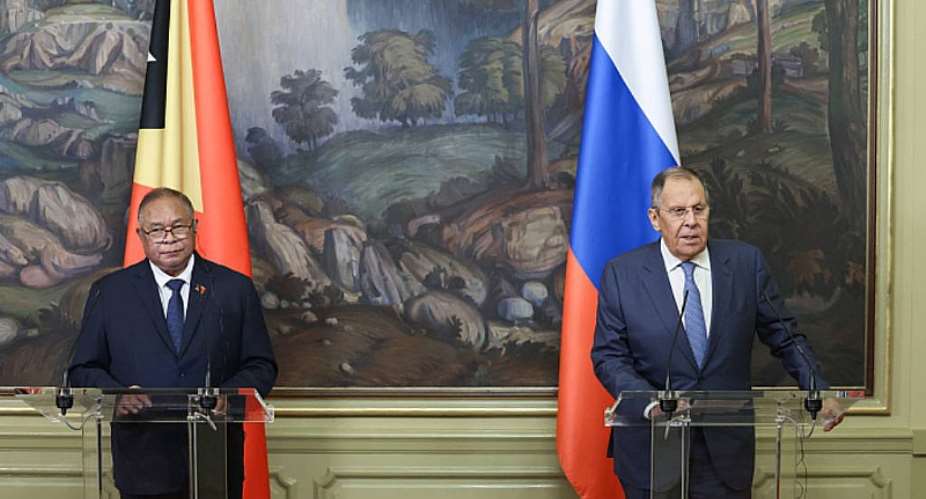
‘Russia’s Pivot to Asia,’ in its latest report, highlights some important messages for ASEAN, as reflected in the growing strategic and economic ties between Russia and Timor-Leste. The Russian Foreign Minister, Sergey Lavrov, has met with Bendito Freitas, the Minister of Foreign Affairs and Cooperation of Timor-Leste in Moscow, the first official visit to Russia by a Timorese foreign minister. In June this year, Prime Minister Kay Rala Xanana Gusmão met with Russian President Vladimir Putin during the 2026 ASEAN–Russia Summit in Kazan.
Timor Leste is an ex-Portuguese colony, but upon achieving initial independence was annexed by Indonesia in 1975. However, given religious and other cultural differences, and after much civil unrest, Timor Leste gained its full independence in 2002, and subsequently joined ASEAN on October 26, 2025.
Lavrov and Freitas held wide-ranging talks covering the full spectrum of bilateral relations, from deepening political dialogue and broadening trade, economic, and humanitarian ties to reinforcing the legal foundation underpinning their relations.
Their discussions also addressed major international and regional developments, with both sides calling for tighter coordination between Russia and Timor-Leste across United Nations institutions and within the Russia-ASEAN dialogue partnership.
The sides agreed to explore investment projects in energy, mineral extraction, fisheries and tourism. Russian economic operators expressed readiness to expand energy supplies, while the two sides agreed to prepare material for expert examination and establish direct contacts between specialists and relevant agencies. Essentially, the two sides need to develop bilateral political and trade relations from ground zero, with Lavrov stating that the two sides were discussing the legal parameters for increasing trade, possibly a precursor to a future bilateral investment treaty. This means that there is potential for developing mutual trade.
Timor-Leste has a landmass of 14,950 km2, a population of about 1.4 million, and a GDP (PPP) of about US$7 billion. Its GDP (PPP) per capita is US$5,200. GDP growth for 2026 is estimated at 4.1%, buoyed by its new relations and support from now fellow ASEAN members.
Timor-Leste has a market economy, although it is dependent upon the export of a few commodities and has a large public sector. Internally, market operations are limited by widespread poverty. The motivating factor behind Timor-Leste’s independence was the discovery of energy resources, with significant wealth, which at the time of independence had per capita value equivalent to an upper-middle income country. Over half of this was in oil, and over a quarter natural gas, which is why Russia is interested in the country. However, mismanagement and diminishing reserves have created some difficulties.
Timor Leste’s Petroleum Fund stood at US$18.61 billion at the end of 2025. Production at the Bayu-Undan field ceased in 2025, increasing the importance of developing new revenue sources. Merchandise exports were approximately US$99 million in 2025, including around US$35 million in coffee, while tourism-related service exports reached US$109.6 million.
Russia – Timor Leste Bilateral Trade
‘Russia’s Pivot to Asia’ said that Timor-Leste’s entry into ASEAN has expanded the association to 11 members and created a new institutional setting for Russia’s engagement with the country. However, bilateral merchandise trade remains extremely small. Imports from Russia were approximately US$3,570 in 2023, with almost no signs of any increase. One monthly figure for April 2026 put that months’ Russian exports to Timor Leste at just US$884.52. A potential bilateral trade value of US$50 million by 2030 has been discussed as a working target.
Bilateral trade is minimal at less than US$15,000, with Russia exporting some personal hygiene products and Timor-Leste exporting coffee. Timor-Leste’s essential contemporary value to Russia lies in its recent full membership of ASEAN, although a back door exists via Indonesia, which has good relations with Russia and is a BRICS partner nation. Timor-Leste’s economy is heavily dependent on imports from Indonesia, which account for about 70% of its total imports. Indonesia is the primary source of food items for Timor-Leste, and adventurous Russian entrepreneurs may seek to enter the Timor-Leste market through Indonesia – which also has a free trade agreement with Russia via the Eurasian Economic Union, ‘Russia’s Pivot to Asia,’said.
For Russian companies, the initial opportunities may involve energy supply, geological assessment, fisheries infrastructure, agriculture (such as specialist coffee) cold-chain logistics and tourism services. Using the Indonesia-EAEU FTA to access Timor Leste consumers would appear a pertinent strategy. The immediate test will be whether the Lavrov- Freitas discussions lead to feasibility studies, supply agreements, exploration commitments and financing arrangements to provide a trade platform that can support development.
Stephen Rozario, a researcher and columnist.

 Obuasi SHTS sexual abuse allegations deeply disturbing – Beatrice Annan
 'Show us the boarding passes' – MP questions evidence for South Africa evacuatio...
 Martin Kpebu explains why Afi Agbenyo should resign over EC appointment
 South Africa evacuation: NPP desperate to see government commit scandal – Appiah...
 Mahama announces GH¢200m for reclamation of lands destroyed by galamsey
 Ghana working to stop exporting raw mineral ores by 2030 – Mahama
 Invest in cocoa, shea processing to create jobs for Ghanaian youth – Veep to Chi...
 'Hypocrisy is the problem of NDC government’ – Elvis Darko on EC appointment
 GHS to vaccinate eligible girls against HPV in nationwide school campaign
 NAIMOS destroys 92 chanfang machines, arrests three suspected illegal miners on ...


