




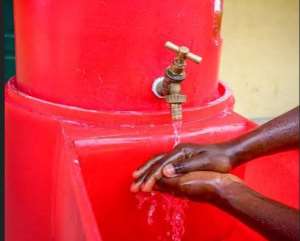
The United Nations designates October 15 as Global Handwashing Day, and a haunting question echoes through Ghana’s public spaces: Where did all the handwashing stations go?
Only a few years ago, at the height of the COVID-19 pandemic, Verona buckets, pedal-operated taps, and brightly coloured plastic sinks were abundant. They stood guard at the entrances of every school, market, and church across the country, a visual shield against a deadly virus.
Today, an investigation by the Ghana WASH Journalists Network (GWJN) reveals a stark, dangerous reality: those lifelines have vanished, leaving the nation's most vulnerable, particularly schoolchildren, exposed to a ticking time bomb of preventable diseases.
"Our kids are spreading germs instead of living," laments a worried mother outside a primary school in Accra. Her frustration captures the essence of a forgotten culture that is quietly endangering a generation.
The Missing Shields of the Classroom
At some public basic schools visited by GWJN reporters on Thursday and Friday, October 15th and 16th, 2026, the morning assembly routine went on as usual. Children laughed, held hands, and played in the dirt.
But when the recess bell rang for lunch, a disturbing pattern emerged. Scores of children rushed straight from the playground to the food vendors; their small hands visibly caked in dust.
Where a robust, multi-tap handwashing station once stood during the pandemic, there is now only a dry, cracked patch of concrete.
"During COVID, we were forced to wash our hands before entering the class and before eating," a 12-year-old pupil told reporters while wiping his hands on his uniform. "Now, the buckets are broken, and there is no water anyway. If you want to wash your hands, you have to buy a sachet of water, and most of us don't have money for that, let alone to talk of soap."
Headteachers, speaking on the condition of anonymity, expressed deep frustration over the lack of sustainable infrastructure. "The facilities provided during the pandemic were temporary fixes. Once the emergency passed, the maintenance culture died. We have no budget for soap, and the water supply is inconsistent. We are teaching WASH (Water, Sanitation, and Hygiene) in textbooks, but we cannot practice it in reality," one administrator admitted.
Markets and Churches: A Direct Return to the Status Quo
The disappearance of handwashing infrastructure isn't isolated to classrooms. At major, bustling local markets, where thousands of hands exchange cash, meat, and vegetables every hour, the pandemic-era hygiene stations are absent.
Reporters searched the main entry points of two prominent markets. In place of the once-mandated sanitising stations, traders have reclaimed the space for their wares.
"We forgot the lessons too quickly," said Auntie Naa, a tomato vendor. "When the government stopped enforcing it, everyone stopped caring. Now, we handle money and eat with the same hands. It is by God’s grace we are not falling sick every day."
A similar apathy hangs over local places of worship. In churches where ushers once strictly policed hand hygiene before letting congregants pass, the entryways are now clear. The plastic tanks that used to sit prominently under church signs have been moved to backrooms, broken, or repurposed for general storage.
A Critical Warning on Global Handwashing Day
The theme for Global Handwashing Day 2026 reminds the world that clean hands are still a fundamental pillar of health. Yet, the findings of the GWJN highlight a massive policy and behavioural relapse in Ghana.
Public health experts warn that the absence of these facilities in public spaces, especially schools, creates a fertile breeding ground for cholera, typhoid, and upper respiratory tract infections. Children are not just passing around dirt; they are vectors for outbreaks that can easily devastate communities.
According to experts, the claim that handwashing prevents about 40 per cent of communicable diseases is highly accurate, particularly when looking at the primary infectious illnesses that affect communities and school children.
Data compiled by global health bodies like the U.S. Centres for Disease Control and Prevention (CDC) and the Global Handwashing Partnership break down the specific preventative power of handwashing with soap under running water into these core figures:
The Real Data Behind the 40% Statistic
• Diarrheal and Gastrointestinal Diseases (Up to 40% Reduction): The 40% claim is a direct match for gut infections. Community handwashing education reduces the number of people who get sick with diarrhoea by 23% to 40%. For individuals with weakened immune systems, that protection shoots up to 58%.
• School Absenteeism (Up to 57% Reduction): In school settings, where kids frequently share objects and germs, proper handwashing with soap reduces school days missed due to gastrointestinal illnesses by 29% to 57%.
• Respiratory Illnesses (Up to 21% Reduction): Handwashing cuts the transmission of respiratory infections, like the common cold, influenza, and pneumonia, by 16% to 21% in the general population.
Ultimately, while the 40% figure is a general average, it holds completely true as a benchmark for the very diseases (diarrhoea and respiratory tract infections) that remain the top killers of young children worldwide.
Public health institutions point out that up to 80% of all infectious diseases are transmitted directly or indirectly by unclean hands touching contaminated surfaces. A single gram of human faeces can contain up to one trillion germs.
When individuals skip washing their hands after using the restroom or handling contaminated surfaces, they introduce these pathogens directly into their systems by touching their eyes, nose, or mouth, or pass them onto others via food and close contact.
Hand hygiene infrastructure boom of the COVID-19 era
During the COVID-19 pandemic, many Non-Governmental Organisations, including World Vision Ghana (WVG), played a pivotal, frontline role in the hand hygiene infrastructure boom.
For instance, WVG leveraging its position as one of the country's largest water, sanitation, and hygiene (WASH) service providers, WVG launched a multi-million-dollar emergency response plan to install handwashing stations and supply Personal Protective Equipment (PPE) across vulnerable communities, schools, and institutional bodies.
World Vision Ghana’s intervention focused on both hardware (deploying engineered physical stations) and software (hygiene behaviour change communication) to protect children and public servants. Sadly, many of the handwashing stations cannot be traced or are destroyed.
The infrastructure boom of the COVID-19 era proved that Ghana has the capacity to implement widespread hygiene protocols. What it lacks, evidently, is the political and communal will to sustain them.
As the world celebrates hygiene today, the empty spaces where Ghana’s handwashing stations used to stand serve as a grim reminder: when the fear of a pandemic fades, our commitment to keeping our children safe should not fade with it.
It is time for corporate bodies, metropolitan assemblies, and the Ministry of Education to move beyond reactive policies and return running water, soap, and life-saving habits to our schools.
Our children deserve to live, not just survive, the germs we neglect to wash away.
The author is the National Organiser, Ghana WASH Journalists Network (GWJN)
Email: [email protected]
Tel: +233 242 353 243


 Mahama checks on Kufuor, discuss national and international issues
 Aflao: Customs seizes 560kg of suspected cannabis worth GH¢11.2million in black ...
 Minority says $750,000 per each charter flight for South Africa evacuation way a...
 How can they implement 24-Hour Economy when they don’t even understand their own...
 Farmers lament how thieves allegedly drug goats with tramadol before stealing th...
 Asantehene endorses Mahama’s reset agenda, backs local mineral processing
 Technical fault at Tetegu disrupts power supply to surrounding areas – ECG
 Minority’s evacuation figures contain ‘total inconsistencies’ – Foreign Affairs ...
 South Africa evacuation: NPP Minority is using AI to manufacture scandal – Emman...
 Invest in cocoa, shea processing to create jobs for Ghanaian youth – Veep to Chi...


