




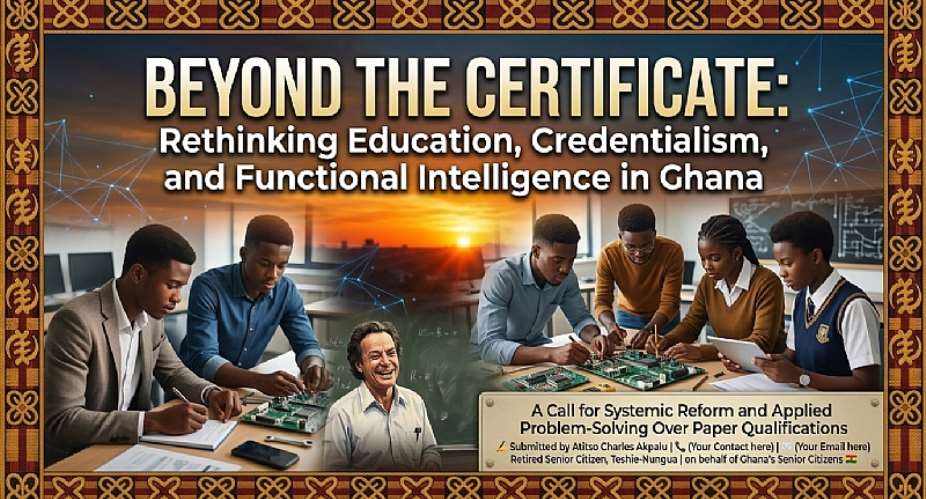
Ghana’s developmental landscape stands at a profound epistemic crossroads. Every academic year, our tertiary institutions, secondary schools, and training academies churn out thousands of graduates decorated with colorful certificates, advanced degrees, and high academic honors. Yet, our most pressing structural challenges—from macro-economic instability to local industrial stagnation and environmental degradation—persist. As a society, we have fallen into the dangerous trap of conflating formal schooling with systemic education, and paper credentials with functional intelligence. This institutional crisis is rooted in a pedagogical model that rewards rote memorization over critical inquiry. When our national metrics for academic excellence are reduced to the classic Ghanaian phrase "chew, pour, pass, and forget," we inadvertently build a workforce that possesses formal certification but lacks the cognitive agility to solve real-world problems. True intelligence is not the passive storage of textbook definitions; it is the capacity to critically analyze complex, systemic issues and translate them into actionable, localized solutions. If we are to achieve sustainable national development, we must urgently transition from a culture of credentialism to an ecosystem of applied understanding.
The Structural Gaps in Our Educational System
- The Dominance of Rote Pedagogies: Our classrooms heavily reward the verbatim replication of textbooks, a practice that stifles original thought, creative exploration, and the independent critical faculties of the student.
- The Myth of the Certificate: Public and private sectors heavily measure a human being's capability entirely by their paper qualifications, frequently overlooking practical technical competence, emotional intelligence, and problem-solving skills.
- Theoretical Jargon Over Localized Execution: Academic discourse in our universities often prioritizes complex foreign theories and buzzwords over teaching practical frameworks to solve immediate socioeconomic problems in the student's immediate community.
- The Suppression of Creative Risk: By penalizing errors instead of treating them as necessary steps in the experimental learning process, our current system produces risk-averse graduates who fear innovation, trial-and-error, and entrepreneurship.
Actionable Suggestions for Systemic Reform
- Institutionalize Applied Learning Frameworks: Academic institutions should restructure their coursework around active learning concepts like the Feynman Technique—forcing students to explain, test, and defend complex concepts in simple, accessible local language.
- Overhaul National Assessment Metrics: Examination bodies like WAEC and university faculties must shift grade weighting away from high-stakes, memory-based written exams toward long-term practical projects, field research, and laboratory case studies.
- Co-Design Curricula with Local Industries: Educational programs must be actively shaped alongside industry leaders, ensuring that academic research directly addresses the evolving engineering, technological, agricultural, and economic realities of the Ghanaian market.
- Dismantle Technical and Vocational Stigma: National policy and media orientation must consciously elevate technical pathways, celebrating vocational innovation as the primary engine driving our domestic manufacturing and industrial self-reliance.
- Mandate Local Community Capstone Projects: Tertiary institutions should require students to complete graduation projects where they design, test, and implement practical solutions for tangible ecological or infrastructural issues within their districts.
A nation’s true wealth does not reside in the collective weight of the certificates archived in its institutions, but in the practical, problem-solving intelligence of its citizens. We must break free from the dogmatic belief that human capability is determined strictly by academic titles. As the legendary physicist Richard Feynman championed throughout his life, we must always distinguish between knowing the mere name of something and truly understanding it. Ghana desperately needs thinkers, builders, innovators, and doers—not just brilliant test-takers. By shifting our national focus from the accumulation of paper credentials to the rigorous cultivation of practical understanding and critical thinking, we will unlock the authentic potential of the Ghanaian youth. Let us choose to build an educational framework that does not merely teach people what to think to pass an exam, but equips them with the tools of how to think to transform a nation.
✍️ Submitted by:
Retired Senior Citizen
For and on behalf of all Senior Citizens of the Republic of Ghana 🇬🇭
Teshie-Nungua
[email protected]

 October 19: Cedi sells at GHS12.25 on forex market, GHS11.67 on BoG interbank
 ECOWAS, AES move to establish cooperation framework after Dakar meeting
 NDC orders interdicted Obuasi SHS headmaster to withdraw from Juaben chairmanshi...
 District Mining Committees to issue mining licences under new law — Lands Minist...
 Ghana to experience afternoon thunderstorms in some areas today as Met Agency wa...
 Government misses treasury bill target by GH¢1.53bn as yields record mixed movem...
 NDC organiser aspirant Alfa Justice criticised over military-style campaign post...
 Ablakwa cites GH¢96.97m COVID-19 evacuation cost to counter Minority’s GH¢16m cl...
 "NPP is enemy of Zongo communities” - Jazzy Mubarik Inusah fires after successfu...
 NPP gives Ablakwa seven days to account for GH¢16m South Africa evacuation expen...


