




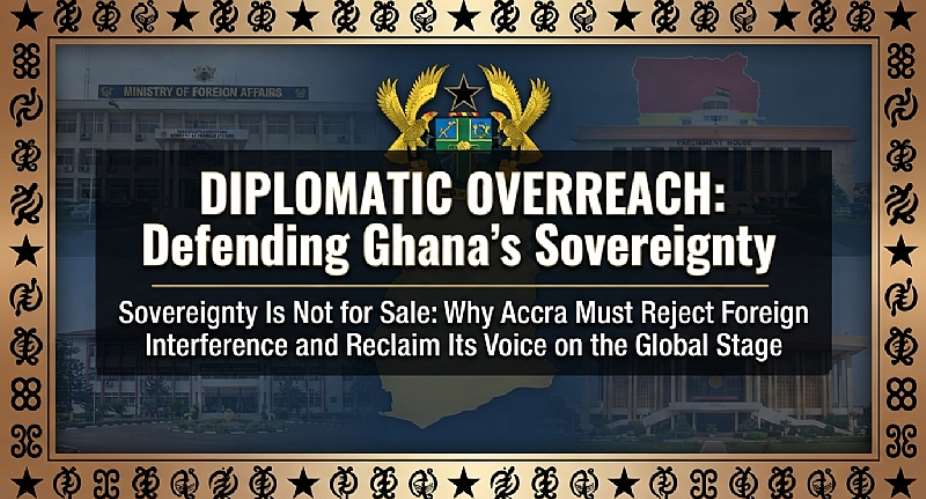
Accra, Ghana — In diplomacy, mutual respect is the foundational bedrock upon which international relations are built. The Vienna Convention on Diplomatic Relations explicitly forbids foreign envoys from interfering in the internal politics or public discourse of their host nations. Yet, the recent actions of the Israeli Ambassador to Ghana, Roey Gilad—who convened a press conference to publicly chastise and "fact-check" former President John Dramani Mahama—represent a grave breach of diplomatic decorum. By attempting to weaponise Ghana's stance on the Russia-Ukraine war to deflect from international criticism of the humanitarian crisis in Palestine, the ambassador overstepped his bounds. Ghanaians must stand united in rejecting any attempts by foreign entities to dictate, gaslight, or manipulate our national foreign policy, which has always been anchored on independence, justice, and the historic principles of the Non-Aligned Movement.
To safeguard Ghana's international standing and protect our sovereign decision-making, the following key points outline the core issues of this controversy and the actions Ghana must take regarding global conflicts:
The Diplomatic Controversy Breakdown
- Breach of Protocol: The Israeli Ambassador’s public reprimand of a Ghanaian statesman on local soil violates the spirit of the Vienna Convention, setting a dangerous precedent for foreign interference.
- Diplomatic Deflection: The envoy's critique attempted to use Ghana's clear position on the Russia-Ukraine war as a geopolitical counterweight to suppress domestic conversations regarding Palestine.
- Sovereignty Under Threat: Foreign policy objectives must be formulated independently in Accra, free from the intimidation or undue influence of external superpowers or foreign embassies.
Actionable Policy Trajectory on the Russia-Ukraine War
- Consistent UN Voting: Ghana must maintain its principled stance at the United Nations General Assembly, consistently voting to condemn territorial aggression and uphold international law.
- Advocacy for Peaceful Mediation: Our foreign ministry should champion a non-military, diplomatic resolution to the European conflict, utilizing international legal frameworks to push for dialogue.
- Refusal of Geopolitical Gaslighting: Ghana must firmly reject any narrative that equates its legal stance against aggression in Europe with a requirement to stay silent on humanitarian crises elsewhere.
Strategic Recommendations and Suggestions
- Summon the Ambassador: The Ministry of Foreign Affairs and Regional Integration should immediately summon Ambassador Roey Gilad to officially caution him against overstepping diplomatic boundaries.
- Reaffirm Non-Aligned Principles: Parliament and the executive should issue a joint bipartisan statement reaffirming Ghana's commitment to an independent, non-aligned foreign policy.
- Establish Clear Code of Conduct: The government should reinforce guidelines for foreign diplomatic missions in Accra regarding public press conferences that target domestic political figures.
- Diversify Global Partnerships: Ghana must strengthen ties with balanced global coalitions to insulate its economy and political leverage from being monopolized by any single geopolitical bloc.
Ghana did not fight for independence only to have its foreign policy managed or policed by foreign diplomats. Our nation's voice on the global stage—whether condemning aggression in Ukraine or highlighting suffering in Palestine—must remain fair, objective, and entirely our own. The Ministry of Foreign Affairs must act swiftly to defend Ghana's sovereign dignity and send a clear message to all foreign missions that our hospitality must not be mistaken for docility. As a pioneer of African liberation, Ghana must continue to lead with a foreign policy that is fiercely independent, deeply principled, and unyielding to external pressure.
✍️ Submitted by:
Retired Senior Citizen
For and on behalf of all Senior Citizens of the Republic of Ghana 🇬🇭
Teshie-Nungua
[email protected]

 CDD‑Ghana: EC Deputy Chair Should Step Down Now
 Family Announces October 23 Memorial Mass for Nana Konadu Agyeman-Rawlings
 Eduwatch Urges Nationwide Audit of Sexual Misconduct in Secondary Schools
 Obuasi SHTS alleged sexual abuse: Kwasi Kwarteng criticises Education Minister o...
 ECOWAS’ $250,000 flood relief donation arrives in Ghana – Ablakwa
 Kennedy Agyapong has not resigned from NPP – Kwasi Kwarteng
 State failure, not GoldBod, driving galamsey – Daryl Bosu
 A Rocha Ghana raises alarm over human rights abuses in mining communities
 ECOWAS, AfDB discuss ways to advance West Africa’s development priorities
 October 16: Cedi gains against dollar, sells at GHS12.25 on forex market, GHS11....


