




Preamble
Having places to sell commodities will not automatically make people to trade all round the clock, especially if not backed by demand for the Commodities. The Kejetia Modern Transport Terminal and Market Complex termed as Kumasi Dubai with better assets than the 24-hour markets being rolled out, is an example since it operates from 5am (0500hrs) to 730pm (1930hrs) with only Security, Cleaners and to some extent the Medical Team and ATM of Banks doing 24-Hour Economy activity. Interestingly, the nearby Pampso Market operates 24/7.
The Kejetia Modern Transport Terminal and Market Complex opens from 5am (0500hrs) to 730pm (1930hrs) hence should be regarded as a Control Market. The operation period has therefore alienated the main Clients of the Market or Actors like the Traders, Transporters and Commuters from operating after 1930hrs, as such any of the mentioned Actors in the Market is forcefully ejected after 1930hours, otherwise treated as trespassers or enemy hence arrested and handed to the Police, if found during the closing period.
It is only the Service Providers as Security, Cleaners etc who are the players who work all round the clock but on 12hours shift and not the three shift system or the 8hours tour of duty per shift system as expected/proclaimed.
Retired Major Mohammed Bogobiri, a Student of Security risk Management was the pioneer of the security operation system of the Kejetia Modern Transport Terminal and Market Complex, he issued the Policy on Security and CCTV Systems, so he has very good experiences of the State of affairs. He made efforts to get part of the Site to operate at least up to 10pm in order to allow the numerous Tailors etc at designated areas to operate without success. An updated Report of the Risk Assessment of the Kejetia Modern Transport Terminal and Market Complex prepared by him in 2017 was handed over to the current Mayor of KMA, alias Hon Mr Zuba in 2025.
The Relevant economy program of the Reset Agenda
The Government of Ghana under the regime of His Excellency President JD Mahama has introduced a Resetting Agenda. Among others, the Agenda encompasses a broad macroeconomic and structural policy termed as 24-hour economy program while a 24-hour market has the physical infrastructures for the transporting and trading projects and for the control systems for an expected 24/7 operation.
A Market is an aspect of Economy, so 24-hour market should be a subset of the 24-hour economy program. Unfortunately, the Director General or the CEO of the 24-hour Economy Authority namely Hon Mr Gossie Tanoh has proclaimed that the 24-hour market system is not under the Authority or the Authority has no oversight responsibility for 24-hour Markets. Notwithstanding the fact that demand and supply by trading (buying and selling) of goods and service makes a Market as an economy.
So you may hear a Kejetia trader telling that the market hence the trading (selling and buying) is not good nowadays. So a definition of the two in the Reset Agenda will make give clear picture how the two are related with the 24-hour Economy as Economy activities all-round the clock whilst the 24-hour Markets in the Resetting Agenda as places where 24-hour Economy activity is expected to take place.
24-Hour Economy
It has been found that the IT Revolution, globalization and digitalization are shifting workforce demographic coverage towards a demand for continuous around the clock economic ecosystem. So production systems and the supply chain operate seamlessly without time zone constraints/bottlenecks.
Thus the traditional working period from 8 am (0800hrs) to 5pm (1700hrs) otherwise from 6am (0600hrs) to 6pm (1800Hrs) in the economy is becoming a vestige of the past, thus providing space for all round the clock hence 24-Hour economic ecosystem, as a critical strategic imperative for driving modern economic growth hence inclusive growth, for wealth and job creations and urban buoyancy.
So, the 24-Hour Economy in the Resetting Agenda is regarded as a comprehensive national economic strategy where processing especially agro-processing, fabrication, manufacturing, mining hence economic production ventures and the related services, governance system, and commerce (Market) operate around the clock. Hopefully for boosting local production through the labor mechanism as the three-shift system by that the creation of more jobs for the teeming youth.
So, the core aim of the 24-Hour Economy in the Reset Agenda is to drive industrialization to boost local production to meet both local (internal) and external (exports) demand thus by shifting the entire nation into a continuous productive cycle with the resultant import substitution and creation of more sustainable jobs.
For the success of the 24-Hour Economy in the Reset Agenda is to be backed by government policy interventions such as tax incentives, cheaper and reliable power, financing, with the ancillary security, safety, environmental, and health services frameworks thus all-embracing entities.
24-Hour Market
A 24-Hour Market is regarded as a physical, modern multipurpose marketplace with vibrant ancillary services especially transport with the hope to shift traditional daytime commerce into all round the clock economic engines So need the site for the Markets to have Night Tourism initiatives or ancillary support services say transport, and with nearby evening projects/ eateries, entertainment hubs.
Thus for the success of 24-Hour Markets as being rolled out by Ghana, need to introduce or encourage targeted night tourism to ensure to support them with great transport flow to their areas to generate vibrant night life.
A 24-Hour Market is expected to have good waste management, and ancillary services such as banks, clinics, crèches, and security (private security, police and fire stations assets and personnel) serving as a physical touch point or supply-chain support rather than the entire economy itself.
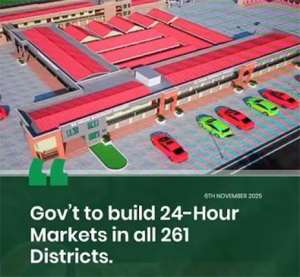
A 24-Hour Market under the Resetting Agenda, involves infrastructure to be built across districts to host commercial activities. It involves the provision of safe, structured trading hubs complete with lockable stalls, cold storage for farm produce to cut post-harvest losses. .
So it is expected that 24-Hour Markets will be anchored on the broader 24-Hour Economy program. But the 24-Hour Markets are to be managed under local government system by the district assemblies rather than the 24-Hour Economy Secretariat or Authority. So, there should be a thin line between the 24-Hour Economy Authority and 24-Hour Market Secretariat, at least with desk schedule or liaison officers.
It is unfortunate that the Government adopted a top down approach with the 24-Hour Markets, this led to one size Market Model (the same, same) as fit for all the 261 Districts. Thus demo a failure to conduct risk assessment before rolling out this very good idea. Hence, it has been realized that the 24-Hour Market is being imposed on the people.
Hmm, her Excellency Mrs. Nana Konadu Agyemam Rawlings in her Book ‘It Takes a Woman’ called on Africans especially Ghanaians to document and to learn their Histories. Unfortunately, Ghana will never learn especially with the history of Galamsey named in English by the PNDC as Small Scale Mining (note a decorated donkey is still a donkey) posing existential threat by causing serious harm to the environment, health, safety and security of Ghana.
So there is also the genuine fear of turning the good people from real production activity to doing marketing jobs especially with Ghana making noises that she wants to join BRICS and Bank of Ghana is thoughtlessly allowing the use of the Cedis instead of the US Dollar for import of goods from China. Cry the Beloved Country.
BOG must appreciate that Ghana has porous borders where Border Security, exist the corruption in the Ghanaian DNA, hence the unpatriotic state of affairs of the Ghanaian posture will lead to comprise with smugglers to bring very cheap and poor standard goods into Ghana.
Scarcity of an item say dollars is to afford good control measures, so making the use of the local currency that is the Cedis for business transaction for merchandize between Ghana and China will turn Ghana into dumping Warehouse thus crowd the Market with Chinese goods, I do not think this is the reason the Government is working hard in preparation to turn into grand marketplace with the 24-Hour Markets.
Note Ghana made a sad thing in 2012 that led to the importation of thousands of excavators to Ghana from China for Small Scale Mining to be intensified daily with the enactment of Minerals and Mining Support Regulation 2012 (LI2174). Ghana had the thinking to support Miners but this law is Ghana’s nemesis or enemy. Google and Read ‘Retired Mohammed Bogobiri’s article on Declare State of Emergency and Review the Small Scale Mining Law’.
Hmm, so promotion of another system of galamsey (gather and sell) with cheap products from China, India in the making. So Ghana must rethink with the noise of joining the BRICS, if necessary then Ghana should join as a partner, otherwise some greedy Ghanaians (with the propensity to front for foreigners) and their Chinese accomplices will intensify their effort to turn Ghana into the biggest Warehouse for Cheap and low standard Chinese goods. Note Rice farmers cannot get buyers for their rice due to Ghana as a Warehouse for cheap rice from Thailand etc. Expect an article warning Ghana to be very careful with joining BRICS.
Enter 24-Hour Market. One of the most compelling economic debates for the 24-Hour Market is need for the optimization of existing assets. So the questions or litmus tests are (a). Should the Nation continue with the one size fit for all for the 261 Districts with a 24-Hour Market model drawn by a Consultant in Accra?. Thus there is the likelihood of creating white elephants (that is some market may be underutilized) in some districts. OR (b). Should 24-Hour Market be based on each area economic activity?
So, one may ask should Market Models be tailored well and placed in the Districts which are recording high internal revenue, trade volume or should Ghana maintains the current evenly distribution of 24-Hour Markets like sharing cakes (bofroto, kosay or massa) evenly across all the districts regardless of the current population with the associated economic activity?
Thus the Champions of the 24-Hour Markets had/have a very wrong thinking mindset with the evenly distributions of the 24-Hour Market with the top down approach, with the hope that the 24-Hour Markets can or may make the country turn into resilient nonstop local market places to be engines of wealth creation, job growth hence inclusive growth.
This may not be so, thus, need to change, hmm reset the Minds of the Champions of the 24-Hour Markets to stop the seemingly imposition of the 24-Hour Markets on the people with the top down approach. A 24-Hour Market is a puzzle as such, it has made some good people or some good communities or some good Chiefs like the revered and respectful Dormahene to kick against the 24-Hour Markets at their Districts. Just like the Chief and People of some communities like Agogo, Atroni near Bibiani fighting their Government for attempting to impose Community Mining at their areas.
Some of the people including Dormahene rather expressed their wish for the completion of the Agenda 111 Hospitals in their Districts, which will also create 24hour economy with in-house services, ancillary services with the associated supply chain including food vendors, transporters, drugstores or pharmacies, laboratories, etc.
So need to change the narrative by making the expected 24-Hour Markets to represent a structural reengineering of local commerce by leveraging existing economic nodes and equipping them with modern infrastructure to eliminate post-harvest losses or waste.
So, imposing 24-Hour Markets on Communities without assessing local economic realities risk underutilizing these infrastructures or making them to be dumping warehouses for cheap Chinese goods. Consequently, there is the need to rethink so that the 24-Hour Markets are grounded with specific high demand local goods say foodstuffs like grains, fish, plantain and yam.
Hence they should be established into the existing economic drivers like commodity hubs like the Konkomba Yam Market at Agogbloshie, Accra or the fish Commodity and food market/Social Market of the old Labadi Beach system Accra which was under the Labadi Traditional Leaders. Unfortunately, Ghana is ejecting the Yam Market at Agogbloshie, Accra to pave way for the marketing of Chinese goods. The old Labadi Beach Market under the Labadi Traditional Leaders is gone. Cry the Beloved Country.
Markets establish into existing economic drivers like the Konkomba Yam Market at Agogbloshie, Accra are more practical approach than building generic top down structures. Since in some areas like the existing Kumasi Race Course Open Air Market, what may be required to make it a formal 24-Hour Market may be good roads, repair or bridges, gravelling of the ground, lighting system etc. See Retired Major Mohammed Bogobiri’s next article on ‘Transform the Race Course Market in Kumasi into a functioning 24-hour market as a Model Market initiative under Ghana’s 24-Hour Economy.
24-Hour Markets should be economic demand driven or demand responsive. A demand driven approach, to be anchored by functional infrastructure rather than the top down mandate is a better option. So 24-Hour Market should be rooted in existing local economic activities such as the Yam Market in Accra, fish landing sites markets, Rice Market in the North with the supporting supply chain. Thus effort must be made to drive volume of trades, transport flows, within organic consumer demand, may lead to create night markets close to the people, hence cheap products to buy and the place is easily accessible to the masses. This may make the Markets to be logical foundations for extended hours of operation.
So need to avoid disrupting thousands of active livelihoods and rather work on the transformation what may be seen as slums or ghetto markets into modern markets through livelihood protection by upgrading or integrating existing commodity hubs into formal economy rather than displacing vibrant communities. So Ghana needs to assess local economic strength, the local economic activity or state of raw material production and transport links and provide the required need and as in the Article ‘Transform the existing Race Course Market in Kumasi into a functioning 24-hour market as a Model Market initiative under Ghana’s 24-Hour Economy to be published on the website of Modern Ghana.
Building all round the clock markets without grounding them with local productivity, local raw material availability with real market demand risk making them galamsey (gather and sell) sites or as white elephants. So need for markets which give Ghana the reason to produce/increase production, supply the goods and services for production, hence reason to invest in production and reason to trade local goods since there is a very good reason for the consumer to go the Market to buy the goods .
So the concept of the one size 24-Hour Market model as fit for all the districts in Ghana is a puzzle. Since having places to sell commodities will not automatically make people to trade all round the clock. The Race Course Open Air Market in Kumasi is a very good candidate as 24-Hour Market, since foodstuffs like yam from the North and Onion are delivered at night, with a lot of women or traders trooping or waiting there in the night to buy cheap foodstuffs for resale or consumption.
This was the state of affairs at Brigadier General Guggisburg’s Kumasi Old Central Market and Makola Market which were both built as Open Air Market in 1924 in the colonial era. But the Modern Kejetia Market termed as Kumasi Dubai in Nkrumah’s Ghana operates from 5am to 730pm or 1930hrs with only Security, Cleaners and to some elements of the Medical Team and ATM doing 24-Hour Economy activity.
District Economy Markets
So, it is heartwarming that Hon Mr Mahama Ayariga, the new Minister of Local Government has to make a U-turn by changing his predecessor’s one size type of 24-Hour Market model as fit for all the districts in Ghana by redesigning the 24-Hour Markets as District Economy Markets to make them as Catalyst for Modern Economy Activity. The Minister needs to educate Ghanaians why this U-turn.
Hon Mr Mahama Ayariga needs the support of the Citizens to make President Mahama’s legacy a very great success. So his dear brother Mr Hassan Ayariga’s call for the reasons for the lack of policy consistency with the 24-Hour Markets was a good one , for the reason for the change of the narrative by his dear brother Hon Mr Mahama Ayariga. This motivated the submission of this paper from their Northern Brother, namely retired Major Mohammed Bogobiri in support of the Reset Agenda being Championed by His Excellency President JD Mahama, who coincidentally is the senior Northern Brother of the above three mentioned persons.
Ghana must change the narrative with the 24-Hour Markets in order not make them Galamsey (gather and sell) sites for Chinese goods and thus turn Ghana into the biggest Warehouse for Chinese goods especially with the noise to join BRICS and BOG saying that Cedis can be used to buy Chinese goods.


 Afenyo-Markin must clear his name over extortion allegation – Kwame Anthony
 Sports Minister, GTA CEO must step aside over World Cup visa scandal – NPP
 NPA secures specialised court to prosecute petroleum product diversion offenders
 Ghanaians have been paying 20% tax on Netflix, Spotify and others since 2022 – G...
 NPP’s position on Affi Agbenyo contradicts its past conduct – NDC's Dr Djokoto
 Extortionist allegations: Afenyo-Markin’s defamation suit was to save face – NDC...
 We must praises NDC for stabilising Ghana's economy – Stephen Amoah
 Chairman Wontumi returned to Nsawam as court adjourns bail ruling to November 4
 NDC can retain power in 2028 on Mahama’s records – Kwame Anthony
 October 15: Cedi sells at GHS12.30 on forex market, GHS11.68 on BoG interbank


