




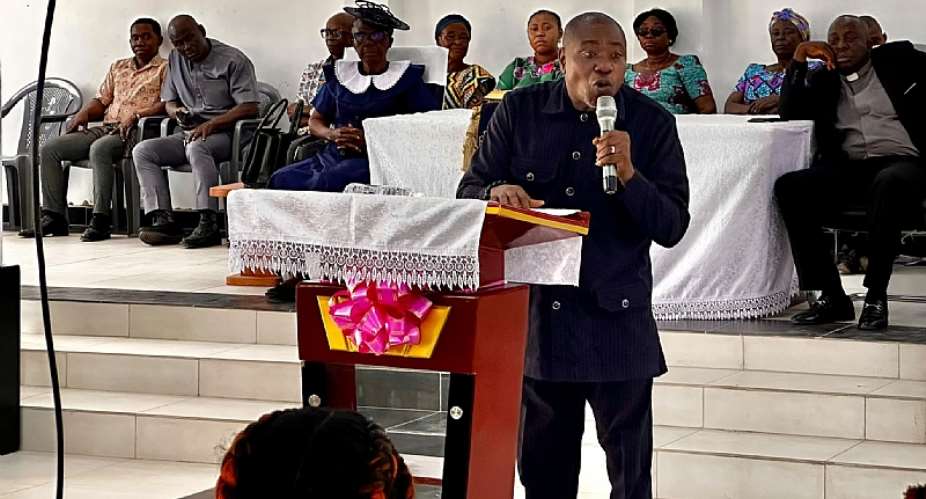
In a decisive push to prevent family disputes, land fraud, and the disinheritance of vulnerable spouses and children, the Commission on Human Rights and Administrative Justice (CHRAJ) has taken its legal education drive to the faith community, with a comprehensive outreach on inheritance rights under both scripture and Ghanaian law.
The educational intervention was held on Sunday, October 11, 2026, at the Shalom Presbyterian Church of Christ, Pantang, where officers from the La-Nkwantanang Madina Municipal Office of CHRAJ engaged the congregation on the theme "Faith that Leaves Inheritance for the Next Generation: The Right to Inheritance Under Scripture and Ghanaian Laws.”
The session was led by Mr. John Ato Breboh, Investigator, accompanied by Mr. Maxwell Desire Afrey-Mensah, Ms. Zoe Gina Effina Williams, and Mr. Ebenezer Amaquandoh, all investigators at the Municipal Office.
The outreach sought to bridge a critical gap—improving the congregation’s understanding of the biblical imperative for inheritance planning and the strict legal framework governing the acquisition, ownership, and distribution of property in Ghana.
Addressing the congregation after morning worship, Mr. Breboh explained that inheritance extends beyond the transfer of physical assets such as money, land, houses, and other property. It also encompasses the transmission of goodwill, reputation, faith, and tradition to succeeding generations.
He noted that inheritance planning is a crucial responsibility for individuals who wish to preserve their legacies and secure the future of their children and descendants, drawing on Proverbs 13:22—"A good man leaveth an inheritance to his children’s children”—as a reflection of the duty to prepare for future generations.
Mr. Breboh cautioned prospective landowners to exercise utmost due diligence before purchasing land intended as inheritance, warning of rampant fraudulent transactions in the land market.
He explained that unscrupulous vendors often sell the same parcel of land to multiple buyers, resulting in protracted litigation and loss of investments. He linked the warning to the legal doctrine of caveat emptor—"let the buyer beware”—and urged individuals to verify ownership, conduct searches at the Lands Commission, and establish legitimacy of transactions before making payments.
This caution is particularly relevant as land remains the most contested asset in Ghana’s inheritance disputes.
On marital property rights, Mr. Breboh cited Article 18 of the 1992 Constitution, which guarantees the right of every person to own property alone or in association with others, and Sections 38 and 47 of the Land Act, 2020 (Act 1036), which govern registration, spousal interests, and transfer of property.
He emphasized that property acquired during marriage carries spousal interests, regardless of whose name is on the documents. The circumstances surrounding acquisition and contributions of each spouse become significant when disputes arise, particularly upon divorce, separation, or death.
He advised married couples to understand their property rights and the legal requirement of spousal consent in transactions involving marital property.
According to Mr. Breboh, a will enables a person—known in law as the testator—to state clearly how their property should be distributed after death, thereby minimizing uncertainty. Citing 2 Kings 20:1, which urges to “set thine house in order,” he encouraged Christians to put their affairs in order while alive.
He explained that where a person dies without a valid will, the estate is distributed under the Intestate Succession Law, 1985 (PNDCL 111), which provides a statutory formula for sharing among surviving spouse, children, and family. Proper estate planning, he said, protects beneficiaries and drastically reduces acrimonious disputes among surviving families.
The interactive session revealed deep public anxiety about inheritance law. The congregation raised critical legal questions:
Mr. Breboh clarified that under the Wills Act, 1971 (Act 360), an executor can be appointed and informed without necessarily being given the full contents of the will during the testator’s lifetime, and that an executor can also be a beneficiary if validly appointed.
On custody of wills, he addressed what happens if a lawyer keeping a will dies before the testator and explained that a duplicate copy retained by the firm and secure custody arrangements are essential to prevent loss of the will.
On separated but not divorced spouses, he clarified that courts will examine contributions and circumstances of acquisition when determining respective interests in jointly and individually acquired property during the subsistence of the marriage.
On multiple wills, he explained that a will is ambulatory—a testator can amend or revoke it during their lifetime. A subsequent valid will revokes an earlier one, while a codicil can be used to amend an existing will.
On disinheritance of children, he referred to Article 28 of the 1992 Constitution, Section 7 of the Children’s Act, 1998 (Act 56), and Section 13 of the Wills Act, 1971 (Act 360), which provide for reasonable provision for children.
He noted that while a testator has testamentary freedom, the law may provide relief to dependent children excluded from a will, depending on age, dependency, and facts of the case, as illustrated by judicial decisions.
The outreach forms part of CHRAJ’s mandate to promote human rights and administrative justice through public education, encouraging informed decision-making on matters that affect families, property ownership, and community stability.







 Afenyo-Markin must clear his name over extortion allegation – Kwame Anthony
 Sports Minister, GTA CEO must step aside over World Cup visa scandal – NPP
 NPA secures specialised court to prosecute petroleum product diversion offenders
 Ghanaians have been paying 20% tax on Netflix, Spotify and others since 2022 – G...
 NPP’s position on Affi Agbenyo contradicts its past conduct – NDC's Dr Djokoto
 Extortionist allegations: Afenyo-Markin’s defamation suit was to save face – NDC...
 We must praises NDC for stabilising Ghana's economy – Stephen Amoah
 Chairman Wontumi returned to Nsawam as court adjourns bail ruling to November 4
 NDC can retain power in 2028 on Mahama’s records – Kwame Anthony
 October 15: Cedi sells at GHS12.30 on forex market, GHS11.68 on BoG interbank


