




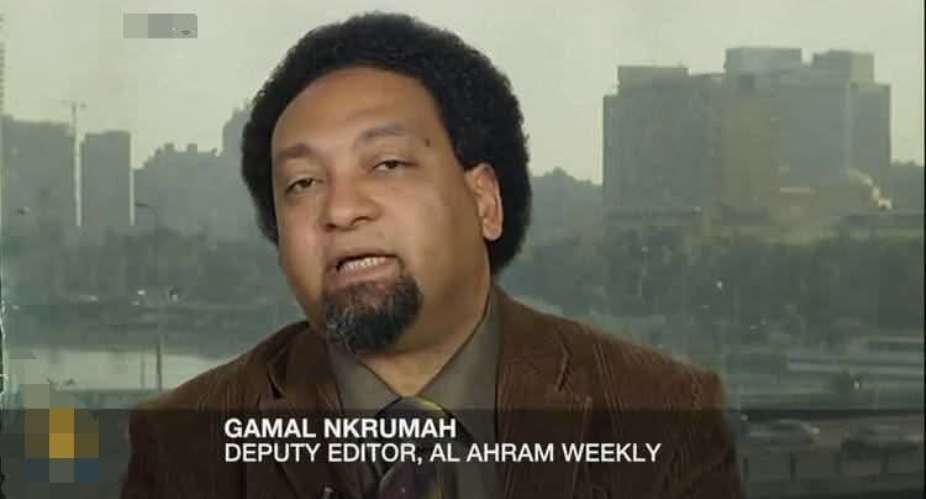
Some journalists report on Africa. A few carry it in their work. Gamal Nkrumah, who died in Cairo on 14 October 2026 at 68, was one of them.
A reader's debt
From the late 1990s to 2010, I read almost everything published about Africa: the dailies, the weeklies and the monthlies. Focus on Africa and New African magazine were part of my routine, and I read with a hunger that felt less like a habit than a calling. In that world, I learned to tell a writer who merely described Africa from one who understood it.
Gamal Nkrumah belonged to the second kind. His work had the grounding, the historical depth and the unsentimental honesty that separated analysis from commentary. Nigeria and Ghana 1998- 2010
The man and his training
Born in Accra in 1958, the eldest son of Kwame Nkrumah and Fathia Nkrumah, he could have lived on his father's name. He chose the harder road, earning a doctorate in political science from SOAS and spending more than fifteen years at Al-Ahram Weekly in Cairo, where he came to lead its international affairs coverage.
A body of work that refused comfortable answers
On Africa's unspoken divisions (1999). In an Al-Ahram Weekly piece of 30 December 1999 (Issue 462), he noted that sub-Saharan Africans have not forgotten the Arab slave trade, which preceded and outlasted the European one, and he did not soften their criticism of racist attitudes in North Africa.
He also called the dismantling of racial discrimination in Southern Africa the century's greatest unfinished business. He wrote this from Cairo, as a Ghanaian, without apology to either side.
On Ethiopia and Islam ("A leap of faith"). He traced how early Muslims sought refuge in Ethiopia and how Egypt's expansion under Mohamed Ali brought it into conflict with the Christian Abyssinian kingdom. The piece shows his habit of making history explain the present, in this case the tensions of the Nile Basin.
On South Sudan (2014). In "South Sudanese ceasefire?" (31 January 2014), he assessed the tentative truce signed in Addis Ababa, the regional players behind it, and the risk of lingering resistance. In "Memo to Machar" (2 May 2014), he argued that peace, not war, was the better way for Riek Machar to reward his followers.
He linked the conflict to a million people facing starvation, the stalled Jonglei Canal and the Egypt–Ethiopia rivalry over the Renaissance Dam, and noted Khartoum's role in arming both sides.
On the West and Islam. He also wrote an essay on a wave of Western artistic attacks on Islam, showing his willingness to take on culturally charged subjects.
Across these pieces, a pattern emerges. He treated the Nile, the Sahel, the Horn and the Gulf as one connected story, and he held every actor to account, African and non-African, Arab and sub-Saharan alike. That is pan-Africanism as a discipline of honest analysis, not a slogan.
What he leaves us
His family said he remained committed to justice, human dignity, African unity and international solidarity. His work bears that out. For those of us who write without a newsroom's protection, he showed that rooted and rigorous can be the same thing.
Those years of reading taught me what serious African journalism sounds like. Gamal Nkrumah wrote it. We will keep reading him, and keep writing in the tradition he served.
Rest in peace, Gamal Nkrumah.
Mustapha Bature Sallama
Medical/Science communicator, Private Investigator, Criminal Investigation and Intelligence Analysis,United States Institute of Peace (USIP), [email protected] +233555275880


 We will remove Affi Agbenyo from EC if NPP returns to power – Kamal-Deen
 Ghana’s economic activity grows 7.4% in July 2026, services lead
 Five remand prisoners remain at large after escape from Konongo police cells
 Burkina Faso bans beauty pageants
 We must praises NDC for stabilising Ghana's economy – Stephen Amoah
 Chairman Wontumi returned to Nsawam as court adjourns bail ruling to November 4
 NDC can retain power in 2028 on Mahama’s records – Kwame Anthony
 October 15: Cedi sells at GHS12.30 on forex market, GHS11.68 on BoG interbank
 Court to rule on Wontumi’s bail pending appeal on November 4
 Police arrest eight in crackdown on suspected drug trade at Okaishie Drug Lane


