




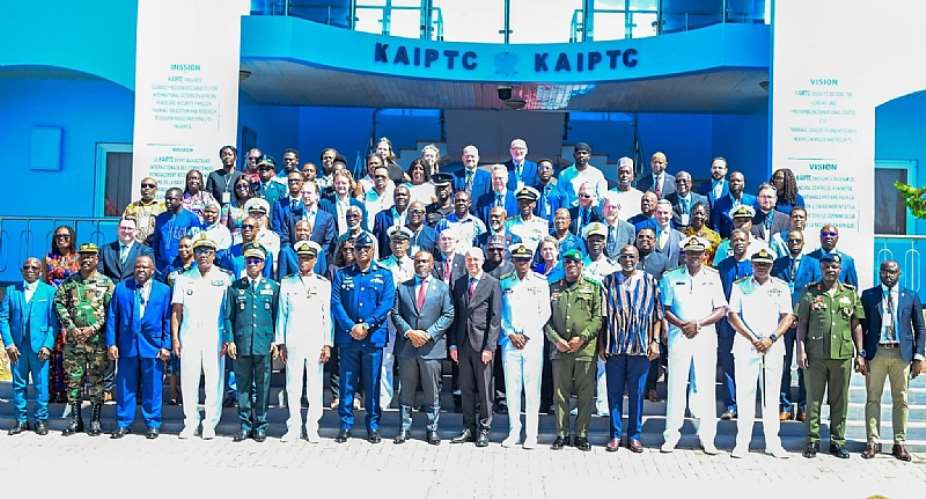
ACCRA, Oct. 15, 2026. Piracy in the Gulf of Guinea has fallen sharply, but the waters around Africa are not getting safer. They are becoming more contested. That was the underlying message of the 1st African Maritime Security Forum, which opened on Wednesday at the Kofi Annan International Peacekeeping Training Centre (KAIPTC) in Accra.
Held under the theme "The African Maritime Landscape in Times of Geopolitical Uncertainty in 2026 and Beyond," the two-day forum is hosted by KAIPTC, the Security Institute for Governance and Leadership in Africa (SIGLA) at Stellenbosch University and the Royal Danish Defence College.
It is organized under the Danish Peace and Stabilisation Fund's Maritime Security Programme for the Gulf of Guinea, which covers 2022 to 2026. Naval chiefs, generals, policymakers, diplomats and researchers attended the opening ceremony.
A shared space, not a boundary
Ghana's Minister for Defence, Kenneth Gilbert Adjei, opened the forum as Guest of Honour and welcomed participants on behalf of the government. He described the sea as a source of livelihood, a strategic avenue for trade and a shared space whose security is indispensable to national and regional prosperity, rather than merely a boundary or passage for commerce.
He warned that illicit activity along maritime routes can extend inland, cross borders and undermine the security of several states at once. No country, he said, regardless of its capabilities, can confront these threats in isolation.
"Our response must therefore be coordinated, intelligence-led and sustained by trust among nations," he said. He urged delegates to turn policy commitments into practical measures that deliver security, confidence and prosperity for coastal communities. He also thanked Denmark for its military, financial and training support, including capacity-building for special operations in the Ghana Armed Forces.
Progress, with caveats
The Commandant of KAIPTC, Air Vice Marshal David Anetey Akrong, said the forum's theme captures the realities of today's maritime environment. He noted that piracy in the Gulf of Guinea has declined significantly and credited collaborative regional initiatives, including the Yaoundé Architecture, the framework for maritime security cooperation and coordination among countries in the region.
Prof. Ishmael Theletsane, Director of the Organ on Politics, Defence and Security Affairs of the Southern African Development Community (SADC), offered a more sobering assessment. He identified policy challenges, institutional fragmentation, inadequate political will and limited information-sharing among institutions and states as the main obstacles to effective maritime governance.
He hoped the deliberations would yield practical solutions and strengthen existing mechanisms.
Danish Ambassador to Ghana Jakob Linulf said Denmark's cooperation with regional partners had helped reduce piracy in the Gulf of Guinea. He drew attention to the Middle East, where shipping disruptions have diverted vessels and added pressure on maritime security, and reaffirmed Denmark's commitment to helping partners build the capabilities to respond.
Where the debate is heading
The programme shows where the forum's attention is moving. Day 1's plenaries covered geopolitical change in and off Africa, including African maritime agency in times of uncertainty, the spillover of conflict from land to sea, and the role of BRICS+ in maritime diplomacy.
Afternoon sessions addressed the resurgence of piracy off Somalia, the implications of the dark fleet for littoral Africa, and the Cape Sea Route as the new normal for global shipping. A panel of naval leaders from Ghana, Nigeria, Kenya, South Africa and Sierra Leone then discussed the pitfalls and opportunities in strengthening maritime governance.
Thursday's agenda turns to technology and information: autonomous systems and drones as force multipliers, the legal questions they raise, and information fusion, including Ghana's National Maritime Fusion Centre and the Combined Maritime Task Force. Sessions on maritime chokepoints, minilateralism and Africa's role in shaping the future law of armed conflict at sea will close the forum.
Analysis: the test after the speeches
The forum's own framing carries a quiet admission. The speakers who celebrated falling piracy were the same ones who named fragmentation, weak political will and poor information-sharing as the continent's central weaknesses.
The old threat is receding while the new ones are harder to see. Dark fleets, opaque flag registries, illegal fishing and rerouted global trade do not fire on ships. They erode sovereignty and revenue quietly.
Africa cannot win this contest with declarations alone. It will depend on who controls registries, who funds patrols and fusion centres, and whether states share intelligence with each other as readily as they now receive support from outside partners.
The Minister's call for responses that are "coordinated, intelligence-led and sustained by trust" is the right standard. The measure
of this first forum will be whether delegates leave Accra with commitments they can be held to.
Credit Danish defense college, Ghana Army Forces and KAIPTC
Mustapha Bature Sallama
Medical/Science communicator, Private Investigator, Criminal Investigation and Intelligence Analysis,United States Institute of Peace (USIP), [email protected] +233555275880


 We will remove Affi Agbenyo from EC if NPP returns to power – Kamal-Deen
 Ghana’s economic activity grows 7.4% in July 2026, services lead
 Five remand prisoners remain at large after escape from Konongo police cells
 Burkina Faso bans beauty pageants
 We must praises NDC for stabilising Ghana's economy – Stephen Amoah
 Chairman Wontumi returned to Nsawam as court adjourns bail ruling to November 4
 NDC can retain power in 2028 on Mahama’s records – Kwame Anthony
 October 15: Cedi sells at GHS12.30 on forex market, GHS11.68 on BoG interbank
 Court to rule on Wontumi’s bail pending appeal on November 4
 Police arrest eight in crackdown on suspected drug trade at Okaishie Drug Lane


