




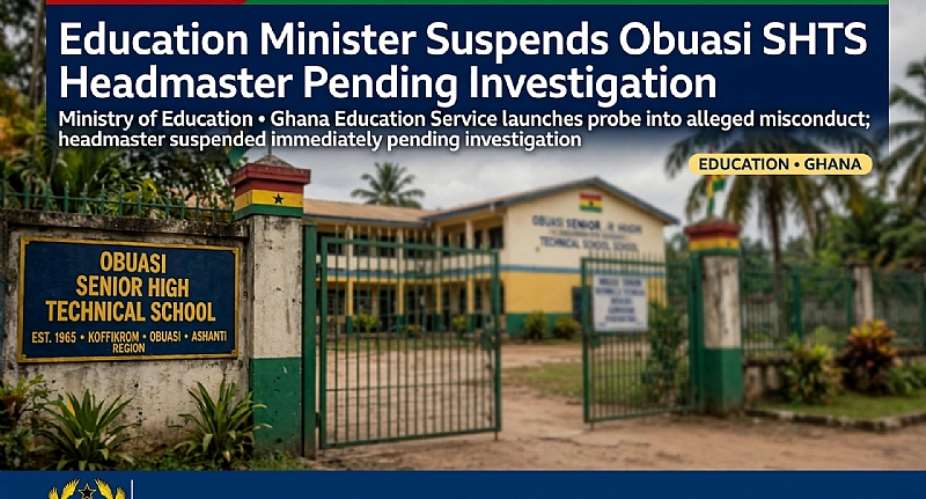
Ghana’s education authorities have ordered the immediate suspension of the Headmaster of Obuasi Senior High Technical School, Zakaria Abdulai, following serious allegations of sexual misconduct involving female students.
In a statement issued on October 13, 2026, the Minister of Education, Haruna Iddrisu, directed the Director-General of the Ghana Education Service to take immediate steps to suspend Mr Abdulai pending a full investigation. The minister also requested the Criminal Investigation Department Headquarters of the Ghana Police Service to begin a formal criminal investigation into the allegations.
The government’s intervention followed an investigation by JoyNews and investigative journalist Manasseh Azure Awuni, titled Inside the Dreaded Headmaster’s Bungalow. Reports associated with the investigation allege that 14 girls were affected—not 16, as stated in some social-media accounts. These claims remain allegations and must be tested through the official investigations.
The Ministry of Education described the matter as serious and reaffirmed that misconduct of this nature would not be tolerated in any educational institution. It stressed that parents and guardians entrust their children to teachers and school authorities with the expectation that they will protect them, not exploit or abuse them.
Suspension in such circumstances is an administrative measure intended to protect the integrity of the investigation and the welfare of students. It is not, by itself, a declaration of guilt. Mr Abdulai is entitled to due process and the presumption of innocence until the allegations have been independently investigated and, where appropriate, determined by a competent court.
The latest development follows violent disturbances at Obuasi SHTS on August 5, 2026. Some students attacked the headmaster after accusing him of involvement in alleged ritual activities on the school compound. His bungalow, household property and vehicle were damaged during the disturbance, while he sustained injuries and was admitted to the Komfo Anokye Teaching Hospital in Kumasi. Police subsequently arrested six students suspected of participating in the assault and destruction.
Two teachers were later arrested over allegations that they had instigated the students’ actions. Those arrests and the accusations that triggered the unrest should, however, be distinguished from the sexual-misconduct allegations now being investigated. Each claim requires independent examination based on evidence rather than rumour, public anger or social-media commentary.
Before the controversy, Mr Abdulai was presented by the school as an experienced education administrator. The school’s website says he had served as headmaster since 2015, held a doctorate in Educational Administration from the Kwame Nkrumah University of Science and Technology and had more than 25 years of experience in educational leadership.
That professional record neither proves nor disproves the allegations. The investigation must focus on verifiable evidence, including testimony from the affected students, school records, communications, witness accounts and any other relevant material. The identities and privacy of the students must also be protected throughout the process. They should receive confidential counselling, legal assistance and protection against intimidation or retaliation.
The case raises wider concerns about the safety of students—particularly girls—in Ghana’s boarding and day schools. Headmasters, teachers and other school employees exercise significant authority over students. When that power is abused, victims may remain silent because of fear, shame, threats, academic consequences or the belief that nobody will take their complaints seriously.
Schools therefore need reporting systems that do not require students to complain directly to the same officials they may be accusing. Every institution should have clearly identified safeguarding officers, confidential reporting channels and procedures for promptly referring possible criminal conduct to the police. Students must also be taught how to recognise inappropriate behaviour and where to seek help.
The Ministry’s intervention is an important first step, but public confidence will depend on what follows. The GES investigation and the police inquiry must be prompt, impartial and transparent without compromising the privacy of the students or the rights of the accused.
If sufficient evidence is established, the law and applicable professional disciplinary procedures must be enforced without fear or favour. If the allegations cannot be substantiated, that conclusion should likewise be communicated clearly. Justice requires protection for complainants, accountability for proven misconduct and fairness to every person under investigation.
The Obuasi SHTS case should ultimately lead to more than the suspension of one official. It should prompt a comprehensive examination of student safeguarding across Ghana’s educational system. Every child sent to school must be able to learn in an environment free from sexual exploitation, intimidation and abuse of authority.
Parents do not surrender their children’s safety when they hand them over to a school. They entrust that safety to the state, teachers and administrators. That trust must be protected through effective supervision, confidential reporting, independent investigations and firm action whenever misconduct is established.


 We will remove Affi Agbenyo from EC if NPP returns to power – Kamal-Deen
 Ghana’s economic activity grows 7.4% in July 2026, services lead
 Five remand prisoners remain at large after escape from Konongo police cells
 Burkina Faso bans beauty pageants
 We must praises NDC for stabilising Ghana's economy – Stephen Amoah
 Chairman Wontumi returned to Nsawam as court adjourns bail ruling to November 4
 NDC can retain power in 2028 on Mahama’s records – Kwame Anthony
 October 15: Cedi sells at GHS12.30 on forex market, GHS11.68 on BoG interbank
 Court to rule on Wontumi’s bail pending appeal on November 4
 Police arrest eight in crackdown on suspected drug trade at Okaishie Drug Lane


