




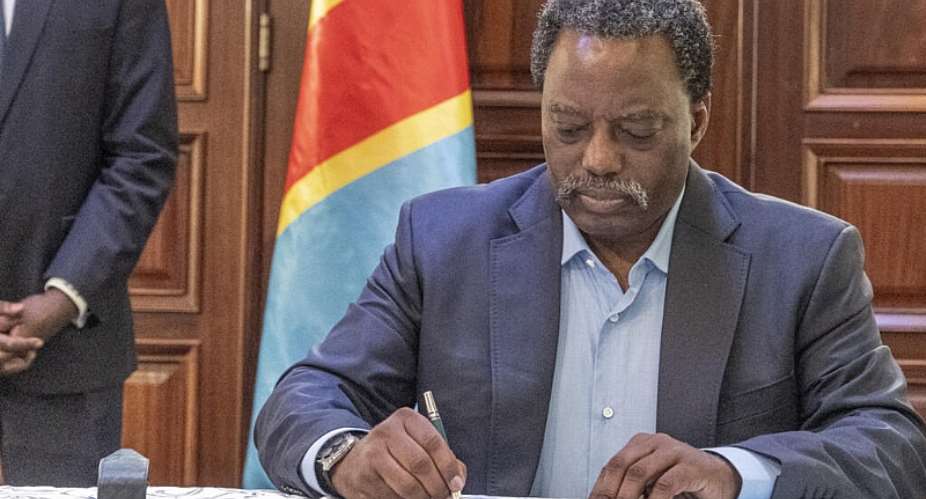
The alliance was unveiled on Monday at a joint press conference at Kabila's residence in Goma – the main city in eastern DRC which has been under M23 control since January 2025.
The new organisation, known as the Front pour la Refondation de la Nation, or FRN, was presented as a “politico-military” movement that would bring together the resources and forces of Kabila's supporters and the rebels.
Its stated objective is to “put an end to tyranny by any means, including force”.
Kabila will head the movement, with senior rebel figures serving as his deputies.
The announcement represents a significant escalation in the former president's confrontation with the government of his successor, Félix Tshisekedi, and brings together one of the country's most prominent political figures with an armed movement that controls large areas of eastern DRC.
Kabila, 55, ruled the country from 2001 until 2019 and has largely stayed out of public view since leaving office.
He was sentenced to death in absentia in 2025 after being convicted of “complicity” with the M23.
Congolese authorities have also accused him of being one of the driving forces behind the Congo River Alliance – known by its French acronym AFC – which previously served as the political wing of the M23 before being dissolved.
Kabila has denied those allegations.
Kabila death sentence deepens political and regional divides in DR Congo
Political tensions ahead of 2028
The alliance comes as political attention increasingly turns to 2028, when Tshisekedi is due to complete his second and final five-year term under the constitution.
Figures within the presidential majority have in recent months raised the prospect of constitutional changes, prompting opposition concerns over whether the rules on presidential mandates could be revised.
Kabila first came to power in 2001 after the assassination of his father, Laurent-Désiré Kabila. He was elected president in 2006 and re-elected in 2011, before eventually stepping down following the 2018 election that brought Tshisekedi to power.
DRC opposition postpones protest after Tshisekedi announces national dialogue
Conflict and stalled peace efforts
M23, whose leadership is drawn largely from the Congolese Tutsi community, first launched an insurgency in eastern DRC in 2012 and returned to arms in late 2021.
The group has since captured extensive territory in North and South Kivu, including Goma.
The United Nations and Western governments accuse Rwanda of supporting the rebels, a charge Kigali denies.
Eastern DRC has been affected by armed conflict for more than three decades, displacing millions of people despite repeated diplomatic efforts.
A Washington-backed agreement between Kinshasa and Kigali signed in December has so far produced little change on the ground, while a separate ceasefire process agreed between the Congolese government and M23 under Qatari mediation in July 2025 has also failed to halt the fighting.
Kabila's new role now ties the eastern rebellion more directly to the political struggle over Congo's future leadership.
(with newswires)

 Balancing the scale will dilute extreme partisanship – Hamza on new Deputy EC Ch...
 October 13: Cedi sells at GHS12.30 on forex market, GHS11.78 on BoG interbank
 ECOWAS begins implementation of 2026–2031 communication strategy
 IMF upgrades 2026 global growth forecast but war and debt threaten outlook
 Education Minister proposes 5–10% annual rent increase cap for public universiti...
 Haruna Iddrisu assures teachers of salary adjustments by October 16
 Madina police sergeant arrested for injuring two in shooting incident at Adenta ...
 Ghana’s rape laws must protect male victims – Kasapa FM’s Akosua Gyambiby
 Ghana needs comprehensive surrogacy law to address complex legal disputes — Afri...
 Value For Money: Govt to audit rural telephony project inherited from previous a...


