




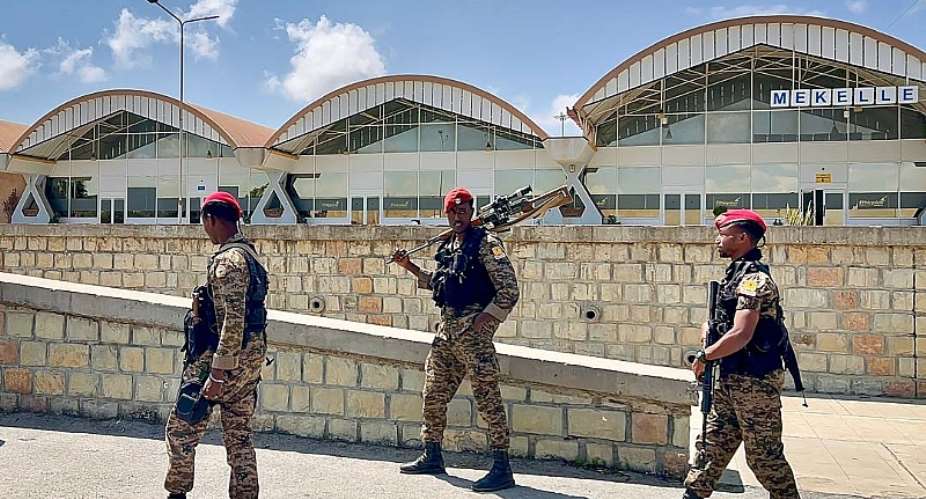
Ethiopia and Eritrea stand perilously close to all-out war as heavy fighting inches close to their shared border. The threat of resurgent interstate conflict in the Horn of Africa follows several weeks of fighting between Ethiopia’s federal government and the Tigray People’s Liberation Front (TPLF), which launched an armed rebellion on 23 September. The Ethiopian military has gained the upper hand in those clashes, moving northward after capturing Tigray’s regional capital, Mekelle, on 3 October. Ethiopia has accused Eritrea of supporting the TPLF and deploying military personnel on its soil, a claim that has been backed up by media reports and other accounts, though it appears that Eritrea subsequently pulled its troops back toward the border in the face of an Ethiopian advance and reported drones strikes on its forces. The effects of these cross-border movements could be dire: they could trigger a full-scale war between Ethiopia and Eritrea that, in turn, could spiral into a wider conflagration along Eritrea’s Red Sea coast. A push at the highest political and diplomatic levels to prevent this budding confrontation is a matter of extreme urgency.
The Resurgence of Conflict
The risk of direct conflict between Ethiopia and Eritrea has risen sharply since late September as war has engulfed Tigray. On 20 September, the TPLF and six other groups announced a new “alliance for survival” aimed at toppling Prime Minister Abiy Ahmed’s government, which they see as authoritarian and bent on centralising power. Two days later, Ethiopia conducted a large drone raid on sites in southern Tigray, where officials believed the TPLF was massing for an attack. On 23 September, the TPLF mounted large-scale offensives against the federal government. It was apparently trying to join forces with two of its allies, the Amhara Fano and Afar Revolutionary Democratic Unity Front, which commenced their own assaults on Ethiopian military positions near Tigray’s boundaries.
This first wave of attacks made gains, but Ethiopian forces quickly regrouped. They have steadily pushed the Tigrayans back since then, recording a string of battlefield victories and capturing most of Tigray. On 3 October, federal forces and their allies took Mekelle without a fight. As the TPLF withdrew, the war’s front line shifted toward the group’s strongholds in the northern mountains, near the border with Eritrea. At the same time, tensions between Ethiopia and Eritrea reached fever pitch in the wake of reported Eritrean troop deployments to northern Tigray in support of the TPLF’s rear guard.
For the first time since 2000, when Ethiopia and Eritrea ended their last war, the two neighbours now seem poised to engage in frontal combat.
For the first time since 2000, when Ethiopia and Eritrea ended their last war, the two neighbours now seem poised to engage in frontal combat. Frictions between the two are neither sudden nor surprising, even if the present rift between them in some ways marks a radical turnaround. For more than a year, Addis Ababa has been denouncing Asmara, and more recently its allies in the Sudanese army, for backing rebel groups in Ethiopia, particularly the TPLF. This antagonism stands in sharp contrast to what prevailed during the last Tigray war, which raged between 2020 and 2022, when Ethiopia and Eritrea had become friends rather than foes.
That conflict came on the heels of Abiy’s ascent to power, which in turn dethroned the TPLF, a pivotal force in national politics for decades, and set the stage for a power struggle between the federal government and the TPLF high command in Tigray. Eritrea, which had fought its previous war with Ethiopia from 1998 to 2000 while the TPLF was in charge in Addis Ababa, sought common cause with Abiy in confronting the group after Tigrayan forces attacked Ethiopia’s Northern Command in November 2020. A seesaw battle ensued, with Addis Ababa and its allies eventually beating back the TPLF ahead of the signing of the Pretoria peace agreement in November 2022. This agreement left the TPLF largely intact, however, and its commitment to fully demobilise its armed forces was never fully enforced. Eritrea, which was not involved in the Pretoria negotiations, had been pushing for the group’s complete elimination. Asmara was incensed at the outcome. In its view, its critical national interests had not been respected during the talks.
Eritrea’s relations with Ethiopia subsequently began to deteriorate. Some say Abiy was quietly courting the TPLF in order to establish a new alliance with it against Eritrea in the acrimonious aftermath of the peace deal. TPLF leaders apparently rebuffed these advances. Abiy also began to argue in public that Ethiopia needed to restore sovereign access to the sea. He said Ethiopia had a historical claim to the Red Sea coastline, which it had lost when Eritrea seceded in 1993. Since then, Ethiopia, the world’s largest landlocked country by population size, has been relying almost exclusively on Djibouti to export goods by sea. Officials in Abiy’s government have stressed that Ethiopia will not be satisfied merely with access to a wider range of ports, a course some have suggested it pursue, but needs a sovereign seaboard with a naval base. Asmara has viewed this rhetoric as a threat to seize Eritrea’s coastline, especially its southern port of Assab, by armed force.
With bilateral relations souring, Eritrea and the TPLF began to explore establishing a common front against Addis Ababa.
With bilateral relations souring, Eritrea and the TPLF began to explore establishing a common front against Addis Ababa. Asmara appears to have seen Tigray in the TPLF’s grip as a potential geographic buffer between it and the Ethiopian heartland, as well as a military counterweight to Addis Ababa. The TPLF, for its part, was keen to break the encirclement it endured in the 2020-2022 war. As a sign of their strengthening ties, Eritrean and Tigrayan authorities promoted new cross-border “people-to-people” exchanges known as tsimdo (“engagement” in Tigrinya), providing further ballast for their switch from adversaries to allies.
Meanwhile, the 2022 peace deal began to fray. The TPLF complained that the government had failed to resolve major issues stemming from the conflict, including the status of disputed territories occupied by Amhara forces during the war and the return of displaced people to their homes in these areas. Little effort was made to remedy the antipathy between the TPLF and Abiy: Addis Ababa never reintegrated Tigray back into the national political federation, with the region remaining without representation in parliament or other institutions in the capital. In March 2025, the TPLF ousted the first post-war interim Tigray administrator, Getachew Reda, who had been a lead negotiator in the Pretoria peace negotiations for the TPLF and was chosen ahead of TPLF chairperson Debretsion Gebremichael. The group claimed that Getachew was too close to the federal government and had not defended Tigray’s interests sufficiently during his time in office. (Getachew fled to Addis Ababa, where he joined Abiy’s administration.) Abiy then appointed Tadesse Werede, a top Tigrayan general, in Getachew’s place, but the relationship between Tigray’s new ruler and the TPLF also began to worsen.
In May 2026, the TPLF retook power in Mekelle, dismantling the interim administration, reinstalling its leader Debretsion as regional president and placing Tadesse under house arrest. The federal government responded by tightening its economic restrictions on the region and launching a campaign of airstrikes inside Tigray. In August, a major clash broke out between TPLF and federal ground forces before quickly subsiding. Shuttle diplomacy by the African Union and others aimed at restarting negotiations failed to gain traction.
Simultaneously, mediators found their efforts thwarted by rising hostility among powers across the Horn. Addis Ababa began to denounce Asmara for trying to coordinate a transnational alliance against it, and accused the Sudanese army, an ally of Eritrea and Egypt (another Ethiopian foe), of supporting meetings of a nascent alliance of opposition groups in eastern Sudan. Ethiopia also complained that Sudan was harbouring a group of Tigrayan troops, known as Army 70, in Sudanese territory, where they were said to have stood alongside the army in fighting its enemy, the Rapid Support Forces (RSF). Ethiopia, on the other hand, began allowing the RSF to base itself in its Benishangul-Gumuz region close to the Sudanese border, from where it could launch attacks into Sudan’s Blue Nile state. Ethiopia’s relations with the Sudanese army, which had continued to function despite the chill between them, became icy as a result. Sudan has also claimed that drones attacking Khartoum were dispatched from Ethiopian territory.
Neighbours at Loggerheads
This mosaic of enmities and alliances has come into sharp relief since war broke out in Tigray. As hostilities have intensified, Ethiopia and Eritrea have edged ever closer to conflict. Ethiopia considers Eritrea to be masterminding the TPLF’s war effort. Soon after fighting broke out, Ethiopian federal officials and Afar’s regional president accused Eritrea of deploying forces in the Afar region. On 1 October, Ethiopia expelled all Eritrean diplomats from the country, accusing Asmara of “direct and indirect acts of hostility and belligerence”. All diplomatic ties between the two states have since been severed. After Ethiopian federal forces began advancing north of Mekelle, the first reports emerged of alleged Eritrean deployments in northern Tigray, seemingly with the aim of bolstering the TPLF’s defensive lines. Several media reports indicated on 7 October that Eritrean units had passed through Adigrat, 30km south of the Ethiopian border. Accounts also suggest that Eritrean forces took up positions south of Adigrat in the Edaga Hamus area. A day later, after reported drone strikes on Eritrean vehicles, some of its forces reportedly withdrew to the border. With Ethiopian forces currently approaching the frontier at several points, the two armies are positioned in alarmingly close proximity.
Asmara’s apparent gamble to intervene more directly in the war, even if the incursion was brief, could well backfire. On 9 October, Ethiopia wrote a letter to the UN Security Council saying it was “taking measures” of self-defence in response to Eritrea’s deployment of infantry and mechanised units across the border and occupation of Ethiopian territory. The letter also accused Eritrea of “harbouring, supporting, financing, arming and directing armed insurgent groups operating within Ethiopia”. On 10 October, Eritrea responded with its own letter, accusing Ethiopia of declaring a “war of aggression” against it three years ago and using self-defence as a pretext for acts of war. The Security Council has scheduled a closed-door session to discuss the crisis on 13 October.
A standoff along the two countries’ frontier would be an ominous turn of events.
A standoff along the two countries’ frontier would be an ominous turn of events. The last major interstate conflict in the Horn of Africa, in which hundreds of thousands perished in trench warfare, was fought along precisely the same border. One flashpoint could be Eritrean military positions inside Ethiopian territory; another could be disputed territory along the border. Should Eritrean forces fully withdraw to their side of the border, Ethiopia could point to Eritrea’s apparent incursion and alleged harbouring of TPLF fighters as justification for seeking to cross into Eritrea. Even if Ethiopia stops short of a land invasion of Eritrea (and Ethiopian officials maintain that they have no intention of fighting a war on Eritrean soil), aerial warfare using drones and other long-range strike weapons could cause devastating harm. Ethiopia possesses the larger air force and drone arsenal, and it could try to quickly overwhelm Eritrea’s air defences.
Should the two states lock horns, war could also extend across the region. The Sudanese army and Egypt look primed to jump to Eritrea’s defence, though it is uncertain how much support they would be willing or able to give. On the other side, the United Arab Emirates could be expected to back Ethiopia with more arms transfers. Saudi Arabia is keen to prevent a new front from emerging along the Red Sea, especially one involving the UAE, and has tried in the past to de-escalate tensions between Ethiopia and Eritrea. On this occasion, however, Riyadh might be tempted to throw its weight behind Eritrea should a larger conflict erupt, given that its own Red Sea security would be at stake. That said, Saudi Arabia is also embroiled in a fresh round of fighting in Yemen and may not want to rally to the side of what might be a losing cause.
Halting the Slide to War
Pulling Ethiopia and Eritrea back from the brink of war should be the priority for all those interested in preventing a deadly chain of interconnected conflicts from snaking across the Horn of Africa and Red Sea regions. Capitals such as Washington, Nairobi, Pretoria, London, Paris, Rome, Riyadh, Ankara and Abu Dhabi should press both sides to avoid escalation. In particular, they should urge Abiy to refrain from advancing into Eritrean territory. They should also appeal to Asmara to respect Ethiopian sovereignty and withdraw any remaining troops from Ethiopian territory, should they still be stationed there. Despite their rift, Saudi Arabia and the UAE could also use this moment to work together to staunch a new conflict along the Red Sea, which could otherwise cause even more trouble in their bilateral relations. Should efforts to avert an outright war prevail, diplomats should not desist until they manage to achieve a durable de-escalation of tensions between the two capitals. The heart of any settlement between the two countries is likely to be respect for each other’s sovereignty and restoration of diplomatic ties.
In focusing on calming regional tensions, mediators should not forget the dispute between the Ethiopian government and the TPLF, should the latter manage to avoid complete collapse following its reversals. African leaders still look best placed to restart the Tigray peace track, even if neither federal officials nor TPLF leaders appear ready for direct talks any time soon. Prior to the start of hostilities, former Nigerian President Olusegun Obasanjo, who oversaw the Pretoria negotiations that ended the last Tigray war, had been acting as the African Union’s peace envoy for the region. He visited Addis Ababa and Mekelle several times earlier in the year but had little success in bringing the two sides together. Efforts should be made to reactivate Obasanjo at the earliest opportunity. Other African leaders or ex-leaders could also be dispatched, such as South African President Cyril Ramaphosa, who made a quick stop in Addis Ababa on 5 October to speak with Abiy, or former Kenyan President Uhuru Kenyatta, who also played a key role in the Pretoria negotiations in 2022. The U.S. or European powers could also play a part behind the scenes in trying to rekindle peace talks. At a minimum, all sides should press the federal government and the TPLF to abide by humanitarian commitments under international law.
The UN Security Council, which as noted will discuss the crisis on 13 October, should make a clear call for both sides to respect the UN Charter and instruct the Secretary-General to undertake urgent diplomacy to prevent a new war between Ethiopia and Eritrea.
Another war in the Horn of Africa may lie around the corner. Outright conflict between Ethiopia and Eritrea would likely spread to the Red Sea, disrupting the African side of this strategic waterway. It could also prove to be yet another front in the Horn that is easy to open and hard to close, especially once it becomes entangled in the mesh of disputes among neighbours and across the region. The best time to stop the looming Ethiopia-Eritrea war is now, before any more damage is done.
Originating at www.crisisgroup.org

 Bechem poultry factory 50% complete, to be ready in March 2027 – Kwakye Ofosu
 Can’t Ghana find non-partisan people for EC positions? – Kwesi Pratt on Affi Agb...
 Emelia Agbenyo’s alleged NDC ties will not affect EC work – Apanga
 Balancing the scale will dilute extreme partisanship – Hamza on new Deputy EC Ch...
 October 13: Cedi sells at GHS12.30 on forex market, GHS11.78 on BoG interbank
 ECOWAS begins implementation of 2026–2031 communication strategy
 IMF upgrades 2026 global growth forecast but war and debt threaten outlook
 Ghana needs comprehensive surrogacy law to address complex legal disputes — Afri...
 Value For Money: Govt to audit rural telephony project inherited from previous a...


