




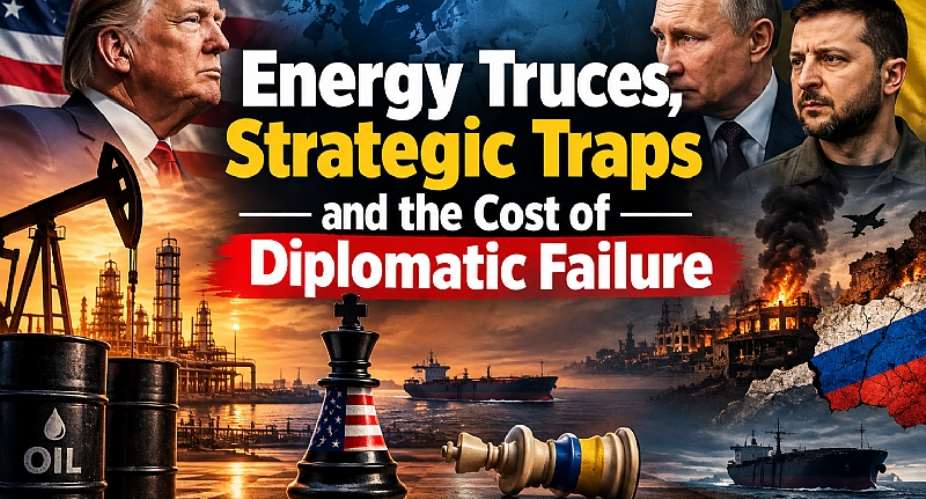
The power of authority lies not merely in exercising it but in maintaining moral and ethical control while doing so. After months of reputational damage, Donald Trump’s administration appears to be attempting another strategic manoeuvre to demonstrate its command over international affairs. Analysts might describe this approach as “Diesel Diplomacy”: an energy-driven bargain intended to stabilise global markets while restoring political confidence at home. Trump’s proposed energy ceasefire between Russia and Ukraine, however, raises a fundamental question: can economic pragmatism deliver peace without diplomatic consensus?
What Does the United States Gain from the Diesel Deal?
Energy prices, which had surged during the preceding week, reportedly declined following Trump’s announcement of an energy ceasefire. Seeking to stabilise prices, his administration moved to ease restrictions on Russian oil supplies, signalling that energy considerations could outweigh conventional pressure tactics. Yet the arrangement appeared vulnerable from the outset. Kyiv’s reported attacks on Russian oil refineries provoked an angry response from Trump, who criticised Volodymyr Zelensky and suggested that Ukraine’s leadership was obstructing a settlement. Russia subsequently retaliated against Ukrainian energy infrastructure.
The sequence exposes the weakness in Trump’s decision-making: announcing an arrangement without securing the agreement of the principal parties risks turning diplomacy into political theatre. If Moscow and Kyiv interpret the same initiative differently, an energy truce can become another battlefield. Trump has also suggested that China and Russia are not assisting Iran in the ongoing conflict, while the evolving China-Iraq energy equation adds further complexity to Washington’s calculations. Meanwhile, concerns over uninterrupted oil supplies persist, and Saudi Aramco’s leadership has warned about the dangers of concentrated control over energy routes.
Is the real threat to global energy security the vulnerability of supply routes—or the absence of a credible diplomatic settlement? The answer may lie less in controlling oil flows than in resolving the conflicts that repeatedly threaten them.
What Is Preventing the De-escalation of the Deadlock?
The European Union has emerged as a significant counterweight to Trump’s approach. His confrontational rhetoric and unpredictable policy decisions have strained relations with European partners, even as European governments continue supporting Ukraine’s defence and sovereignty. Although European leaders may welcome any genuine opportunity for peace, their continued commitment to military assistance reflects their fear that a settlement without credible security guarantees could leave Ukraine exposed.
This creates a fundamental contradiction. Washington seeks to reduce the economic costs of war and calm energy markets, while European capitals remain concerned that premature concessions could strengthen Moscow’s strategic position. Canadian assurances and alternative energy arrangements may offer some relief, but they cannot eliminate Europe’s exposure to prolonged instability.
Consequently, a ceasefire announced without mutual confidence risks producing the opposite of its intended result. Rather than ending hostilities, it may deepen mistrust between allies and adversaries alike. Can a diplomatic agreement survive when the parties disagree not only on its terms but also on the political objectives it is supposed to achieve?
How Is MBS Paying the Price of the US-Israel War?
The regional consequences extend beyond Eastern Europe. As diplomatic channels involving Iran reportedly move forward, renewed tensions around Yemen and Saudi Arabia threaten to undermine any broader de-escalation effort. Reports of Houthi attacks on Saudi territory, including allegations involving Riyadh’s international aviation infrastructure, have intensified concerns about the security of vital regional corridors.
For Crown Prince Mohammed bin Salman, the dilemma is particularly serious. Saudi Arabia seeks economic transformation, regional stability and investor confidence under Vision 2030, yet its strategic calculations remain entangled in the wider confrontation involving Washington, Israel and Iran. Houthi drone capabilities and threats around the Bab al-Mandab Strait demonstrate how regional armed groups can impose costs far beyond their immediate theatres of operation.
However, allegations of Iranian involvement require credible evidence rather than political assumption. The existence of a naval blockade also does not, by itself, conclusively establish whether or how weapons could reach Houthi forces. The contradiction deserves scrutiny: if Iran’s supply channels are severely restricted, what evidence establishes the extent of its operational support, and how much responsibility should Riyadh attribute directly to Tehran?
Saudi Arabia risks paying a strategic price for a conflict whose consequences it cannot fully control. Turkey’s Kurdish question and Pakistan’s Balochistan challenge also illustrate how internal security problems can acquire regional dimensions, although their political circumstances differ considerably. If outside powers become further involved, the conflict could widen rather than contain itself.
Ultimately, the world’s major powers face a diplomatic dilemma. Diesel Diplomacy may offer temporary relief to energy markets, but economic bargains cannot substitute for trust, enforceable commitments and regional dialogue. Unless negotiations address the political grievances driving these conflicts, the international community may remain trapped between fragile ceasefires and renewed escalation. The real test is not whether another deal can be announced, but whether it can prevent the next crisis.


 Balancing the scale will dilute extreme partisanship – Hamza on new Deputy EC Ch...
 October 13: Cedi sells at GHS12.30 on forex market, GHS11.78 on BoG interbank
 ECOWAS begins implementation of 2026–2031 communication strategy
 IMF upgrades 2026 global growth forecast but war and debt threaten outlook
 Education Minister proposes 5–10% annual rent increase cap for public universiti...
 Haruna Iddrisu assures teachers of salary adjustments by October 16
 Madina police sergeant arrested for injuring two in shooting incident at Adenta ...
 Ghana’s rape laws must protect male victims – Kasapa FM’s Akosua Gyambiby
 Ghana needs comprehensive surrogacy law to address complex legal disputes — Afri...
 Value For Money: Govt to audit rural telephony project inherited from previous a...


