




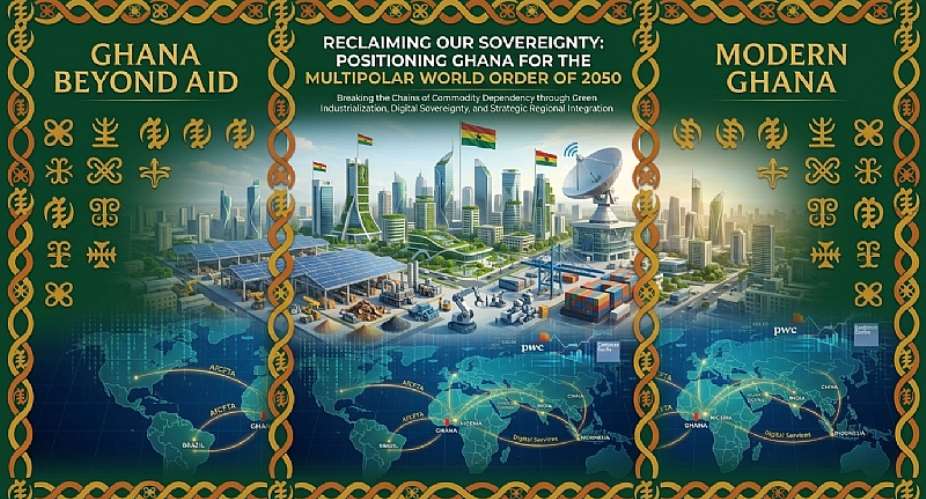
The Dawn of a Fractured Global Horizon
The tectonic plates of global power are shifting at an unprecedented velocity, fracturing the traditional unipolar world order and giving rise to a highly competitive, fragmented multipolar reality. Recent macroeconomic and demographic projections reveal that by the year 2050, the absolute economic anchors of the world will no longer reside exclusively in the West. Emerging powerhouses across the Global South—including India, Indonesia, Brazil, Nigeria, and the hyper-capitalized Gulf States—are systematically altering the global rules of trade, technology, and energy sovereignty. For Ghana, this transition represents both an existential challenge and an extraordinary historic opportunity. We cannot afford to remain passive observers or raw material exporters in a world being rapidly re-engineered by artificial intelligence and green industrialization. To avoid being marginalized by global disruptions, Ghana must move with calculated strategic clarity, proactively positioning itself as a vital economic, technological, and infrastructure hub within the West African sub-region and the broader global economy.
The Forces Reshaping the Global Economic Landscape
To effectively prepare for mid-century, we must understand the dual engines driving the rise of these new global leaders:
- The Demographic Dividend vs. The Automation Hurdle: Nations like India and Nigeria are exploding in human capital, with Nigeria projected to become the third most populous nation globally by 2050. This creates a massive, young working-age population. However, the rapid rise of AI automation means Ghana and its neighbors can no longer rely on low-cost manual labor alone for economic development; we must aggressively pivot toward rapid digital literacy and advanced technical skills.
- The Power of Resource Downstreaming: Indonesia has proven that the path to global dominance requires "resource nationalism"—banning raw mineral exports and forcing multinational firms to build localized refineries within its borders. Ghana must adopt this blueprint to maximize the domestic value of our lithium, bauxite, and gold.
- Sovereign Financial Autonomy: The Gulf States are leveraging trillions of dollars from their Sovereign Wealth Funds to finance global data centers, logistics hubs, and renewable energy assets. Simultaneously, bilateral trade structures are channeling billions in direct capital into West African transport and infrastructure networks.
- Digital Interoperability and Cross-Border Systems: India is leading a global shift by exporting Open-Source Digital Public Infrastructure (such as biometric identity platforms and real-time payment architectures). The introduction of regional payment networks across the African continent, such as the Pan-African Payment and Settlement System (PAPSS), is beginning to allow cross-border trade in local currencies, directly protecting domestic reserves against foreign exchange volatility.
Re-Anchoring the 'Ghana Beyond Aid' Agenda
To survive this multipolar shift, Ghana must look inward and fortify its national economic foundations. This requires a structural transition away from foreign assistance and cyclic dependency toward a model built on genuine internal production:
- Breaking the Cycle of Raw Material Exports: For over a century, Ghana has remained trapped in a raw-export model, subjecting our national economy to the volatile price shocks of global commodity markets. True sovereignty requires shifting our trade footprint to value-added goods.
- Capitalizing Local Industrialization: Under the national factory industrialization strategy, Ghana has seen the establishment of over 160 operational factories across various districts, with an additional 140 in various stages of development. These setups have collectively generated more than 170,000 direct and indirect jobs for our youth.
- Targeting Strategic Import Substitution: Local processing has significantly reduced our import bills in vital sectors. For example, our domestic container housing, steel fabrication, and agro-processing factories have expanded capacity, proving that we have the indigenous talent to build our own infrastructure.
- Fostering Indigenous Industrial Champions: Embracing this structural policy allows Ghana to empower and scale local manufacturing giants, ensuring that major domestic infrastructure and manufacturing assets are steered by local leadership rather than external actors.
Leveraging Strategic Regional and Continental Initiatives
Ghana's domestic agenda cannot succeed in isolation. To maximize our geopolitical bargaining power, we must actively anchor our foreign policy within broader regional economic blocks:
- The AfCFTA Multi-Alignment Strategy: As the proud host of the African Continental Free Trade Area (AfCFTA) Secretariat, Ghana occupies a unique diplomatic position. With the AfCFTA framework targeting the liberalization of 90% of non-sensitive tariff lines, Ghana must transform into a regional manufacturing hub rather than a mere administrative center. We must rapidly finalize pending rules of origin in key industrial sectors like automotives and textiles to enable uninhibited cross-border commerce.
- Re-activating ECOWAS Coordination: The recent re-establishment of the ECOWAS National Office and the inauguration of the Community Levy and Finance Committee in Accra signal a critical shift toward deeper institutional alignment. Ghana must use this administrative architecture to actively mobilize capital through the ECOWAS Regional Infrastructure Fund. This capital must be funneled directly into cross-border public-private partnerships (PPPs) to develop resilient maritime transport, digital connectivity, and integrated electricity grids across the sub-region.
- Securing Sub-Regional Resource Integrity: Aligning with the ECOWAS Vision 2050 and the AU's Agenda 2063, Ghana must work with neighboring states to harmonize environmental and agricultural standards. Coordinated policies are required to safeguard our transboundary ecosystems, manage climate-induced population shifts, and prevent the illegal extraction of minerals that undermines public revenue across West Africa.
Strategic Recommendations for Ghana’s Leadership and Citizens
If Ghana is to transition from a vulnerable economy into an active, sovereign player in this emerging multipolar era, we must take immediate action across several key pillars:
- Enforce Direct Resource Downstreaming: Ghana must enact and aggressively defend policies that restrict the export of raw, unrefined critical minerals. We should legally mandate that vital resources like lithium and bauxite can only be extracted if processing, battery manufacturing, and value-addition take place within our borders.
- Accelerate Digital Public Infrastructure Interoperability: The Bank of Ghana and local financial institutions must fully accelerate integration with cross-border digital architectures like PAPSS. Lowering transaction friction and allowing direct, local-currency trade within the ECOWAS region will insulate the Cedi from external shocks and empower local cross-border entrepreneurs.
- Pivot Education and Workforces Toward the AI Era: Our educational frameworks must be comprehensively updated to focus on advanced data science, artificial intelligence architecture, and cyber-physical engineering. As routine tasks are automated globally, our youth must be equipped to build, manage, and scale digital technologies rather than just consume them.
- Deploy Localized, Sustainable Infrastructure: To build true economic resilience, Ghana must prioritize decentralized, off-grid infrastructure. Expanding strategic partnerships that deploy solar-powered microgrids to power essential agricultural processing centers, telecom hubs, and community health networks (such as rural CHPS compounds) will ensure continuous economic productivity independent of central grid failures.
- Aggressively Secure Strategic Bilateral Alliances: Our foreign and economic trade policies must move beyond traditional aid models. Ghana should actively court high-value infrastructure partnerships with the Gulf Cooperation Council (GCC) and technology-co-creation agreements with India, ensuring foreign capital is directly tied to the development of our national rail networks, smart agriculture, and maritime logistics.
The Mandate for Mid-Century Custodianship
The year 2050 is not a distant, abstract horizon; it is an active economic reality being constructed right now through policy, capital, and technology. The rapid rise of a multipolar world proves that geography is no longer destiny—strategic execution is. If Ghana continues to operate on an economic model based on raw resource extraction and reliance on external policy, we risk being left behind by the dual currents of climate disruption and artificial intelligence. However, by embracing resource downstreaming, protecting our digital sovereignty, upskilling our youth, and executing bold infrastructure upgrades, Ghana can successfully anchor itself as an indispensable gateway for West Africa. The tools of the future are within our reach, but we must have the collective courage and institutional discipline to wield them. The time to build Ghana’s mid-century legacy is now.
✍️ Submitted by:
Retired Senior Citizen
For and on behalf of all Senior Citizens of the Republic of Ghana 🇬🇭
Teshie-Nungua
[email protected]


 Balancing the scale will dilute extreme partisanship – Hamza on new Deputy EC Ch...
 October 13: Cedi sells at GHS12.30 on forex market, GHS11.78 on BoG interbank
 ECOWAS begins implementation of 2026–2031 communication strategy
 IMF upgrades 2026 global growth forecast but war and debt threaten outlook
 Education Minister proposes 5–10% annual rent increase cap for public universiti...
 Haruna Iddrisu assures teachers of salary adjustments by October 16
 Madina police sergeant arrested for injuring two in shooting incident at Adenta ...
 Ghana’s rape laws must protect male victims – Kasapa FM’s Akosua Gyambiby
 Ghana needs comprehensive surrogacy law to address complex legal disputes — Afri...
 Value For Money: Govt to audit rural telephony project inherited from previous a...


