




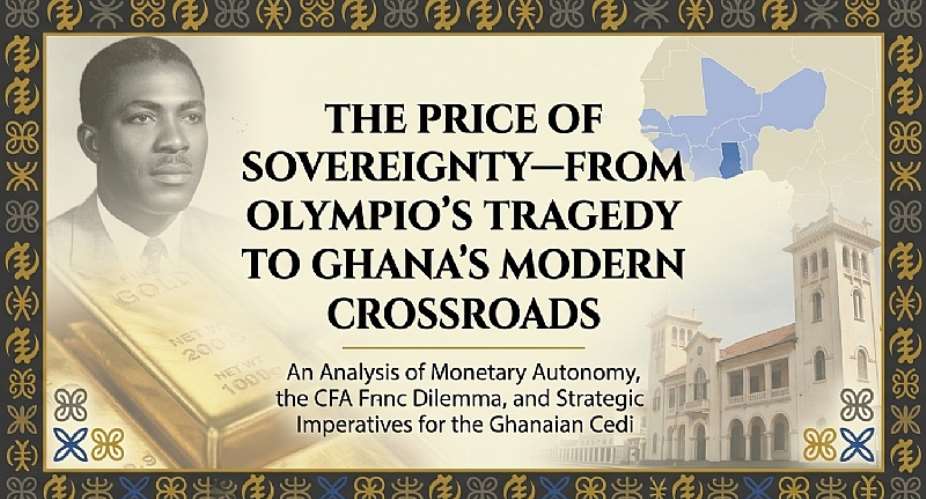
A pivotal tragedy shook West Africa when Sylvanus Olympio, the first President of Togo, was assassinated just days before launching an independent national currency designed to break away from the French-backed CFA franc. Today, a viral social media video using fictional Hollywood footage from the series Watchmen has re-ignited this history across Ghanaian digital spaces.
But this is far more than a history lesson or a trending clip. As Ghana navigates intense domestic economic pressures, currency stabilization hurdles, and the continuous management of the Cedi, Olympio’s legacy stands as a stark mirror. It forces a confrontation with a fundamental question: What is the true price of macroeconomic sovereignty?
For Ghanaians, understanding the ongoing structural battle of our Francophone neighbors to reform or dismantle the CFA franc is not just a matter of regional solidarity—it offers an analytical roadmap for our own financial policies, currency architecture, and the broader integration of the West African sub-region.
The Historical Blueprint: Olympio’s Quest for Monetary Autonomy
Sylvanus Olympio, a trained economist and London School of Economics graduate, recognized that political statehood was structurally incomplete without monetary self-determination. His governance framework highlighted the complexities of colonial economic decoupling:
- Institutionalizing Separation: In December 1962, Olympio’s administration legally established the Banque Centrale du Togo to issue a sovereign currency outside the colonial CFA zone.
- Reserve Diversification: To mitigate isolation risks, Olympio negotiated with West Germany, Great Britain, Ghana, and Nigeria to back and peg the proposed Togolese currency to the stable West German Deutsche Mark, rather than French reserves.
- The Fiscal Precedent: Relying on strict fiscal discipline, Olympio reportedly cleared Togo's colonial debts to ensure sovereignty. However, the domestic austerity required—combined with his refusal to absorb hundreds of French-colonial army veterans into Togo's budget—triggered the January 13, 1963 coup. His assassination marked the first post-independence military overthrow in sub-Saharan Africa and consolidated the French-African geopolitical framework known as Françafrique.
The modern macroeconomic divergence between Ghana's floating currency regime and the fixed-rate regime of the West African Economic and Monetary Union (WAEMU) underscores the trade-offs of monetary autonomy:
- The Inflation Paradox: The Euro-pegged CFA franc provides member states with an institutional shield against exchange-rate volatility and imported inflation. For instance, regional inflation across the WAEMU bloc routinely hovers near 0.0% to 0.1%, with regional powerhouses like Côte d'Ivoire maintaining an inflation rate of just 1.2%.
- The Cost of Autonomy: Conversely, Ghana possesses total monetary independence but experiences significant consumer price volatility. While Ghana's headline inflation decelerated to 5.2% (driven largely by service inflation at 8.3% and local price pressures), it follows years of severe double-digit inflation crises.
- The Depreciation Tax: Despite recent interventions by the Bank of Ghana and the Gold Board—which managed to slow weekly depreciation to just under 1% and peg official interbank rates around GH¢10.6 to GH¢10.7 per US Dollar—retail forex bureaus still trade at higher premiums between GH¢11.9 and GH¢12.4. This continuous spread operates as a direct tax on Ghana's import-reliant economy.
- The Integration Deficit: Geopolitical fractures have further complicated regional integration. Dissident Sahelian nations (Mali, Burkina Faso, and Niger) have exited the Economic Community of West African States (ECOWAS) while planning a separate sovereign currency, the Sira. Concurrently, the wider ECOWAS rollout of the unified regional currency, the Eco, remains stalled ahead of its tentative July 2027 phased launch due to a widespread failure among member states to satisfy strict macroeconomic convergence criteria.
Strategic Policy Recommendations for Ghana
Ghana must pivot from a passive observer to an active architect of West African monetary reform. To safeguard the Cedi and honor the economic pan-Africanism of Sylvanus Olympio and Dr. Kwame Nkrumah, policymakers should implement the following structural measures:
- De-Dollarize Reserves via Asset-Backing: The Bank of Ghana must formalize and aggressively scale up its Gold for Oil and domestic gold-purchasing frameworks. Diversifying central bank reserves away from fiat US Dollars toward tangible, localized gold reserves naturally hedges the Cedi against speculative market shocks.
- Enforce Aggressive Fiscal Consolidation: As demonstrated by the World Bank's economic growth projection for Ghana, currency stability is tethered to structural discipline. The state must urgently curb public sector credit deficits and address high bank non-performing loan (NPL) ratios, which sit at 18.5% to 19.4%, to drive down domestic interest rates and incentivize industrial production.
- Operationalize Regional Payment Infrastructure: Rather than remaining bottlenecked by the political delays of the 2027 Eco currency launch, Ghana must aggressively utilize the Pan-African Payment and Settlement System (PAPSS) under the African Continental Free Trade Area (AfCFTA). Enabling direct Cedi-to-CFA clearing allows Ghanaian exporters to bypass third-party Western currency conversions entirely.
- Lead the Institutional Design of the Eco: Ghana must actively coordinate with Nigeria to lead the ECOWAS President’s Task Force. Our diplomatic mission must guarantee that the eventual transition to the Eco enforces a complete institutional break from foreign treasury guarantees, ensuring the regional central bank remains entirely autonomous.
The historical precedent established by Sylvanus Olympio’s fatal termination in 1963 underscores a profound economic axiom: monetary sovereignty is an instrument of economic management, not an automated guarantee of stabilization.
Possessing an independent central bank and a floating sovereign currency is an institutional privilege that millions of citizens within the CFA zone are actively struggling to secure. However, that independence is effectively compromised if domestic fiscal imbalances, high credit risks, and structural import-dependencies continue to erode the real purchasing power of the Cedi. As West Africa approaches a critical monetary transition, Ghana must steer the sub-region away from both the neocolonial stagnation of fixed foreign-guaranteed systems and the volatile hazards of isolated, unbacked currencies. True economic liberation lies in a disciplined, asset-backed, and strictly integrated regional monetary alliance.
✍️ Submitted by:
Retired Senior Citizen
For and on behalf of all Senior Citizens of the Republic of Ghana 🇬🇭
Teshie-Nungua
[email protected]


 Balancing the scale will dilute extreme partisanship – Hamza on new Deputy EC Ch...
 October 13: Cedi sells at GHS12.30 on forex market, GHS11.78 on BoG interbank
 ECOWAS begins implementation of 2026–2031 communication strategy
 IMF upgrades 2026 global growth forecast but war and debt threaten outlook
 Education Minister proposes 5–10% annual rent increase cap for public universiti...
 Haruna Iddrisu assures teachers of salary adjustments by October 16
 Madina police sergeant arrested for injuring two in shooting incident at Adenta ...
 Ghana’s rape laws must protect male victims – Kasapa FM’s Akosua Gyambiby
 Ghana needs comprehensive surrogacy law to address complex legal disputes — Afri...
 Value For Money: Govt to audit rural telephony project inherited from previous a...


