




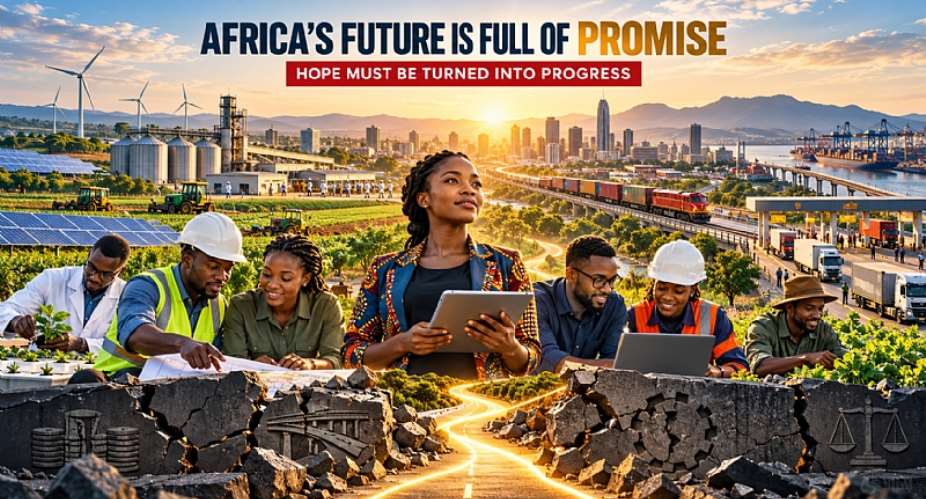
Africa is often discussed through two competing narratives. One presents a continent trapped by poverty, conflict, corruption and dependence. The other describes a rising Africa powered by young people, technology, natural resources and economic integration. Neither account is complete on its own. The continent possesses extraordinary potential, but potential does not automatically become prosperity.
Perhaps Africa’s greatest advantage is its people. It has the world’s youngest and one of its fastest-growing populations. This demographic profile could provide the workforce, entrepreneurs and consumers needed to drive decades of economic expansion. Across the continent, young Africans are establishing technology companies, creating digital financial services, producing films and music, modernising agriculture and finding solutions to problems that governments have struggled to address.
Mobile technology has already demonstrated how quickly African innovation can advance when it responds to local needs. Digital payments, online education, telemedicine and mobile commerce are reaching communities previously excluded from formal services. In countries such as Ghana, Kenya, Nigeria, Rwanda, Senegal and South Africa, technology ecosystems have attracted international attention and investment.
Youth, however, becomes an economic advantage only when young people are educated, healthy and productively employed. Without adequate schools, vocational training, affordable electricity, internet access and employment opportunities, the so-called demographic dividend could become a demographic crisis. Population growth alone cannot guarantee prosperity.
The African Continental Free Trade Area offers another reason for optimism. By connecting markets across the continent, the AfCFTA seeks to reduce trade barriers, expand regional value chains and create opportunities for African companies to achieve economies of scale. Instead of exporting raw cocoa, minerals, cotton and crude oil while importing finished products, African countries could trade more processed foods, pharmaceuticals, textiles, machinery and manufactured goods among themselves.
World Bank analysis suggests that comprehensive implementation of the agreement could increase African incomes by about nine per cent by 2035 and help as many as 50 million people escape extreme poverty. These are projections rather than guaranteed outcomes. Achieving them will require efficient ports, reliable transport corridors, harmonised customs procedures, stable currencies, affordable finance and the political commitment to remove the non-tariff barriers that continue to obstruct African trade.
Africa’s natural wealth also places it at the centre of the global transition towards cleaner energy. The continent possesses critical minerals needed for batteries, electric vehicles and renewable-energy technologies. It also has enormous solar, wind, hydroelectric and geothermal potential.
Yet the old extractive model must not simply be repackaged as a green economy. If African countries export unprocessed lithium, cobalt, graphite and other strategic minerals while importing expensive batteries and manufactured equipment, the continent will remain at the bottom of another global value chain. The real opportunity lies in processing minerals locally, manufacturing components, developing African technical expertise and ensuring that mining communities receive a fair share of the benefits.
There are encouraging signs in climate policy. A UN Development Programme assessment found that 89 per cent of the African national climate plans it examined were considered robust, while 87 per cent demonstrated national ownership and inclusiveness. The same assessment also revealed the central difficulty: almost half the supported African countries required additional financing to implement their commitments. UNDP Climate Promise
Africa’s future cannot be discussed honestly without confronting its governance problems. Military coups, electoral manipulation, corruption, weak institutions and violent conflicts continue to undermine development in parts of the continent. Every coup interrupts constitutional rule, discourages investment and weakens the principle that political authority must come from citizens. Every public contract inflated for private benefit takes money away from schools, hospitals, roads and productive industries.
Good governance is not merely a moral aspiration; it is economic infrastructure. Investors, entrepreneurs and citizens need predictable laws, independent courts, accountable public institutions and peaceful transfers of power. Countries that provide these conditions are better positioned to retain talent, attract productive investment and plan beyond the electoral cycle.
The departure of skilled professionals presents another serious danger. African doctors, nurses, engineers, academics and technology specialists frequently leave because they can secure better salaries, equipment, working conditions and career opportunities elsewhere. Migration can generate valuable remittances and international networks, but excessive losses from essential sectors weaken the institutions that educated these professionals.
The answer is not to prevent Africans from travelling. Governments must create conditions that make remaining, returning or investing at home attractive. Competitive pay matters, but so do functioning institutions, research facilities, professional respect and confidence in the future.
Debt is also restricting the continent’s room for action. UN Trade and Development reported that nearly half of African countries had debt-to-GDP ratios above 60 per cent in 2023, with several spending more on interest than on either health or education. Its later assessment found that governments in sub-Saharan Africa spent 18.7 per cent of their revenues servicing external public debt in 2024—about three times the proportion recorded in 2014.
Borrowing is not inherently harmful when it finances productive infrastructure and generates future income. The danger arises when loans support consumption, poorly selected projects or corruption, leaving future generations with debt but few productive assets.
There is therefore genuine hope for Africa, but hope must not be mistaken for certainty. The continent has young people, natural resources, expanding markets and growing technological capabilities. What it needs is disciplined leadership capable of converting these advantages into industries, jobs and improved living standards.
Africa’s transformation will not come from another aid programme, commodity boom or inspirational international conference. It will come from producing more of what Africans consume, processing more of what the continent extracts, trading more with neighbouring countries and investing seriously in education, infrastructure and accountable institutions.
The central question is no longer whether Africa possesses potential. That debate has been settled. The question is whether its governments, businesses and citizens can organise that potential into lasting progress. Africa has reason to hope—but the future will belong only to those prepared to build it.


 Balancing the scale will dilute extreme partisanship – Hamza on new Deputy EC Ch...
 October 13: Cedi sells at GHS12.30 on forex market, GHS11.78 on BoG interbank
 ECOWAS begins implementation of 2026–2031 communication strategy
 IMF upgrades 2026 global growth forecast but war and debt threaten outlook
 Education Minister proposes 5–10% annual rent increase cap for public universiti...
 Haruna Iddrisu assures teachers of salary adjustments by October 16
 Madina police sergeant arrested for injuring two in shooting incident at Adenta ...
 Ghana’s rape laws must protect male victims – Kasapa FM’s Akosua Gyambiby
 Ghana needs comprehensive surrogacy law to address complex legal disputes — Afri...
 Value For Money: Govt to audit rural telephony project inherited from previous a...


