




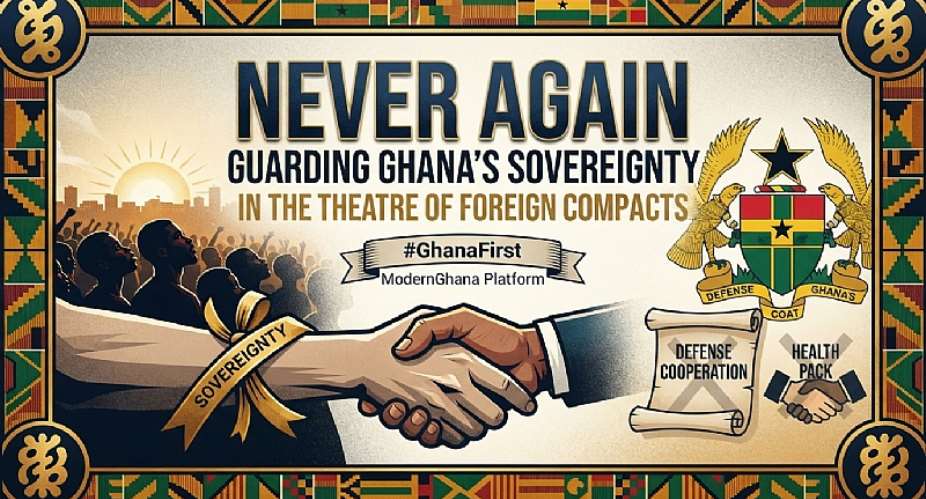
As the legendary Alhaji A.B.A. Fuseini wisely observed, "When a handshake reaches the elbow, it is no longer greetings, it is a defeat". For decades, Ghana has stood as a beacon of independence in Africa, built on the sacred sweat of founders who believed that the black man is capable of managing his own affairs. Yet, in our contemporary history, we have watched the handshakes of foreign diplomacy slowly crawl toward our elbows, testing the very boundaries of our national sovereignty. From the controversial 2018 US-Ghana Defense Cooperation Agreement (DCA) to the executive’s decisive rejection of the $109 million US Health Compact, our leaders face a recurring test: Will they trade our birthright for a mess of pottage?
Scripture admonishes us in Proverbs 22:28, "Remove not the ancient landmark, which thy fathers have set." Sovereignty is our ancient landmark. When we sign pacts that bar our own security personnel from inspecting foreign military cargo, or when we are asked to hand over sensitive pathogen data and citizen medical profiles for a fistful of dollars, we are shifting those landmarks. With the benefit of hindsight, we must declare a collective "Never Again." Bilateral agreements must never become modern instruments of subjugation. Ghana must institute rigorous, non-negotiable mechanisms for reviewing, ratifying, and amending international deals to ensure that our national pride and legal autonomy remain uncompromised.
The Two Pacts: A Tale of Two Sovereignties
To chart a path forward, we must look backward. As A.B.A. Fuseini reminds us, "The testicle that will degenerate into a hernia can be spotted from the first day it is seen". The structural weaknesses of our international negotiations have long been visible. We must objectively analyze how these two major agreements impacted our national landscape:
- The 2018 Defense Cooperation Agreement (DCA): For a package valued around $20 million in grants and training, Ghana integrated past frameworks into an expanded security agreement. While the US Embassy and state actors maintained it enhanced counter-terrorism, it introduced deeply troubling clauses:
- The Blindfold Clause: Ghanaian customs and security agencies are prohibited from inspecting US military vessels, aircraft, or cargo entering the country.
- The Sovereign Enclave Clause: US forces were granted unhindered access and control over "agreed facilities and areas," effectively functioning as extraterritorial zones.
- The Legal Shield: US personnel are granted diplomatic immunities, ensuring that any civil or criminal infractions committed on Ghanaian soil are handled under US military law, rendering local courts powerless. Though challenged, the Supreme Court unanimously dismissed the suit in May 2020, cementing its legality but leaving the political scar wide open.
- The Rejected $109 Million Health Compact: Under an "America First Global Health Strategy," Washington proposed a five-year, $109 million health package to replace traditional USAID streams. However, the cabinet correctly flagged and rejected "humiliating" conditions:
- Data Biopiracy: It demanded that Ghana surrender its national pathogen profiles and citizens' private medical records to foreign oversight.
- Regulatory Bypass: It restricted Ghana’s Food and Drugs Authority (FDA) from inspecting foreign-supplied medicines and medical equipment entering our borders.
- The Debt Trap: It mandated strict counterpart financial contributions from the Ghanaian government, forcing us to pay to receive aid.
Ghana is not alone in this geopolitical chess game. Other nations have shown that international agreements are not "cast in concrete" and can be successfully resisted, renegotiated, or dismantled when sovereignty is threatened:
- The Philippines and the VFA: The Philippines repeatedly used the threat of terminating its Visiting Forces Agreement (VFA) with the United States to force renegotiations, ensuring local jurisdictional control over US military personnel who commit crimes on Filipino soil.
- Kenya's Stand on Data Privacy: Kenya previously resisted specific international health financing structures that demanded unrestricted access to national genomic sequence data, forcing international partners to respect domestic data protection laws.
- Ecuador and Manta Air Base: In 2009, Ecuador exercised its sovereign right to refuse the renewal of a 10-year lease for a US military outpost at Manta Base, proving that developing nations can successfully enforce territorial autonomy.
As the former UN Secretary-General Boutros Boutros-Ghali once observed: "True diplomacy is the art of letting the other party have your way." We must learn to navigate these waters with the same tactical calculation.
Recommendations for Radical Ratification and Renegotiation
To ensure that Ghana never again signs away its dignity, we must implement institutional reforms. After all, "If a thief kisses you, you must count your teeth and be sure they are all intact". We must check our teeth before, during, and after every diplomatic encounter:
- Establish a Multi-Stakeholder Treaty Review Commission: Before any international compact reaches the Cabinet or Parliament, a non-partisan commission composed of security experts, constitutional lawyers, data scientists, and civil society must audit the deal for sovereignty risks.
- Enforce Mandatory "Sunset and Review" Clauses: No international agreement should be perpetual. Every bilateral pact must include a hard "sunset clause" requiring a comprehensive review and parliamentary re-ratification every four to five years.
- A Non-Negotiable "Inspection and Regulatory Protocol": Ghana must establish a baseline legal statutory framework: No foreign entity—military or medical—shall bypass the regulatory oversight of the Ghana Armed Forces, Customs, or the Food and Drugs Authority. If you cannot be inspected, your cargo cannot land.
- Activate Re-negotiation Pathways Immediately: Because international law recognizes changing circumstances (rebus sic stantibus), the state must leverage current diplomatic openings. For instance, following the cabinet's rejection of the health compact, the US government actively sought fresh talks to amend the toxic clauses. We must apply this exact pressure to renegotiate the lopsided clauses of the 2018 defense deal.
- Instate Civic Transparency Mechanisms: All bilateral agreements involving national security, public health data, or major natural resources must be published in the state gazette at least 30 days before parliamentary debate. Sunlight is the best disinfectant against bad deals.
In the ultimate analysis, we must realize that aid wrapped in the cloth of subjugation is not aid at all; it is a Trojan horse. To quote the wise words of A.B.A. Fuseini, "A risk taker is someone who has a running stomach and still farts comfortably in public". Ghana cannot afford to play the reckless risk-taker on the global stage, gambling with our national security, regulatory autonomy, and data sovereignty while our geopolitical house is on fire.
We must echo the timeless warning of Galatians 5:1: "Stand fast therefore in the liberty wherewith Christ hath made us free, and be not entangled again with the yoke of bondage." Let the rejection of the humiliating health compact serve as our new baseline. Let it be known to Washington, Beijing, London, and Brussels that Ghana’s sovereignty is not a commodity for auction. We welcome partnerships, we cherish development, and we value diplomacy—but never again shall we let the handshake reach our elbow.
✍️ Submitted by:
Retired Senior Citizen
For and on behalf of all Senior Citizens of the Republic of Ghana 🇬🇭
Teshie-Nungua
[email protected]

 Balancing the scale will dilute extreme partisanship – Hamza on new Deputy EC Ch...
 October 13: Cedi sells at GHS12.30 on forex market, GHS11.78 on BoG interbank
 ECOWAS begins implementation of 2026–2031 communication strategy
 IMF upgrades 2026 global growth forecast but war and debt threaten outlook
 Education Minister proposes 5–10% annual rent increase cap for public universiti...
 Haruna Iddrisu assures teachers of salary adjustments by October 16
 Madina police sergeant arrested for injuring two in shooting incident at Adenta ...
 Ghana’s rape laws must protect male victims – Kasapa FM’s Akosua Gyambiby
 Ghana needs comprehensive surrogacy law to address complex legal disputes — Afri...
 Value For Money: Govt to audit rural telephony project inherited from previous a...


