




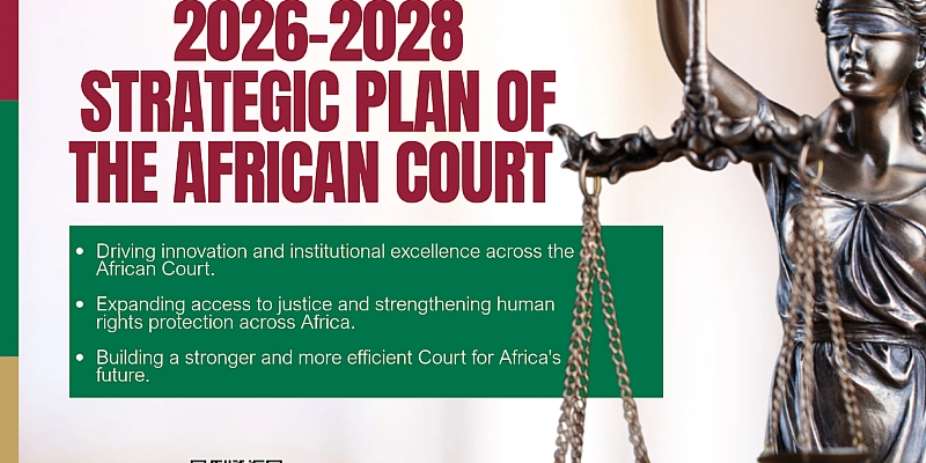
The African Court on Human and Peoples’ Rights has unveiled a transformative and forward-looking strategic plan for the period 2026 to 2028, charting a bold new course to enhance access to justice, modernize its judicial operations, and deepen its impact across the continent.
The unveiling of the new three-year blueprint comes at a historic and symbolic moment for the continental court, as it commemorates 20 years of service in protecting human and peoples’ rights in Africa [2006-2026] under the theme "20 Years of Service in Protecting Human and Peoples’ Rights in Africa.”
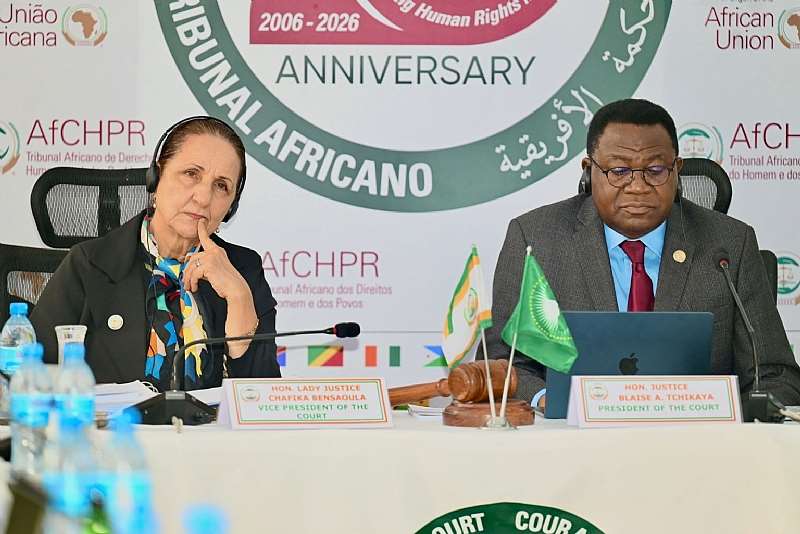
Commenting during the unveiling, the President of the African Court, Justice Blaise Tchikaya, noted that the new strategic cycle provides a critical opportunity to consolidate gains made over the past two decades and strengthen the African Court’s relevance and impact for the future.
“The Strategic Plan 2026–2028 is both a reflection of how far the Court has come and a statement of where we intend to go. As we commemorate 20 years of protecting human and peoples’ rights in Africa, it reaffirms our commitment to making justice more accessible, effective, and responsive to the needs of the continent,” President Tchikaya stated.
“The Plan provides a clear roadmap for strengthening our work, deepening engagement with stakeholders, and ensuring that the Court continues to meet the expectations of those it serves,” he added.
The unveiling of the Strategic Plan at the 20th anniversary is highly significant. For two decades, the African Court has been the continent’s apex judicial guardian of human rights, complementing the work of the African Commission.
As it reflects on that journey, the plan provides a forward-looking framework to build on achievements, draw lessons from challenges, and chart a clear, dynamic, and progressive path for the years ahead, in line with Agenda 2063’s aspiration for justice and rule of law.
The complete Strategic Plan package, including the 2026–2028 Strategic Plan and the Implementation Report 2021–2025, is now publicly available and can be accessed via the African Court’s official website through the link 2026-2028 Strategic Plan. The documents are available in the African Court’s four working languages: Arabic, English, French, and Portuguese.
The Strategic Plan is accompanied by a comprehensive, data-driven Implementation Report that provides a transparent review of progress, achievements, and challenges under the Court’s previous 2021–2025 Strategic Plan, ensuring that the next phase is built on evidence and lessons learned.
According to the Implementation Report issued by the Communication and Information Unit of the African Court in Arusha, Tanzania, and copied to the Communication for Development and Advocacy Consult (CDA Consult) in Accra, Ghana, significant progress made over the last five years, despite operating in a complex continental environment.
Among the key achievements is a 27 percent increase in finalized cases, demonstrating growing efficiency and judicial output; expanded use of digital technologies to improve case management and access; and strengthened engagement with a wide range of stakeholders across Africa.
The report also candidly identifies persistent challenges that continue to require strategic attention. These include the low rate of implementation of the Court’s decisions by Member States and the need to further strengthen institutional capacity and resources. These challenges have directly informed and shaped the priorities of the new 2026–2028 Strategic Plan.
This evidence-based approach marks a new era of results-oriented management for the Court, moving from aspiration to measurable delivery.
What makes the 2026–2028 Strategic Plan distinctively progressive and purposeful is how it was developed.
The African Court says its development was informed by extensive consultations with a broad spectrum of stakeholders across the justice ecosystem.
Contributions were received from representatives of member states, African Union organs, civil society organizations, legal practitioners and bar associations, academia, development partners, media practitioners, African Court users and litigants, judges and staff of the Court, and members of the general public.
This inclusive and participatory process ensures that the Plan is not an internal document but a continental compact that reflects the expectations of those the Court serves. Every contribution helped shape the Court’s priorities and strategic direction for the next three years.
Building on the findings of the Implementation Report and stakeholder consultations, the 2026–2028 Strategic Plan focuses on five interconnected pillars designed to deliver smarter and more impactful justice.
According to the report, the African Court will intensify efforts to make its services more accessible to ordinary Africans, particularly vulnerable groups, through legal aid, outreach, translation of key documents, and closer engagement with national judiciaries and human rights institutions.
The plan prioritizes accelerated digital transformation. This includes e-filing, virtual hearings, digital case management systems, and a more robust online database of judgments to improve efficiency, transparency, and speed of delivery.
The African Court will invest in strengthening its human resources, financial sustainability, and internal systems to handle an increasing caseload while maintaining the highest standards of judicial excellence.
It will focus on reducing case backlogs, improving turnaround time for judgments, and enhancing the quality of engagement with applicants, respondents, and counsel.
The African Court will deepen its contribution to the continental human rights architecture by reinforcing its complementarity with the African Commission on Human and Peoples’ Rights and engaging Member States on compliance and implementation of its orders.
The African Court is a continental court established by African Union Member States to ensure the protection of human and peoples’ rights in Africa. The Court complements and reinforces the functions of the African Commission on Human and Peoples’ Rights.
It is composed of eleven judges, nationals of member states of the African Union elected in their individual capacity. It meets four times a year in Ordinary Sessions and may hold Extra-Ordinary Sessions. Its mandate includes hearing cases concerning the interpretation and application of the African Charter on Human and Peoples’ Rights and any other human rights instrument ratified by the concerned states.

 October 13: Cedi sells at GHS12.30 on forex market, GHS11.78 on BoG interbank
 ECOWAS begins implementation of 2026–2031 communication strategy
 IMF upgrades 2026 global growth forecast but war and debt threaten outlook
 Education Minister proposes 5–10% annual rent increase cap for public universiti...
 Haruna Iddrisu assures teachers of salary adjustments by October 16
 Madina police sergeant arrested for injuring two in shooting incident at Adenta ...
 Ghana’s rape laws must protect male victims – Kasapa FM’s Akosua Gyambiby
 Ghana needs comprehensive surrogacy law to address complex legal disputes — Afri...
 Value For Money: Govt to audit rural telephony project inherited from previous a...
 Former DR Congo president Kabila forms new force with M23 armed group


