




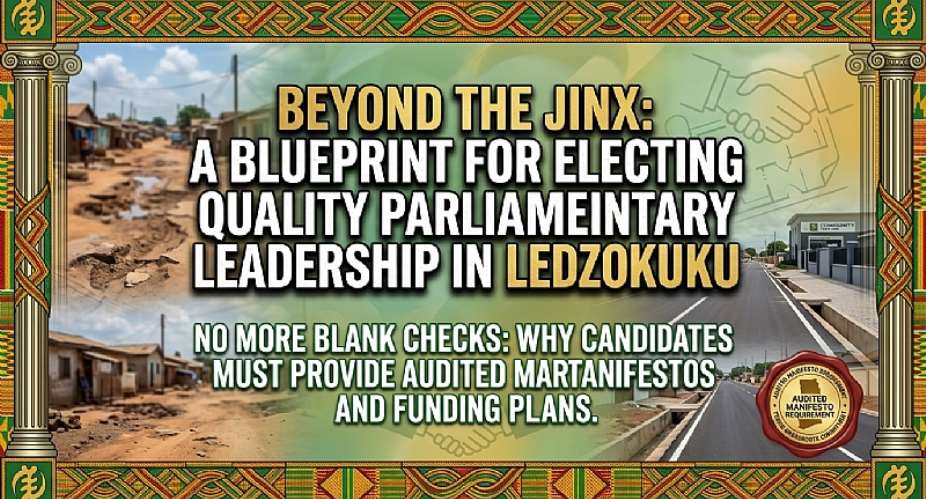
The Ledzokuku Constituency (Teshie) in the Greater Accra Region has earned a fierce national reputation as Ghana’s most ruthless political graveyard for underperforming politicians. For nearly three decades, voters enforced an unwritten "one-term jinx," systematically booting out any Member of Parliament who failed to deliver on grassroots development. However, breaking a historical voting pattern does not automatically translate into a gold standard of leadership. When elected representatives become detached, outsource their governance to family proxies, and ignore the very executive committees that built their campaigns, it becomes clear that simply punishing a non-performing MP at the ballot box is only half the battle.
The real challenge facing Ghanaians today—and the people of Ledzokuku specifically—is not just how to kick an unapproachable leader out, but how to strategically engineer a superior replacement. Waiting every four years to cycle through politicians who disappear behind security walls is a recipe for perpetual underdevelopment. If the people of Teshie Zongo, the Estates, Marteye Tsuru, and Tsuibleoo want to see their cratered roads paved, their flood-prone gutters permanently fixed, and mobile healthcare delivered to their doorsteps, they must completely rewrite the rules of political engagement. This article provides an objective, step-by-step anatomy of how constituents can systematically identify, vet, and elect high-performing parliamentary leadership ahead of the next electoral cycle.
The Anatomy of the Problem: Why the Current Pipeline Fails
Before electing a better replacement, voters must diagnose why the traditional political system repeatedly yields unapproachable representatives:
- The Total Absence of a Binding Constituency Manifesto: Candidates routinely mount rallies making vague, verbal promises about infrastructure. Because these intentions are never documented into a structured, community-owned manifesto before vetting, MPs easily run from accountability once sworn into office.
- Vague, Unfunded Project Declarations: Politicians love to declare what they will build without ever detailing how it will be paid for. Without explicit financial budgeting written down, candidates can later blame a lack of central government funds for their own stagnation.
- Ghost Job Promises: "Youth employment" has become a meaningless campaign catchphrase. Because candidates are never forced to define the exact types of jobs or industries they are targeting, local youth are left stranded with temporary, unsustainable political handouts after the elections.
- The Monopoly of the Party Primaries: National political parties rely on a closed system where a tiny pool of local delegates selects the parliamentary candidate. This allows wealthy but detached aspirants to "buy" the primary ballot, bypassing the broader consensus of the community.
- Post-Election Executive Cannibalization: Once victory is secured, rogue representatives often dismantle or ignore the local Constituency Executive Committee that managed their campaigns, creating an echo chamber of family gatekeepers and yes-men who shield the politician from reality.
Strategic Recommendations: How to Engineer a Better MP
To ensure the next representative of Ledzokuku is accessible, competent, and fiercely dedicated to local infrastructure, community organizers must deploy the following structural interventions:
- Mandate a "No Manifesto, No Vetting" Pre-Condition: The absolute top priority for any aspirant presenting themselves for local leadership must be the submission of a comprehensive, written constituency manifesto. This document serves as the primary ticket of admission for public vetting.
- Enforce an Explicit Funding Blueprint Within the Manifesto: Every aspirant must clearly document how they intend to finance their suggested local projects. Their manifesto must explicitly detail the allocation breakdown between the MP's Common Fund, private-public partnerships (PPPs), international development grants, and targeted corporate social responsibility (CSR) lobbying from industries operating within Ledzokuku.
- Demand a Transparent Job-Creation Matrix: The manifesto must move away from generic promises of "employment." Candidates must explicitly itemize the exact types of jobs being created (e.g., permanent municipal sanitation technicians, local construction laborers for inner-road paving, tech-hub apprenticeships, or specialized healthcare assistants for community outreach) alongside measurable quarterly hiring targets.
- Draft a Non-Partisan "Ledzokuku Development Compact" to Anchor Manifestos: Community elders, structural engineers, and local health practitioners must collaborate to publish a baseline infrastructure blueprint. Every candidate's manifesto must align with this compact, detailing exactly how they will fund immediate needs like deep concrete drainage systems around the Teshie Zongo Mosque and the deployment of mobile medical vans.
- Enforce a Public Signing and Vetting Process: Any prospective parliamentary aspirant from any political party must be subjected to a public town hall vetting. Using their submitted manifestos as a literal financial and employment scorecard, candidates must publicly sign the community compact, committing to specific, binding timelines.
- Infiltrate and Democratize the Delegate System: Local youth groups, professional associations, and market women must actively contest polling station executive elections within the dominant parties. By becoming the delegates themselves, the grassroots can enforce the manifesto mandate and block arrogant or incompetent aspirants at the primary level.
- Establish Mandatory Quarterly Open-Mic Accountability Forums: The next representative must constitutionally commit to a physical open-door policy. They must hold rotational, quarterly town hall meetings across all electoral areas to present progress reports based directly on their election manifesto's funding and job metrics, facing direct cross-examination from constituents.
In the grand theater of Ghanaian democracy, sovereignty does not belong to the elite; it resides firmly in the calloused hands of the ordinary voter. The legendary swing-seat status of Ledzokuku is a powerful weapon, but it must be wielded with strategic precision, not just emotional frustration. A candidate's written manifesto—complete with a clear funding plan and explicit job types—is the only shield the electorate has against broken verbal promises and proxy family rule. The citizens of Teshie Zongo and the surrounding Estates deserve representatives who see public office as a documented, mathematically sound, and sacred burden, not an unaccountable family business. It is time to organize, vet ruthlessly using audited manifestos as our ultimate standard, and show the political class that the keys to the Parliament House are no longer for sale to the highest bidder.
✍️ Submitted by:
Retired Senior Citizen
For and on behalf of all Senior Citizens of the Republic of Ghana 🇬🇭
Teshie-Nungua
[email protected]


 Balancing the scale will dilute extreme partisanship – Hamza on new Deputy EC Ch...
 October 13: Cedi sells at GHS12.30 on forex market, GHS11.78 on BoG interbank
 ECOWAS begins implementation of 2026–2031 communication strategy
 IMF upgrades 2026 global growth forecast but war and debt threaten outlook
 Education Minister proposes 5–10% annual rent increase cap for public universiti...
 Haruna Iddrisu assures teachers of salary adjustments by October 16
 Madina police sergeant arrested for injuring two in shooting incident at Adenta ...
 Ghana’s rape laws must protect male victims – Kasapa FM’s Akosua Gyambiby
 Ghana needs comprehensive surrogacy law to address complex legal disputes — Afri...
 Value For Money: Govt to audit rural telephony project inherited from previous a...


