




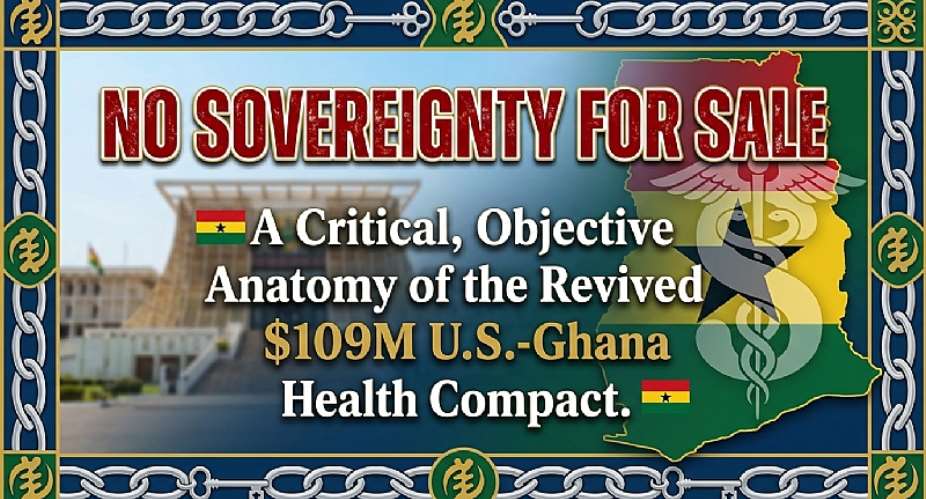
The Price of Dignity in Global Diplomacy
Ghana stands at a critical geopolitical crossroads where the core definitions of national sovereignty are being actively tested. The recent confirmation that the United States government has formally reopened talks to salvage a rejected $109 million health compact is not a mere routine update in bilateral aid—it is a profound validation of Ghana’s sovereign right to say "No." When the Ghanaian Cabinet initially threw out this five-year agreement, it sent a shockwave through international diplomatic circles, forcing a global superpower back to the negotiating table to amend what has been rightfully termed "humiliating" and intrusive clauses.
International partnership must never mimic modern-day capitulation. While the promise of $109 million over five years sounds substantial on paper, it averages out to roughly $21.8 million annually—a marginal sum in the context of Ghana's macro-healthcare framework. To compromise public safety, citizen data privacy, and domestic regulatory autonomy for this financial pittance would be an historic blunder. As negotiations resume, the Ghanaian public, civil society, and state actors must approach this review with absolute analytical clarity, stripping away the benign language of "humanitarian aid" to confront the aggressive geopolitical and surveillance demands hidden beneath the surface.
What the United States is Strategically Seeking
Behind the veneer of health sector support and pandemic preparedness, the original compact contained sweeping conditions designed to seamlessly integrate Ghana into Washington's global security and data apparatus:
- Surveillance Infrastructure: The U.S. sought unrestricted, direct access to Ghana's national pathogen profiles, which include the specific genetic fingerprints and biological data of infectious diseases circulating within our borders.
- Mass Bio-Data Harvesting: The terms required the systematic sharing of private medical records of Ghanaian citizens, effectively moving local healthcare data and demographics into foreign-controlled databases.
- Regulatory Subversion: Most egregiously, the deal demanded a complete waiver of the Ghana Food and Drugs Authority's (FDA) regulatory oversight, legally preventing Ghanaian scientists from inspecting or testing U.S.-supplied medications and medical devices brought into the country.
- Financial Leverage: The insertion of "counterpart funding" mandates forced Ghana to divert its own scarce tax revenues to match U.S. financial inputs, effectively dictating local budgetary priorities.
An Objective Analysis of Competing Interests
To analyze this deal objectively, it must be looked at through the cold lens of national self-interest, recognizing that both nations are negotiating to protect their own distinct priorities:
Strategic Recommendations and Suggestions for Ghanaian Negotiators
Ghana holds the distinct leverage in this scenario; the U.S. returned to us, not the other way around. Our negotiators must enforce five non-negotiable redlines to protect the republic:
- Absolute FDA Supremacy: No medical product, vaccine, or drug may enter Ghanaian territory without undergoing full, independent validation and testing by the Ghana Food and Drugs Authority. The waiver clause must be permanently deleted.
- Sovereign Data Co-Ownership: Any pathogen data or bio-medical profiles shared must remain under a joint-intellectual property framework. Ghana must retain primary ownership, ensuring that if these profiles are used to develop commercial vaccines or treatments, Ghana receives royalties and guaranteed technology transfers.
- De-anonymization and Local Storage: Citizen medical records must never leave the physical boundaries of Ghana. All health informatics must be stored on local, secured state servers, with access strictly limited to aggregate, entirely anonymous statistical data.
- Infrastructure Over Consumables: Shift the allocation of the $109 million away from purchasing foreign-manufactured medical consumables. Demand that the funds be explicitly locked into building permanent local laboratory infrastructure and upgrading domestic medical research institutions like the Noguchi Memorial Institute for Medical Research.
- Removal of Budgetary Coercion: Eradicate counterpart funding clauses that force the Ghanaian treasury to defund other vital local sectors just to trigger the release of foreign aid tranches.
Setting a New Template for African Sovereignty
The renegotiation of this health compact is a litmus test for Ghanaian leadership and a defining moment for our national dignity on the global stage. For decades, developing nations have accepted highly asymmetrical aid packages under the desperate pressure of economic necessity. By rejecting the original terms of this deal, Ghana proved that it values its institutional integrity and the safety of its citizens far above a $109 million price tag.
As talks resume, our message to Washington must be loud, clear, and unyielding: Ghana is open to equal partnership, but our sovereignty is not for sale. If the United States truly wishes to stand as an ally in global health, it must respect our regulatory bodies, protect our citizens' data privacy, and treat our institutions as peers, not dependencies. Anything less than a complete overhaul of these intrusive clauses should result in a final, permanent walk away from the table. Ghana can, and will, fund its own health security on its own proud terms.
✍️ Submitted by:
Retired Senior Citizen
For and on behalf of all Senior Citizens of the Republic of Ghana 🇬🇭
Teshie-Nungua
[email protected]


 'Stop excessive financial demands before sharing information with us' — Interior...
 EC will serve national interest, not partisan politics – Deputy Chair Dr Kwaku A...
 I expect no preferential treatment from EC for myself as President, my party or ...
 Afenyo-Markin meets management, proposes reforms to turnaround struggling ECG
 ECG management commends Afenyo-Markin for reforms during short stay as Board Cha...
 Mahama tasks new EC deputy chairpersons to uphold impartiality
 Attorney-General urges court to reject Adu-Boahene’s no-case submission
 Nyaho Medical Centre ordered to report to CID over expired data protection certi...
 Mahama swears in new Electoral Commission deputy commissioners
 PTAAM-Africa calls for government probe into alleged World Cup visa fraud


